In a small town in northeastern Thailand, hundreds of people dressed as ghosts pour through the streets every summer — wearing hand-painted masks with long phallic noses, shaking cowbells, wielding carved wooden swords, and chasing anyone who looks too serious. Phi Ta Khon is Thailand’s strangest festival, and one of its oldest. It happens once a year in Dan Sai, a farming district in Loei Province that most tourists have never heard of.
The 2026 dates haven’t been confirmed yet — the exact days are determined by a local spirit medium, typically announced 1-2 months before the event. Based on recent years, expect late June or early July. When the dates drop, check our Thailand Events Calendar for updates.
Key Facts: Phi Ta Khon 2026
- Official name: Bun Luang and Phi Ta Khon Festival (บุญหลวง และ ผีตาโขน)
- Location: Dan Sai District, Loei Province (~520 km northeast of Bangkok)
- Dates: Late June or early July 2026 (TBA — announced by local spirit medium)
- Duration: 3 days
- Cost: Free — no tickets needed, open to everyone
- Nearest airport: Loei (LOE), then 83 km by road to Dan Sai
- Best for: Photographers, culture enthusiasts, off-the-beaten-path travellers
- Pronunciation: “Pee Tah Kohn” (ผีตาโขน)
The Story Behind the Ghosts
Phi Ta Khon is rooted in a Buddhist tale called the Vessantara Jataka — the story of Prince Vessantara, the Buddha’s penultimate incarnation before enlightenment. The prince was famous for his extreme generosity. He gave away the kingdom’s sacred white elephant (which had the power to bring rain), then his chariot, his children, and finally his wife. After years of exile in the forest, all was restored through divine intervention, and Vessantara returned to a hero’s welcome.
The celebrations were so loud, so wild, and so full of joy that they woke the dead. Spirits of the forest and deceased ancestors rose from their graves to join the party. That’s what the masked figures represent — ghosts who couldn’t resist a good time.
The name “Phi Ta Khon” comes from “Phi Tam Khon” — literally “ghosts following people.” The festival merges Buddhist merit-making with far older animist traditions of spirit worship, fertility rites, and rain-seeking ceremonies. It’s the kind of thing that could only survive in a remote farming town where modernity arrived slowly and tradition ran deep.
What Happens Over 3 Days
Day 1: Invoking the River Spirit
The festival begins before dawn at the Mun River. At around 3 AM, spirit mediums wade into the water to summon Phra Upakhut — a legendary Buddhist monk believed to have retreated underwater and remained there as a guardian spirit. The ritual involves picking up stones from the riverbed, each time asking “Is this Phra Upakhut?” until the spirit medium identifies the correct one.
The chosen stone is carried in a procession back to Wat Phon Chai, the central temple of Dan Sai, where it’s enshrined to protect the festival from evil spirits. The procession is led by Jao Pho Kuan — the hereditary spirit medium whose role passes from generation to generation. He’s the one who determines the festival’s dates each year by casting lots.
By mid-morning, the first masked figures start appearing in the streets. The atmosphere shifts from sacred to playful.
Day 2: The Grand Ghost Parade
This is the main event — the day that draws over 100,000 visitors to a town with a population of roughly 35,000.
Hundreds of participants in full ghost costumes and hand-painted masks flood Kaew Asa Road, Dan Sai’s main street. The procession starts at Wat Phon Chai and moves through town in a riot of colour, noise, and chaos. Two types of masked characters appear:
- Phi Ta Khon Yai (Large Ghosts): Two towering bamboo-framed figures — one male, one female — draped in white cloth with enormous head masks. These are the festival’s icons. At the end of the day, they’re traditionally thrown into the Mun River to carry away the past year’s misfortune.
- Phi Ta Khon Lek (Small Ghosts): Individual participants of all ages wearing personally crafted masks. Every mask is unique. Costumes are stitched from patchwork cloth with cowbells, tin cans, and bottle caps sewn in that jingle and clatter with every step.
The “ghosts” dance, chase spectators, wave carved wooden phalluses, and generally cause joyful mayhem. Mor lam bands (Isan folk music) blare from trucks. Bamboo rockets are launched — a fertility rite meant to coax rain from the gods. The atmosphere is family-friendly in the morning and increasingly alcohol-fuelled by evening, as local rice whiskey (lao khao) flows freely.
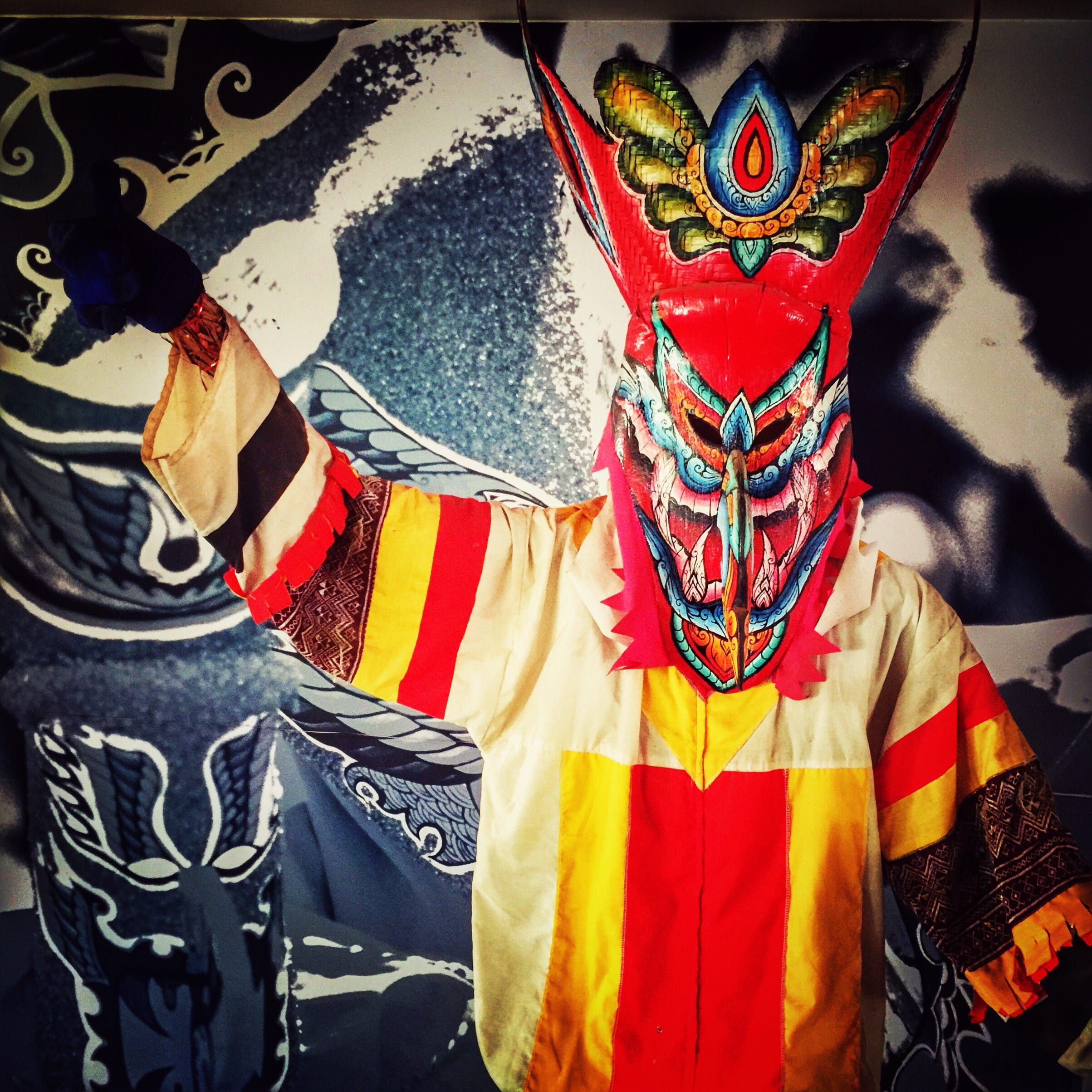
Tip: Arrive early on Day 2 to secure a spot along Kaew Asa Road before the crowds build. The parade is most photogenic in the morning — softer light, fewer people, and participants at peak energy.
Day 3: The Sermons
The tone shifts entirely. Day 3 takes place inside Wat Phon Chai, where monks deliver up to 13 Dhamma sermons culminating in a full recitation of the Vessantara Jataka — the same story that gave birth to the festival. The marathon sermon can last many hours. Villagers make merit by offering food to monks and dedicating merit to deceased ancestors.
Most tourists leave after Day 2. But if you want to understand what Phi Ta Khon actually means to the people of Dan Sai — not just the masks, but the faith underneath — Day 3 is worth staying for.
The Masks: How They’re Made
Phi Ta Khon masks are built from materials found in any Isan farming household:
| Part | Material | Details |
| Hat/crown | Sticky rice steaming basket (huat) | The woven bamboo basket normally used for steaming sticky rice |
| Face | Coconut palm leaf sheath | The hard bottom section of a coconut frond, soaked in water for 2-3 days to soften |
| Nose | Carved soft wood | Elongated and phallic — the most distinctive feature |
| Paint | Acrylics, watercolours, resin | Originally natural dyes; modern masks use vibrant commercial paints |
| Costume | Patchwork cloth, bells, tin cans | Designed to make maximum noise during the parade |
Each mask takes 7-14 days to build and every one is unique. Traditional designs feature bold geometric patterns, but modern masks increasingly incorporate pop culture references — superheroes, anime characters, political figures, and internet memes have all appeared. Best mask competitions drive the creativity higher each year.
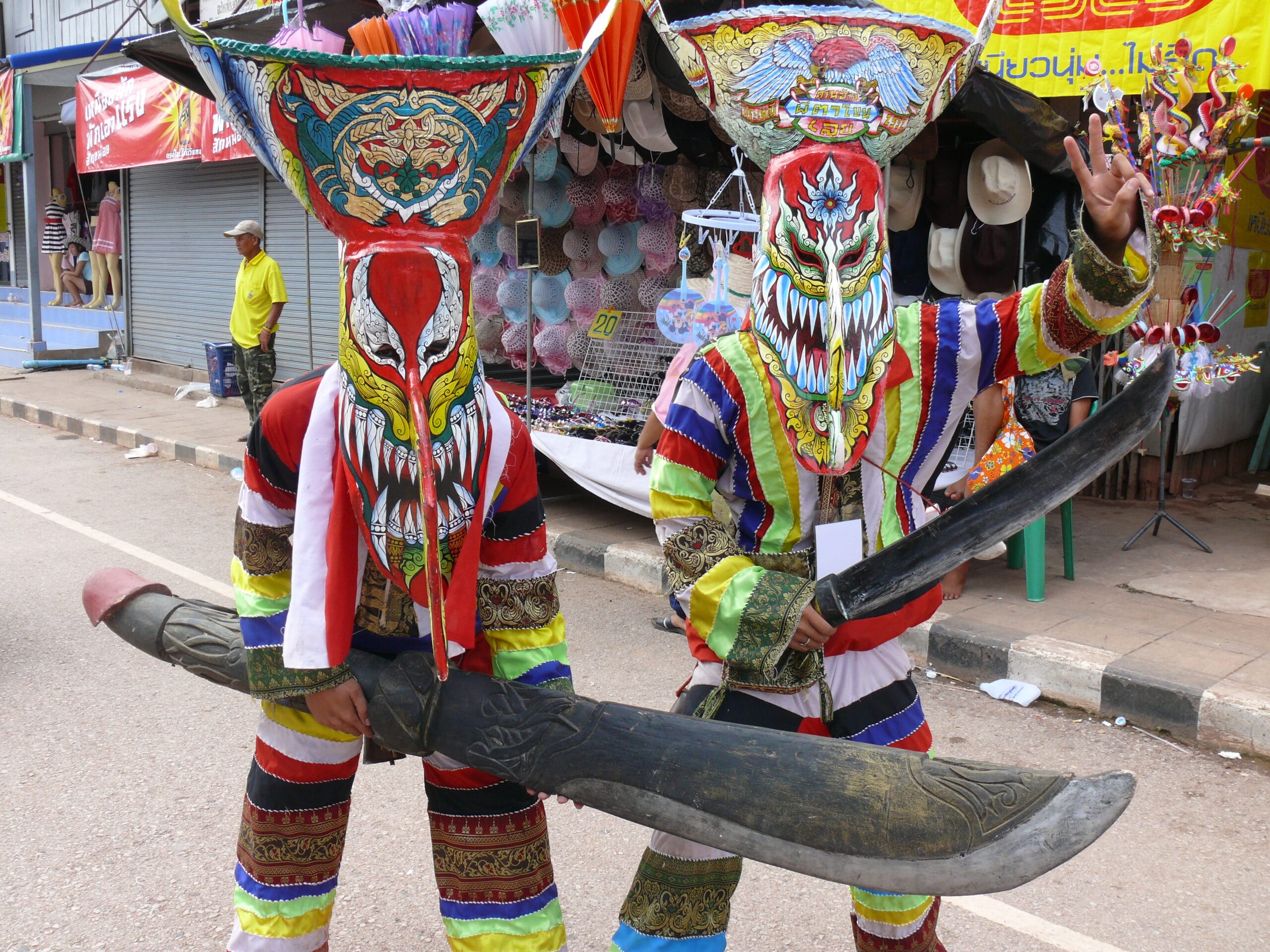
The phallic noses aren’t crude humour. They connect to palad khik — Thai phallic amulets believed to bring luck, fertility, and protection. The tradition predates Buddhism in Thailand, rooted in Hindu lingam worship and agricultural fertility rites. The festival falls at the start of the planting season, and every phallic symbol, wooden sword, and launched rocket is a prayer for abundant rain and a good harvest.
Getting to Dan Sai
Dan Sai isn’t easy to reach — that’s part of its charm. The remoteness has kept the festival authentic while Songkran water fights in Bangkok become increasingly commercialised.
| Method | Duration | Cost | Notes |
| Fly + transfer | ~3 hours total | 1,500-3,000 THB flight + 70-200 THB transfer | Fly to Loei (LOE) on Nok Air or AirAsia from Bangkok DMK. Then minivan to Dan Sai (83 km, 90 min) |
| Bus direct | 8-10 hours | 350-600 THB | Phetprasert Tour runs Bangkok (Mo Chit) to Dan Sai twice daily. Or bus to Loei + minivan transfer |
| Self-drive | 6-7 hours | Fuel only | ~520 km via Highway 21 through Phetchabun. Good roads, scenic route |
Important: Book your Loei flight early. There are only a few daily flights, and they sell out fast during festival week. If flights are gone, the overnight bus from Mo Chit is the fallback — it arrives early morning, giving you the full day.
Where to Stay
Dan Sai is a farming town, not a tourist hub. Accommodation is limited and books out months before the festival.
- Phunacome Resort: The only resort-grade option near Dan Sai. Traditional wooden houses and modern rooms in a valley setting, 10 minutes from town. Restaurant, spa. Book 3-6 months ahead for festival dates. Expect 2,000-5,000+ THB/night.
- Local guesthouses and homestays: A handful of small guesthouses exist in town. Very basic but authentic — this is how locals live. Ask Booking.com or Agoda, but expect thin listings. 500-1,500 THB/night.
- Stay in Loei city: 83 km away (~1.5 hours by car). Far more hotel options, from budget to mid-range. The practical fallback if Dan Sai is fully booked. Hire a car or arrange transport for the festival days.
If you have a car, staying in Loei is fine — you’ll just need to factor in the drive each day. If relying on public transport, Dan Sai accommodation is essential since minivans don’t run late.
What to Expect (Honestly)
Phi Ta Khon is not a polished tourist event. It’s a working-class farming community’s annual celebration, and the experience reflects that — in the best possible way.
- Heat: Late June/early July in Isan means 25-33°C with high humidity. Drink water constantly. Carry sunscreen and a hat.
- Rain: This is the start of the rainy season. Afternoon showers are common. Bring a rain poncho or compact umbrella.
- Food: Street stalls line the parade route. Expect Isan classics — somtam (papaya salad), gai yang (grilled chicken), sticky rice, larb, nam tok. The food is excellent, cheap, and authentic. This is not tourist food.
- Alcohol: Lao khao (rice whiskey) flows freely, especially by afternoon. The atmosphere transitions from family-friendly morning to raucous evening.
- Crowd size: Over 100,000 visitors in recent years. Most are Thai domestic tourists with a small contingent of international visitors. You will be in a minority as a foreigner, which is part of what makes it special.
- Language: English is rarely spoken. A few Thai phrases go a long way. The festival is genuinely welcoming regardless — the ghosts don’t discriminate when choosing who to chase.
Photography Tips
- Gear: Fast lens (f/2.8 or wider) for indoor temple shots. A 24-70mm zoom covers the parade well. Phone cameras handle the bright outdoor scenes fine.
- Shutter speed: Keep it at 1/500 or faster — the dancing is constant and unpredictable.
- Get close: Participants actively engage with the crowd and are happy to pose. The masks are best shot from slightly below, looking up.
- Protect your gear: Rain is always possible. A simple plastic bag can save your camera. Dust is also a factor on the unpaved sections.
- Phi Ta Khon Yai: The two giant ghost figures are the iconic shots. Position yourself along the parade route before they pass.
- Day 3 etiquette: Temple ceremonies require discretion. Ask before photographing monks or rituals. Remove shoes before entering temple buildings.
The Phi Ta Khon Museum
Located at Wat Phon Chai, the Phi Ta Khon Dan Sai Museum displays historic masks, costumes, and explains the festival’s origins. It’s open year-round, making it worthwhile even outside the festival period. Entry is free (donation box). If you’re interested in mask-making, some local workshops offer hands-on sessions where you can build your own using traditional materials.

Extend Your Trip: Loei Province
Loei is one of Thailand’s most underrated provinces — mountainous, forested, and almost entirely tourist-free outside of a few highlights. Pair the festival with a few days of exploration:
- Phu Ruea National Park (40 km from Dan Sai) — The “coldest spot in Thailand,” with a 1,400m peak accessible by car. Sea of clouds at sunrise. Open year-round, unlike Phu Kradueng which closes for the rainy season.
- Chiang Khan (90 km from Loei city) — Charming Mekong River town near the Laos border. Renovated wooden shophouses, walking street market, sunrise almsgiving. One of Isan’s most popular weekend destinations.
- Suan Hin Pha Ngam (50 km from Dan Sai) — Limestone karst formations compared to China’s Stone Forest. Free entry. Open daily 8 AM-6 PM.
- Wat Somdet Phu Ruea (40 km) — Spectacular hilltop temple complex with massive wooden structures, tunnels, and panoramic views.
Tip: Rent a car in Loei city. Public transport in the province is sparse, and having your own wheels opens up the national parks and Mekong River towns that make Loei worth more than a day trip.
Frequently Asked Questions
When is Phi Ta Khon 2026?
The exact dates haven’t been announced yet. Phi Ta Khon typically falls in late June or early July — recent years have ranged from June 20 to July 9. The dates are determined by the local spirit medium (Jao Pho Kuan), who casts lots and announces them 1-2 months before the festival. Follow TAT (Tourism Authority of Thailand) or check our events calendar for confirmed dates when available.
Do I need tickets for Phi Ta Khon?
No. The festival is completely free and open to everyone. There are no tickets, no entrance fees, and no restricted areas. You just show up. The Phi Ta Khon Museum at Wat Phon Chai is also free (donation box). Your only costs are transport, accommodation, and food.
Is Phi Ta Khon safe for families?
The morning parade on Day 2 is family-friendly and many local children participate in full costume. Thai families attend with kids of all ages. The atmosphere gets rowdier and more alcohol-fuelled toward evening. The “ghosts” will chase and tease spectators, but it’s playful, not threatening. Some of the phallic imagery may need explaining to younger children.
Can I buy a Phi Ta Khon mask as a souvenir?
Yes. Miniature Phi Ta Khon masks are Dan Sai’s signature craft product, sold at shops around town and at the museum year-round. During the festival, vendors sell masks of all sizes along the parade route. Prices range from 100 THB for a small decorative mask to 1,000+ THB for a full-size hand-painted piece. Some workshops let you paint your own.
What other Thai festivals are similar to Phi Ta Khon?
Nothing else in Thailand is quite like Phi Ta Khon. The closest comparison is the Bun Bang Fai (Rocket Festival), which shares the fertility/rain-seeking elements and happens across Isan in May-June. For other unique Thai celebrations, see our guides to Loy Krathong (water lanterns), Songkran (water festival), and our full Thailand festivals guide.
Is Phi Ta Khon Worth the Trip?
Phi Ta Khon rewards effort. Getting to Dan Sai takes planning — it’s not a festival you stumble into between beach days. But that’s exactly why it works. The crowd is overwhelmingly Thai, the traditions are unfiltered, and the atmosphere sits somewhere between sacred ceremony and village party that got gloriously out of hand.
If you’ve done Songkran and the Full Moon Party and want something genuinely different — something that feels like the Thailand that exists when the cameras aren’t rolling — put Phi Ta Khon on the list. Pair it with a few days in Loei Province and you’ll come home with stories nobody else at the dinner party has.