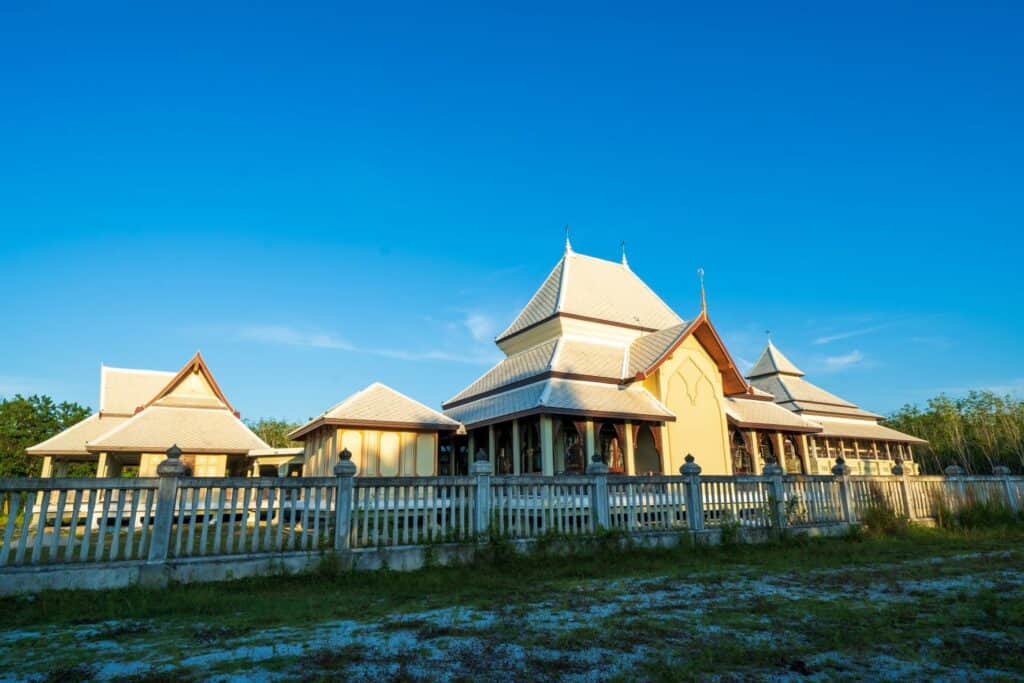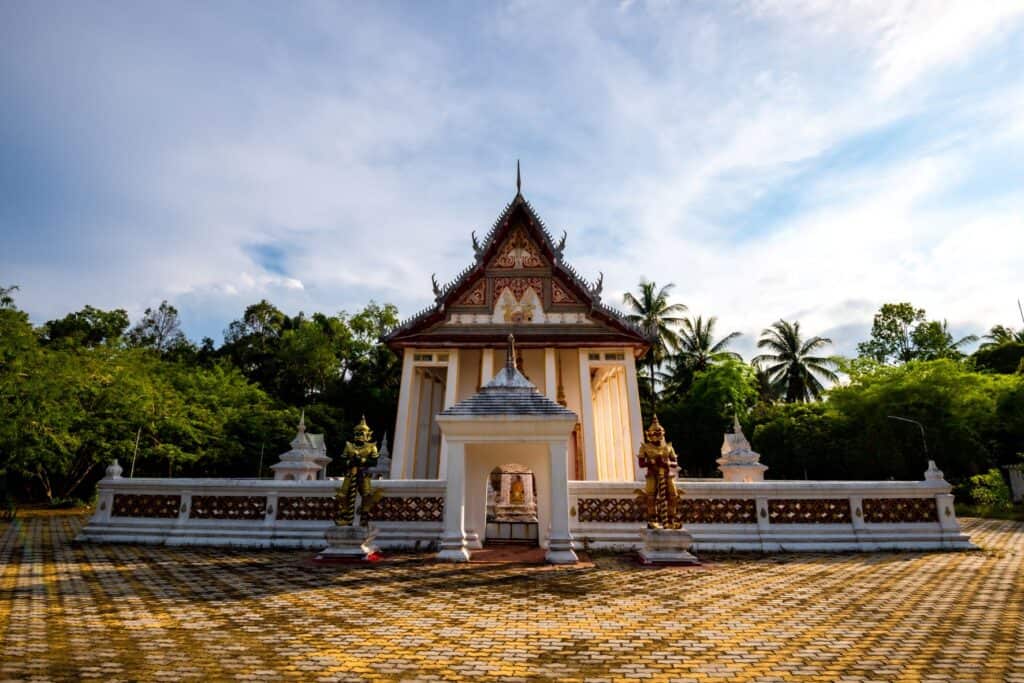
Phrakhru Opas Buddhakhun (Phut) was the founder of this temple and had to ask for land from Phraya Kelantan in order to build the temple. In 1873, Tak Bai still belonged to Kelantan. This temple was also involved in the Tak Bai land secession between Siam (Thailand) and Melayu (Malaysia), which was a colony of the United Kingdom at that time (reign of King Rama V the Great in 1909). For the Siamese side, Buddhism, temples, and temple art were raised as a bargaining mechanism for sharing boundaries. As such, the United Kingdom accepted the reason by using the Kolok River that occupies the area and flows through the city of Tak Bai to be the border. This temple is also known by another name as ‘Wat Phithak Phaen Din Thai’. Inside the temple, there is a peaceful atmosphere and a wide terrace by the river. The Ubosot was built during the reign of King Rama V the Great. There are murals inside illustrated by a monk from Songkhla. It is the Buddha’s life that inserts images of the lives of people in those days. It also enshrines the principal Buddha image covered with gold causing the appearance of the original mouth to be red, and the hair is black. The image is enshrined on a busabok, 1.5 metres high. From the characteristics of the Busabok, it is assumed to be a Mon monk. There is also a wihan enshrining a reclining Buddha image, which along the wall is decorated with Sangkhalok ware.
Location
Find a Place to Stay
More Satun Attractions