




Asanha Bucha Day 2027: The Buddha's First Sermon


On this page
Asanha Bucha 2027 falls on 18 July: a Thai public holiday with a nationwide 24-hour ban on alcohol sales, observed the day before Khao Phansa (the start of Buddhist Lent). It marks the day the Buddha delivered his first sermon, the Dhammacakkappavattana Sutta, or “Turning of the Wheel of Dharma”, to five disciples at a deer park in Varanasi, India. That sermon established the core teachings of Buddhism: the Four Noble Truths and the Eightfold Path. It also marks the founding of the Sangha, the community of Buddhist monks. The date follows the full moon of the eighth lunar month.
The day is observed as a public holiday across Thailand. Devout Buddhists visit temples in the morning to offer alms to monks, listen to Dhamma talks, and make merit through donations of food, robes, and other necessities. Many Thais take the day to reflect on the Buddha’s teachings, and some observe the eight precepts. The atmosphere at temples is contemplative rather than festive: this is a day of genuine religious devotion, not celebration.
As with other major Buddhist holidays, the evening wien thien ceremony is the centrepiece. Worshippers walk three times around the temple’s main chapel carrying lit candles, incense, and flowers. Large temples like Wat Pho and Wat Arun in Bangkok, Wat Phra That Doi Suthep in Chiang Mai, and Wat Phra Mahathat in Nakhon Si Thammarat hold well-attended ceremonies. What makes Asanha Bucha distinct is its connection to the following day, Khao Phansa, the start of Buddhist Lent. Many monks receive the supplies they will need for their three-month retreat during Asanha Bucha.
Alcohol sales are banned nationwide on this day: shops, supermarkets, bars, and most restaurants stop selling, though since the 2025 reforms licensed hotels and international-airport departure areas may keep serving guests. If you are visiting Thailand around this date, plan accordingly: stock up the day before if needed. To attend a wien thien ceremony, arrive at your chosen temple before sunset (around 6:30 PM in July), dress modestly in white or muted colours, and follow the lead of Thai worshippers around you.
- Date: 18 July 2027 (full moon, eighth lunar month)
- Public holiday: Yes: banks, government offices closed
- Alcohol: Nationwide ban for 24 hours (also applies on Khao Phansa, 30 July); licensed hotels and airport departure areas exempt
- Wien thien timing: Typically starts around 6:30–7 PM
- Entry fee: Free at all temples
- Dress code: Shoulders and knees covered; white or muted colours appropriate
The First Sermon and Its Significance
The five disciples who heard the first sermon at the Deer Park of Isipatana (modern-day Sarnath, near Varanasi) became the founding members of the Sangha. Before that day, the Buddha had taught no one. He had attained enlightenment weeks earlier and initially doubted whether his insights could be communicated at all. His decision to teach, and the content of that first teaching, is what Buddhism has built on ever since.
The sermon’s core message, the Four Noble Truths, states that suffering exists, that suffering has a cause (craving and attachment), that suffering can end, and that a path exists to bring about that end. The Eightfold Path (right understanding, right intention, right speech, right action, right livelihood, right effort, right mindfulness, right concentration) is that path. These are not abstract theology in Thai Buddhism; they are practical daily guidelines. Monks recite them in the morning chants you will hear if you visit a temple before 7 AM.
The Day at a Temple
Morning almsgiving (tak bat) on Asanha Bucha is more elaborate than an ordinary day. Monks receive not just food but also robes and practical necessities for the coming three-month retreat. At many temples, laypeople compete gently to give more generously: the merit of giving on a major holy day is considered greater. The robes offered on this day are sometimes called Phansa robes, symbolically providing for a monk throughout Buddhist Lent.
Dhamma talks run through the morning. The content on Asanha Bucha focuses on the first sermon itself: monks explain the Four Noble Truths and the Eightfold Path in the context of the Buddha’s life and the founding of the Sangha. Sitting in on a Dhamma talk, even without understanding Thai, gives a sense of how seriously these teachings are still taken.
Insider Tip: Doi Suthep in Chiang Mai sees heavy evening traffic for wien thien. Songthaew (shared red truck taxi) from Chiang Mai city centre to the base of the mountain costs around 40–50 THB per person; a separate ticket is needed for the cable car or the 306-step staircase. If you want to avoid the queue at the top, arrive by 5:30 PM and walk up the stairs: the combined exercise and atmosphere is worth the effort.
The Wien Thien Ceremony
Shortly after dark, the ceremony begins. Candle sets (usually a candle, three incense sticks, and a flower) are available at the temple entrance for a small donation, typically 20–40 THB. Monks lead the congregation out of the main hall. The procession circles the ubosot (ordination hall) three times, clockwise. Each circuit represents one of the Three Jewels: the Buddha, the Dhamma, and the Sangha.
The mood is quiet. Even children in large families walk slowly and hold their candles carefully. The sound of monks chanting inside the temple carries across the courtyard while the procession moves outside. At Wat Phra That Doi Suthep, the view from the mountain terrace (hundreds of candles winding around the gilded chedi in darkness) is as striking as any sight on the Thai festival calendar.
Watch out: July is the middle of the rainy season across Thailand. Short, heavy downpours are common in the late afternoon and evening. Bring a small umbrella or rain jacket to the temple: the ceremony will go ahead in light rain, but standing in a downpour for 40 minutes with a lit candle is uncomfortable. Most temples have covered areas near the procession path.
Connection to Khao Phansa
Asanha Bucha and Khao Phansa are inseparable. Khao Phansa, the start of Buddhist Lent, begins the very next morning, 19 July 2027. On Asanha Bucha, temples are already buzzing with preparation: monks receive their supplies, novices prepare their quarters, and laypeople bring the donations that will sustain the monastery through the retreat.
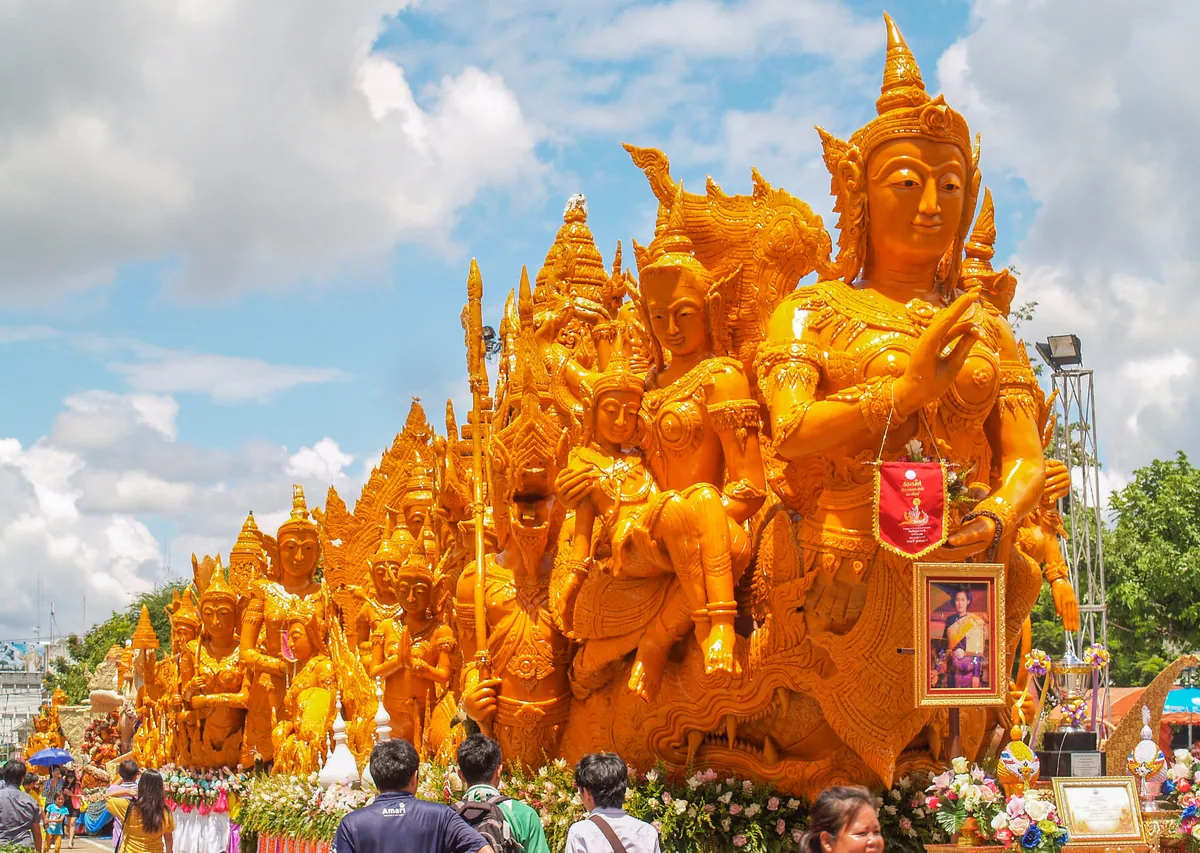
For travellers, this means the alcohol ban extends over two consecutive days: 18 and 19 July 2027. It also means that if you are in Ubon Ratchathani for the Khao Phansa Candle Festival, you will arrive on Asanha Bucha, a good time to visit a local temple before the parade preparations begin the following morning.
Temple Etiquette
Remove shoes before entering any temple building, including the ordination hall where Dhamma talks are held. Sit with your feet pointing away from Buddha images: pointing feet toward a Buddha image or a monk is considered disrespectful. Women should not hand objects directly to monks; place donations on the cloth or tray the monk carries.
Photography is generally permitted inside temple grounds but not always inside the main hall during ceremonies. Ask a temple volunteer if you are unsure. During the wien thien procession, avoid crossing the walking path: walk around the outside rather than cutting through the procession column.