








Chinese New Year in Thailand 2026: Celebrating the Year of the Fire Horse
About a third of Thailand’s population has Chinese ancestry, and Chinese New Year — known in Thai as Trut Chin (ตรุษจีน) — is one of the most visually spectacular events in the country’s calendar. It is not a public holiday, so shops, offices, and transport all run normally. But in the neighbourhoods where Thai-Chinese communities are concentrated — Bangkok’s Yaowarat, Phuket Old Town, Nakhon Sawan, Hat Yai — the streets transform completely.
2026 Dates
Main day: Tuesday, February 17, 2026 — the Year of the Fire Horse begins.
Festivities run across three days: February 16 (eve), 17 (main day), and 18. The evening of the 16th is typically when families gather for reunion dinners. The 17th brings the street celebrations — lion dances, firecrackers, and crowds. By the 18th things wind down, though some shrines continue activities through the Lantern Festival on March 3 (the 15th day of the lunar month).
Bangkok (Yaowarat)
Yaowarat Road is the beating heart of Chinese New Year in Thailand. The celebrations here are the largest in the country — the city closes off lanes along Yaowarat and Charoen Krung from early afternoon, and the road fills with food stalls, decorated archways, and enormous crowds.
Lion dance troupes move between businesses along the strip, invited in by shopkeepers who pay for the performance — the lion “eating” a red envelope hung above the door is believed to bring prosperity. Dragon parades — the longer, more theatrical performances — typically happen in the evening along the main stretch between the Yaowarat arch near Odeon Circle and Ratchawong Pier.
Wat Traimit (Temple of the Golden Buddha), a short walk from the main strip, holds its own ceremonies and is worth visiting — it sits at the historical centre of Bangkok’s Chinese quarter.
The crowds on the 17th are serious. Arrive by 4–5pm for a decent spot; by 7pm Yaowarat is barely walkable. If you want to eat, go early or accept that you’ll be standing.
Chiang Mai
Chiang Mai’s Thai-Chinese community is smaller than Bangkok’s or Phuket’s, but the Tha Pae Gate celebrations draw large crowds — partly because the old city’s moat and gate make a dramatic backdrop.
The main event is a fireworks display launched from near the gate on the evening of the 17th, visible from the moat road. There is also a parade of floats and lion dance performances in the streets of the old city in the days leading up to the main date. Several Chinese shrines in the Warorot Market area (known locally as Kad Luang) hold ceremonies and are busy with offerings throughout the three days.
Phuket
Phuket has one of the largest Thai-Chinese communities outside Bangkok, and the Old Town celebrations feel distinctly different from Yaowarat — smaller scale, but more neighbourhood-rooted.
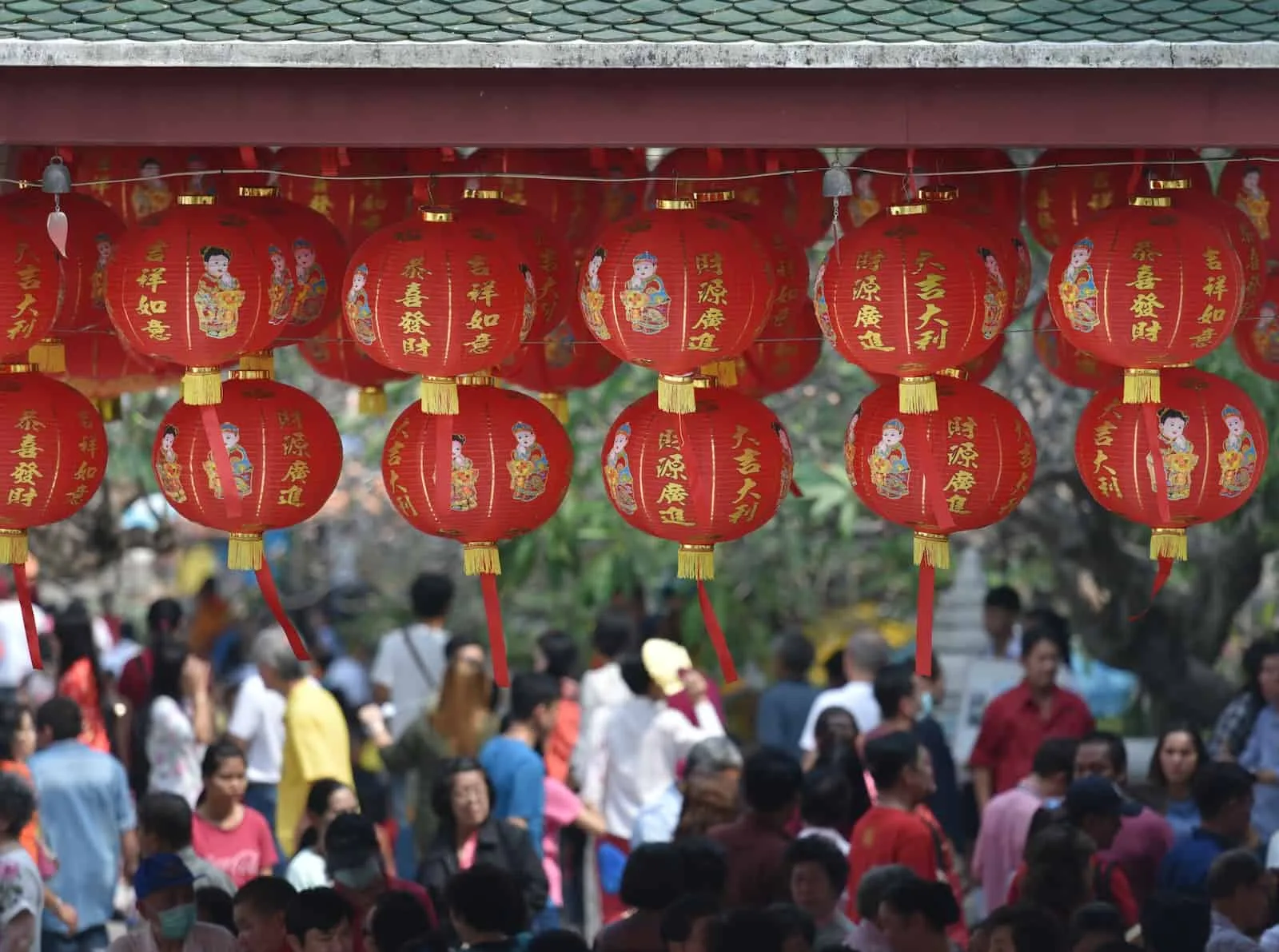
Kathu Shrine, a few kilometres inland from Patong, is one of the oldest Chinese shrines in Phuket and draws serious worshippers rather than tourists. The shrine grounds fill with incense smoke, red lanterns, and ceremonial offerings from early morning on the 17th. Jui Tui Shrine in Old Town (the same shrine associated with Phuket’s Vegetarian Festival) also holds ceremonies.
The Old Town streets — Thalang Road, Phang Nga Road — are decorated with red lanterns and host evening street markets across the three days. Phuket’s celebration is more intimate and easier to move around in than Yaowarat.
What to Expect
Lion dances are everywhere — small troupes of two performers inside a single lion costume, accompanied by drums and cymbals. The noise is deliberately loud; the point is to scare off bad spirits. You will not escape it.
Red envelopes (lai see in Cantonese, hong bao in Mandarin) are given by married adults to children and unmarried younger relatives. It is not a tourist custom to expect envelopes, but if you are invited to a family home you may witness the exchange.
Vegetarian food at shrines — many Chinese shrines in Thailand serve simple vegetarian dishes during New Year. The food is cheap, sometimes free, and often excellent. Look for signs reading เจ (jay — vegetarian) near shrine entrances.
Firecrackers — technically banned in Bangkok but reliably set off anyway in Yaowarat. Expect sudden, very loud bursts at close range. Not ideal if you are noise-sensitive.
Temple visits — Thai-Chinese families visit Chinese shrines (not Buddhist temples) during New Year to make offerings and pray. The atmosphere at larger shrines is chaotic and fragrant rather than serene.
Practical Tips
Book accommodation early. Yaowarat-area hotels — and anything walkable from Chinatown — fill weeks in advance. If you want to be in the middle of it, book by January. If you don’t mind a short taxi or MRT ride from Wat Mangkon station, you have more options.
What to wear. Red is auspicious; wearing it is a gesture of goodwill. Black and white are associated with mourning — not a great choice for the main day, though nobody will say anything to a tourist.
What not to do. Don’t step on the threshold of a shrine entrance — step over it. Don’t point at religious figures. Don’t arrive expecting quiet; Trut Chin is one of the noisier events in Thailand’s calendar.
Getting around Bangkok. The MRT Blue Line runs to Hua Lamphong and Wat Mangkon, both close to Yaowarat. Do not attempt to drive into Chinatown on the 17th. Grab and taxis are unreliable once the road closures go up — walk in from the nearest station.
FAQs in Relation to Chinese New Year in Thailand
Do they celebrate Chinese New Year in Thailand?
Yes, Chinese New Year is celebrated in Thailand. It is one of the most important festivals for Thai-Chinese communities and it is also widely celebrated by other Thais. The festival usually lasts three days, beginning with a grand parade on the first day. During this time people visit temples to pray for good luck and fortune, exchange gifts, and enjoy traditional food such as sweet rice cakes and dumplings. Fireworks are often seen lighting up the night sky during this festive period.
What is Chinese New Year called in Thailand?
Chinese New Year is known as Trut Chin (ตรุษจีน) in Thailand. It is not an official public holiday but is widely celebrated, especially in areas with large Thai-Chinese communities such as Bangkok’s Yaowarat (Chinatown), Phuket Old Town, and Nakhon Sawan. Celebrations include lion and dragon dances, firecrackers, red envelope gifting, and special vegetarian food offerings at Chinese shrines. Note: Songkran (April 13-15) is the separate traditional Thai New Year — not Chinese New Year.
How long is Chinese New Year holiday in Thailand?
Chinese New Year is one of the most important holidays in Thailand and typically lasts for three days. The exact dates vary each year, but it usually falls between late January and mid-February. In 2026, Chinese New Year falls on February 17th — the Year of the Fire Horse. During this time, many businesses close down as people take part in traditional festivities such as lion dances, parades and fireworks displays. Many Thais also travel back to their hometowns to spend time with family members during this festive period.
Why do Thais celebrate Chinese New Year?
Thais celebrate Chinese New Year to honor their shared cultural heritage with China. It is a time for families and friends to come together, exchange gifts, enjoy feasts and pay respects to ancestors. The celebration typically lasts for 15 days and includes activities such as lion dances, fireworks displays, lantern festivals and dragon boat races. During this period of festivities, Thais also make offerings at temples in order to bring luck and prosperity into the new year. Chinese New Year is a time of joy and celebration for Thais, and it serves as an important reminder of their shared cultural roots.