


























Money in Thailand: ATMs, Cards, Exchange Rates & How to Avoid Fees
Published 11 April 2026
Thailand runs on a mix of cash and cards, and the balance shifts depending on where you are. Bangkok malls accept contactless payments. Koh Phangan beach bars want cash. Market vendors across the country deal exclusively in banknotes. Understanding how money works here saves you hundreds of baht in unnecessary fees.
The Thai baht (THB) trades at roughly 35-37 THB to 1 USD, 45-47 THB to 1 GBP, and 24-26 THB to 1 EUR (rates fluctuate — check xe.com before you leave). Thailand is affordable by Western standards: a street food meal costs 40-80 THB ($1-2), a beer at a tourist bar is 80-150 THB ($2-4), and a Grab ride across central Bangkok runs 60-150 THB ($2-4).
-
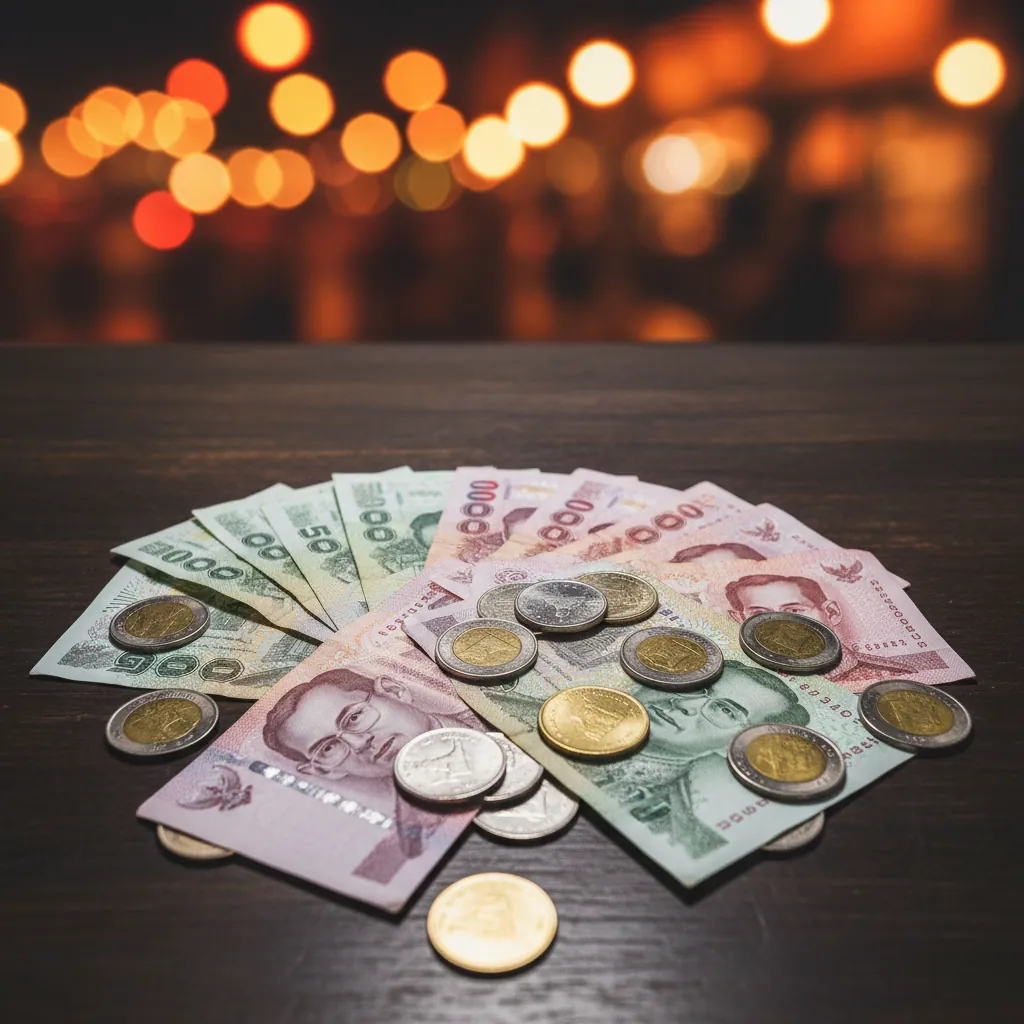
Currency: Thai baht (THB). Coins: 1, 2, 5, 10 THB. Notes: 20 (green), 50 (blue), 100 (red), 500 (purple), 1,000 (brown)
-
ATM fee: 220 THB (~$6) per international withdrawal at ALL Thai ATMs — unavoidable
-
Best exchange rate: SuperRich (green or orange) and Vasu in Bangkok — within 0.5% of interbank
-
Best travel card: Wise multi-currency card — interbank rate + 0.4-0.6% fee, no ATM markup
-
Credit cards: Visa and Mastercard widely accepted in tourist areas. Amex accepted at major hotels only. Cash still needed for markets, street food, transport
-
Contactless: Increasingly common in Bangkok and major tourist areas. Less common on islands and rural areas
-
How much to budget: 1,000-3,000 THB/day for mid-range travel (see our Thailand cost guide for detailed breakdowns)
ATMs in Thailand
ATMs are everywhere — every 7-Eleven has one nearby, and there are machines at airports, malls, and on every main street in tourist areas. The major banks are Bangkok Bank (blue), Kasikorn Bank (green), SCB (purple), and Krungsri (yellow).
The 220 THB fee: Every Thai ATM charges 220 THB (~$6) per international withdrawal. This fee is charged by the Thai bank, not your home bank, and appears as a separate charge. Your home bank may add its own foreign transaction fee on top. There is no way to avoid the Thai ATM fee — it applies to all international cards at all Thai banks.
How to minimise ATM costs:
- Withdraw the maximum each time — most Thai ATMs allow 20,000-30,000 THB per transaction. Withdrawing 30,000 THB means the 220 THB fee is 0.7%. Withdrawing 5,000 THB means the fee is 4.4%
- Use a Wise or Revolut card — these charge near-interbank exchange rates with no additional foreign transaction fee, so you only pay the 220 THB Thai ATM fee
- Decline the ATM’s exchange rate — Thai ATMs will offer to convert your withdrawal to your home currency (“Dynamic Currency Conversion”). Always select “withdraw without conversion” or “Thai baht”. The ATM’s conversion rate adds a 3-5% markup
Safety Tip: Use ATMs attached to bank branches rather than standalone machines at convenience stores — they are better maintained and have CCTV. Cover your PIN. If an ATM swallows your card, the branch can retrieve it during business hours.
Travel Cards: Wise vs Revolut
A multi-currency travel card is the cheapest way to spend and withdraw money in Thailand. Both Wise and Revolut offer near-interbank exchange rates — dramatically cheaper than your regular bank card.
| Feature | Wise | Revolut |
|---|---|---|
| Exchange rate | Interbank + 0.4-0.6% fee | Interbank (fee-free up to monthly limit) |
| ATM withdrawals | 2 free/month (up to $100-200), then 1.75% | Free up to $200-400/month (plan dependent) |
| Card type | Visa or Mastercard debit | Visa or Mastercard debit |
| Multi-currency | 40+ currencies, hold THB | 30+ currencies, hold THB |
| Setup time | 1-3 business days (physical card) | 1-3 business days (physical card) |
| Fee transparency | Fees shown upfront before conversion | Fee-free up to limit, then 0.5-1% |
| Best for | Transparency, larger transfers | Day-to-day spending, casual travel |
Pro Tip: Order your Wise or Revolut card 2-3 weeks before your trip. Load it with Thai baht before you leave (when you spot a good exchange rate) — both apps let you hold THB in your account and spend directly without conversion fees.
Wise
Wise (formerly TransferWise) charges a small, transparent fee on every conversion (typically 0.4-0.6% for GBP/USD to THB). The rate is always the real mid-market rate — no markup. You can hold over 40 currencies and convert between them in the app. ATM withdrawals are free up to a monthly limit (varies by country, typically $100-200), then 1.75% after that.
Why it is good for Thailand: You can pre-load THB at a rate you like, then spend directly from your THB balance with zero conversion fee. The card works at ATMs (you still pay the 220 THB Thai bank fee) and at any merchant that accepts Visa or Mastercard.
Revolut
Revolut offers fee-free currency exchange up to a monthly limit that depends on your plan (Standard: ~$1,000/month, Plus/Premium: higher). After the limit, a 0.5-1% markup applies. ATM withdrawals are free up to $200-400/month depending on your plan.
Why it is good for Thailand: If your spending falls within the free exchange limit, Revolut is effectively free to use. The app also includes budgeting tools, instant spending notifications, and the ability to freeze your card if it is lost — useful when travelling.
Which to Choose?
For a 2-week holiday, the difference between Wise and Revolut is a few dollars at most. Pick whichever you already have. If you are choosing fresh, Wise edges it on transparency (every fee is shown upfront) and Revolut edges it on features (budgeting, free exchange limits, virtual cards).
Currency Exchange
If you prefer cash, exchange in Thailand rather than at your home airport. The difference is significant — airport exchange counters in London, Sydney, and New York typically charge a 5-10% markup. Bangkok exchange booths charge 0.3-1%.
Best exchange in Bangkok:
- SuperRich (green logo) — consistently the best rates. Main branch at CentralWorld, Pratunam. Also at Suvarnabhumi Airport (arrivals level) but with slightly worse rates than city branches
- SuperRich (orange logo) — confusingly, a separate company. Rates are nearly identical to green SuperRich. Branches at Khao San Road, Asoke, and Ratchada
- Vasu Exchange — Nana area (Sukhumvit Soi 7/1). Competitive rates. Long queues on weekends
Exchange tips:
- Bring clean, undamaged notes in large denominations ($50 and $100 bills get better rates than $20s)
- Compare rates on the SuperRich website before visiting — rates change daily
- Avoid exchange at hotel front desks and tourist-area booths — they add 3-8% markup
- Airport exchange is acceptable for small amounts (3,000-5,000 THB to get you into the city)
Outside Bangkok: Exchange booths in Chiang Mai, Phuket, Koh Samui, and Pattaya offer competitive rates but slightly worse than Bangkok. On smaller islands (Koh Lanta, Koh Phangan, Koh Tao), options are limited and rates are poor — bring enough cash or use ATMs.
Cash vs Card: Where You Need What
| Situation | Cash or Card? |
|---|---|
| Hotels (tourist areas) | Card accepted |
| Restaurants (tourist areas) | Card usually accepted |
| Street food stalls | Cash only |
| Night markets | Cash only |
| Local markets (Chatuchak, Warorot) | Cash only |
| 7-Eleven | Card accepted (contactless too) |
| Grab taxi | Card in app, or cash |
| Tuk-tuks and songthaews | Cash only |
| Temple entrance fees | Cash only |
| National park entrance | Cash only |
| Massage shops | Cash only (most) |
| Pharmacies | Card sometimes, cash safer |
| Hospital (private) | Card accepted |
Bottom line: Carry 1,000-2,000 THB in cash at all times, even if you plan to use a card for most spending. The cash is for transport, street food, market shopping, and the many small businesses that do not accept cards.
How Much Things Cost
| Item | Price (THB) | Price (USD) |
|---|---|---|
| Street food meal | 40-80 | $1-2 |
| Restaurant meal (tourist area) | 150-400 | $4-11 |
| Beer (convenience store) | 40-60 | $1-2 |
| Beer (tourist bar) | 80-180 | $2-5 |
| Thai iced coffee | 35-60 | $1-2 |
| Grab ride (central Bangkok) | 60-150 | $2-4 |
| Tuk-tuk (short ride) | 100-200 | $3-6 |
| Songthaew (shared) | 20-40 | $0.50-1 |
| BTS/MRT (Bangkok) | 16-62 | $0.50-2 |
| Temple entrance | 0-500 | $0-14 |
| Thai massage (1 hour) | 200-400 | $6-11 |
| Scooter rental (per day) | 150-300 | $4-8 |
| Budget hotel | 400-800 | $11-22 |
| Mid-range hotel | 1,000-3,000 | $28-85 |
| Luxury resort | 5,000-30,000+ | $140-840+ |
For a detailed daily budget breakdown by travel style, see our Thailand cost guide.
Common Money Mistakes
- Exchanging at home airports — you lose 5-10% immediately. Exchange the minimum before you fly and do the rest in Thailand
- Accepting ATM currency conversion — always decline “convert to your home currency” and withdraw in Thai baht. The ATM markup is 3-5%
- Withdrawing small ATM amounts — the 220 THB fee is fixed. Withdraw the maximum (20,000-30,000 THB) each time
- Not carrying cash on islands — ATMs on small islands can run out of cash, break down, or charge even higher fees. Bring enough baht before you leave the mainland
- Paying with 1,000 THB notes at small vendors — street food sellers and songthaew drivers often cannot break large notes. Keep a supply of 20s, 50s, and 100s
Tipping Guide
Tipping is not culturally expected in Thailand the way it is in the US, but it is appreciated for good service.
| Service | Suggested Tip |
|---|---|
| Restaurant (tourist area) | Round up to nearest 20-50 THB, or 10% at upscale places |
| Street food | Not expected |
| Thai massage | 50-100 THB |
| Hotel porter | 20-50 THB per bag |
| Hotel housekeeping | 20-50 THB/day |
| Taxi/Grab | Round up to nearest 10 THB |
| Tour guide (full day) | 200-500 THB |
| Dive instructor | 300-500 THB per day |
Before You Travel
Sort your money setup before you fly: order a Wise or Revolut card (allow 1-3 weeks for delivery), exchange a small amount of baht, and notify your home bank you are travelling to Thailand so they do not block your card. Make sure you also have an eSIM for mobile data, travel insurance (especially for motorbike coverage), and have checked the latest Thailand entry requirements.
Frequently Asked Questions
Should I exchange money before going to Thailand?
Exchange a small amount (3,000-5,000 THB / $85-140) for your first taxi, SIM card, and meal. You will get a much better rate in Thailand than at your home airport. SuperRich and Vasu exchange booths in Bangkok offer rates within 0.5% of the interbank rate.
Can I use credit cards everywhere in Thailand?
In Bangkok, Chiang Mai, Phuket, and tourist areas — most restaurants, hotels, and shops accept Visa and Mastercard. Street food stalls, local markets, songthaews, tuk-tuks, small guesthouses, and rural areas are cash-only. Carry at least 1,000-2,000 THB in cash at all times.
What is the ATM fee in Thailand?
All Thai ATMs charge a flat 220 THB (~$6) fee per international withdrawal, regardless of the amount withdrawn. This is on top of any fees your home bank charges. Withdraw the maximum each time (usually 20,000-30,000 THB) to reduce the per-baht cost of the fee.
Is Wise or Revolut better for Thailand?
Both offer near-interbank exchange rates. Wise charges a small transparent fee (0.4-0.6%) per conversion. Revolut offers fee-free exchange up to a monthly limit (varies by plan), then charges 0.5-1%. For most trips, the difference is negligible — pick whichever you already have.
How much cash should I carry in Thailand?
For a typical day: 1,000-3,000 THB ($28-85) covers street food, transport, entrance fees, and small purchases. Keep larger amounts in your hotel safe. Thailand is generally safe, but pickpocketing happens in crowded tourist areas like Khao San Road, Chatuchak Market, and Full Moon Party.
Do I need to tip in Thailand?
Tipping is appreciated but not expected. Round up restaurant bills to the nearest 20-50 THB. Tip massage therapists 50-100 THB. Hotel porters: 20-50 THB per bag. Taxi/Grab drivers: round up. Tipping is not customary at street food stalls or local restaurants.