




Wat Phichai Songkhram
วัดพิชัยสงคราม
Wat Phichai Songkhram sits in Pak Nam, the river-mouth district of Samut Prakan, on a site that’s carried three names across three Thai kingdoms. Built around 1810 as “Wat Nok,” it takes its current name — “Temple of Victory in War” — from King Rama II, who renamed it after visiting and presenting robes in the early 19th century. Entry is free, and the grounds are open daily from 08:00 to 16:30.
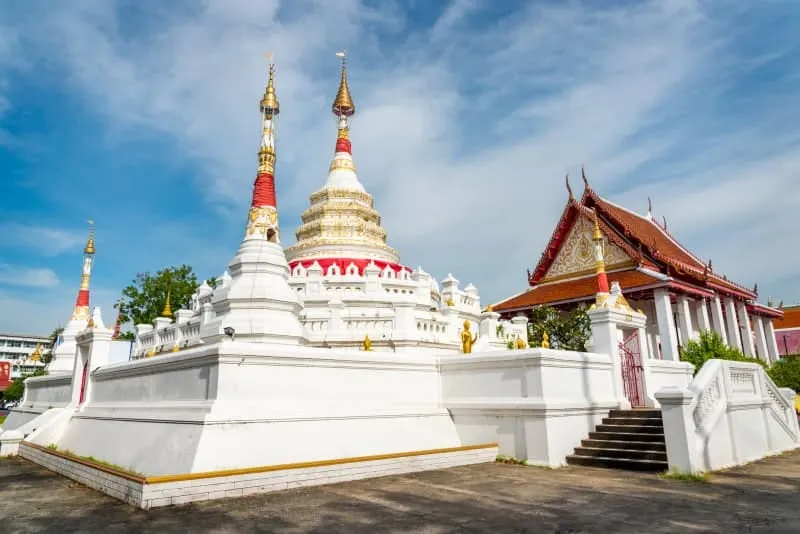
The temple’s military history predates the renaming: Phraya Phichai Songkhram, a Thonburi-era military figure, built four small bastions here — Pom Prakonchai, Pom Kayasit, Pom Narayanaprabseuk, and Pom Prakan — as part of the river-mouth defences guarding the approach to Bangkok. Rama II’s visit and renaming led to the forts being dismantled, so what stands today is entirely religious: a bell-shaped stupa in Ayutthaya style, registered as a national historic monument, and a newer Rattanakosin-style ordination hall with a quadrangular spire that seats several hundred worshippers for major ceremonies. The site has been in continuous use across three periods of Thai history — late Ayutthaya, Thonburi, and Rattanakosin — which is unusual for a temple this size; most river-mouth structures from the earlier periods were lost or rebuilt from scratch.
Watch out: don’t confuse this with Wat Pichai Songkram in Ayutthaya, a similarly-named temple about 90km north that’s linked to King Taksin’s 1766 escape from the Burmese siege. The two temples share a near-identical name but different provinces, different centuries, and unrelated histories — search results and map apps sometimes conflate them.
Pak Nam itself feels more industrial and workaday than the temple-hopping circuit further into Bangkok, and Wat Phichai Songkhram reflects that — a community temple serving the neighbourhood around the old ordination hall rather than a stop built for tour buses. Morning brings the usual rhythm of incense, quiet prayer, and monks moving between the residence halls and the newer vihara.
- Entry fee: Free
- Hours: Daily 08:00-16:30
- Landmark: Ayutthaya-style bell stupa, registered national monument
- Named by: King Rama II, early 19th century
- Location: Pak Nam subdistrict, Mueang Samut Prakan
Dress modestly and remove shoes before entering the halls. Ancient City and Wat Asokaram, both also in Mueang Samut Prakan district, are easy to combine with a visit here.
Location & Directions
29 Prakhon Chai Road
Samut Prakan, Thailand
Show your taxi or Grab driver
วัดพิชัยสงคราม
Frequently Asked Questions
Is this the same temple as Wat Pichai Songkram in Ayutthaya, the one tied to King Taksin's 1766 escape?
What does Phichai Songkhram mean?
Is there an entry fee?
What can you actually see there today?
Were there really forts at this temple?
Spotted something out of date or incorrect? Let us know
Stay Near Wat Phichai Songkhram
Live prices for places closest to Wat Phichai Songkhram — tap a pin to compare.