

Ok Phansa 2026: End of Buddhist Lent and Boat Processions


DepositPhotos (standard license)
On this page
Ok Phansa marks the end of the three-month Buddhist Lent (Phansa), when monks conclude their rainy-season retreat and are once again free to travel. It falls on the full moon of the eleventh lunar month, which in 2026 is Monday 26 October, and is celebrated with merit-making, temple ceremonies and illuminated boat festivals along the Mekong.
Quick answer: where to spend Ok Phansa. For the boats, go to Nakhon Phanom for the evening of 26 October 2026, when giant illuminated boats from all 12 districts float on the Mekong (the festival runs 16–27 October). For the Naga Fireballs, go to Nong Khai and head downriver to Phon Phisai or Rattanawapi. Both are free; the things to book are a room and transport. Riverside rooms sell out first, so pick from the hotels below and check buses and flights on 12Go. Nakhon Phanom and Nong Khai are about 300 km apart, so choose one for the night.
Choose your town before your room. Nakhon Phanom (boats) and Nong Khai (fireballs) are about 300 km apart, and riverside rooms in both go first. For the boat procession, Fortune River View Hotel and Fortune View Khong Hotel sit on the Mekong road; for the fireballs, LePont Riverfront Resort is the pick in Nong Khai. All three open on the night of 26 October. The full list is under Hotels We Like for Ok Phansa.
- Date: Monday 26 October 2026 (full moon, eleventh lunar month)
- Public holiday: No. Banks and government offices open as normal
- Alcohol: Nationwide sales ban for the day; licensed hotels, licensed entertainment venues and some approved tourist venues exempt
- Illuminated boats: Nakhon Phanom Lai Ruea Fai festival, 16–27 October 2026; main procession after dark on 26 October
- Naga Fireballs: Nong Khai province, mainly Phon Phisai and Rattanawapi. Free from the riverbank
- Entry: Free along the public riverfronts
Why the Retreat Ends Here
The three months of Buddhist Lent, from Khao Phansa in late July to Ok Phansa in October, follow the rainy season across mainland Southeast Asia. Monks stay in one temple through the rains, traditionally to avoid trampling crops and small creatures on wet paths. Ok Phansa is literally the “exit from Phansa”: monks can travel again, visit other temples and their families, and resume the wider work of the Sangha.
For Thai laypeople, Ok Phansa opens the Kathin season, about a month in which new robes can be formally presented to monks. Many temples also hold Tak Bat Thewo, a mass almsgiving that recalls the Buddha’s descent from heaven, on or just after Ok Phansa.
The Lai Ruea Fai: Illuminated Boat Procession
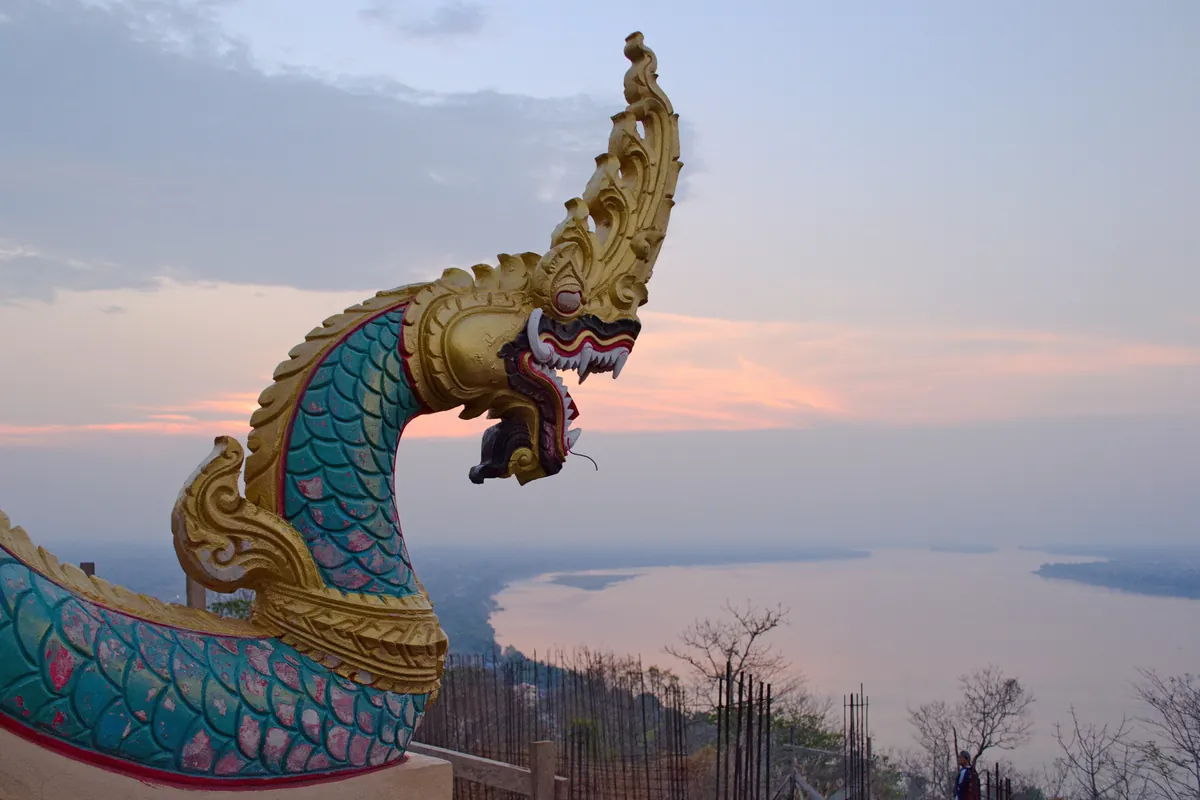
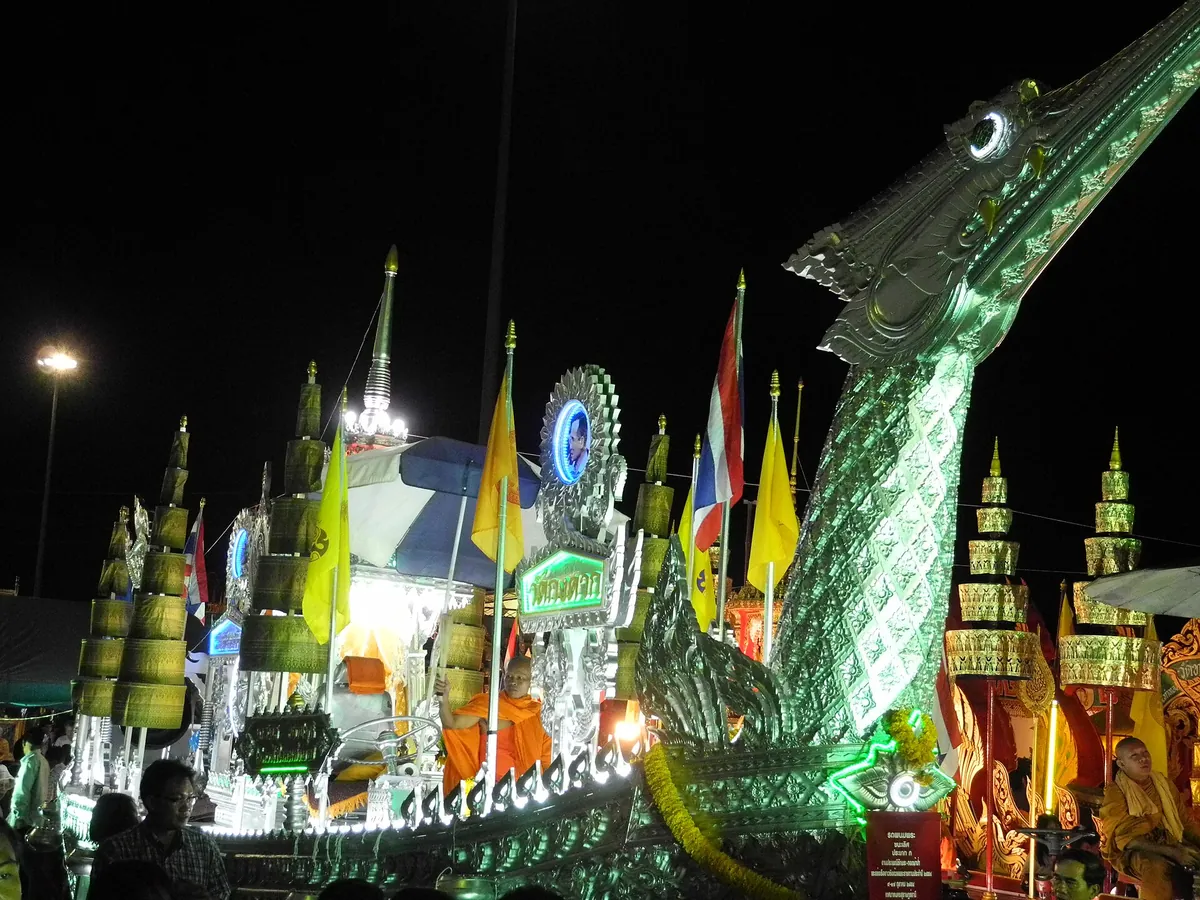
The Lai Ruea Fai (ไหลเรือไฟ, literally “flowing fire boats”) is the defining Ok Phansa spectacle in Nakhon Phanom. Each of the province’s 12 districts builds one giant boat: a bamboo or steel frame on a raft, worked into temples, Naga serpents and other designs, and lit with thousands of small lamps. In 2025 the boats were around 80 metres long and 20–30 metres tall, each lit with 20,000–25,000 handmade lamps, many made from recycled coffee cans (Nation Thailand). After dark the boats are set afloat on the Mekong one by one, with Laos on the far bank.
The 2026 festival runs for 12 days and nights, 16–27 October, around the provincial hall and the riverfront along Sunthon Wichit Road, with merit-making for Phra That Phanom, cultural shows, handicraft and food markets and light installations. The highlight is Ok Phansa night, 26 October, when all 12 district boats appear (77 Kaoded).
Insider Tip: For 2026 the province has banned all selling on the river side of the promenade. Food stalls are in the Maha Thai market area, around the provincial hall, along the road from Wat Phra In Plaeng to Wat Pho Si, and on the side streets off Sunthon Wichit Road, with separate food-truck zones (77 Kaoded). Eat early, then claim a spot on the riverbank well before dark.
Getting to Nakhon Phanom
Nakhon Phanom is about 720 km from Bangkok by road. Flights from Don Mueang take about 1 hour 10 minutes and are the realistic option for a short trip; buses from Mo Chit take around 11–12 hours. Compare buses and flights on 12Go Bangkok to Nakhon Phanom. Phra That Phanom, about 50 km south, is an easy day trip while you are there.
The Naga Fireballs at Phon Phisai and Rattanawapi
On the same evening, in Nong Khai province, crowds gather on the Mekong to watch for the Bung Fai Phaya Nak, the Naga Fireballs. Small, reddish-pink lights are reported rising silently from the river and fading as they climb. The province counts them each year: 371 in 2024 and 287 in 2025, when 237 were logged in Rattanawapi (about 80 km downriver of Nong Khai town) and 50 in Phon Phisai (about 50 km).
Scientists have proposed natural explanations, most commonly flammable gas from the riverbed igniting at the surface. Locals attribute the fireballs to the Phaya Nak, the mythical serpent of the Mekong. Nong Khai town hosts the main festival stage, long-boat races and krathong floats on the river from 22 to 28 October, but sees few fireballs itself.
Watch out: Roads to Phon Phisai and Rattanawapi back up on Ok Phansa evening. Pick one viewing area, arrive before dusk and stay put rather than trying to combine several riverbank spots in one night.
Temple Ceremonies Across Thailand
Not everyone travels to Isan for Ok Phansa. At temples across Thailand, the morning begins with tak bat, monks’ alms rounds, with larger crowds of donors than usual as laypeople celebrate the end of the retreat. Many Thais dress in white for temple visits. The mood is warmer than the more solemn Asanha Bucha or Visakha Bucha: Ok Phansa feels like a reunion between monks and the community that supported them through the rains.
Pro Tip: The alcohol sales ban means convenience stores and most restaurants will not sell on 26 October. If you want a drink with dinner, eat at a licensed hotel or entertainment venue, which are exempt under the 2025 rules.
Hotels We Like for Ok Phansa
Book early: festival nights fill riverside rooms in both towns. Each name opens Booking.com for the night of 26 October (check-in 26th, check-out 27th).
Nakhon Phanom (illuminated boats)
- Fortune River View Hotel Nakhon Phanom: 4-star hotel on the Mekong with river-view rooms and an outdoor pool, on the Nakhon Phanom–That Phanom riverside road. Our review.
- Fortune View Khong Hotel Nakhon Phanom: 3-star hotel on Sunthon Wichit Road, the festival riverfront road, with river-view balcony rooms (confirm the view when booking). Our review.
- SP Residence: 3-star hotel on Nittayo Road in the town centre that lends free bicycles, handy for reaching the riverfront on busy festival nights. Our review.
Nong Khai (Naga Fireballs)
- LePont Riverfront Resort Nongkhai: 4-star resort on the Mekong with river-view rooms and a pool, walking distance from Tha Sadet Market and the town festival grounds. Our review.
- Amanta Hotel Nongkhai: 4-star hotel with a pool and free parking, a good base if you are driving out to Phon Phisai. Our review.
For live prices, use the hotel map below.
The Month After: Kathin Season
Ok Phansa opens the Kathin season, about a month during which communities can formally present robes to their local monastery. Kathin differs from ordinary robe-giving in that it requires a quorum of monks and follows a set ritual: the Kathin robe goes to a single monk chosen by the assembly, after formal recitation and communal agreement.
Royal Kathin ceremonies, in which robes are presented on the King’s behalf at temples of royal patronage, take place across the country during this month.