





Ho Chi Minh’s House (Ban Na Chok)
บ้านลุงโฮจิมินห์ (บ้านนาจอก)
A preserved wooden house on stilts in Ban Na Chok village, about 4 km west of Nakhon Phanom town, marks where Ho Chi Minh lived for several months in 1928 into 1929, while organising Vietnamese independence activities from exile among the area’s Vietnamese community. Entry is free, open daily.
Nakhon Phanom sat across the Mekong from French Indochina, and by the late 1920s it held a sizeable Vietnamese exile population — fertile ground for a revolutionary keeping a low profile from French colonial surveillance. Ho Chi Minh, travelling under an alias, based himself in Ban Na Chok during this period, meeting local supporters and coordinating with the wider Vietnamese resistance network across Isan before moving on later in 1929 as French pressure increased. Northeast Thailand’s Mekong-side towns — Nakhon Phanom, Udon Thani, Sakon Nakhon — hosted a loose network of Vietnamese exile communities through the 1920s and 30s, and Ban Na Chok functioned as one node in that wider organising effort rather than an isolated hideout.
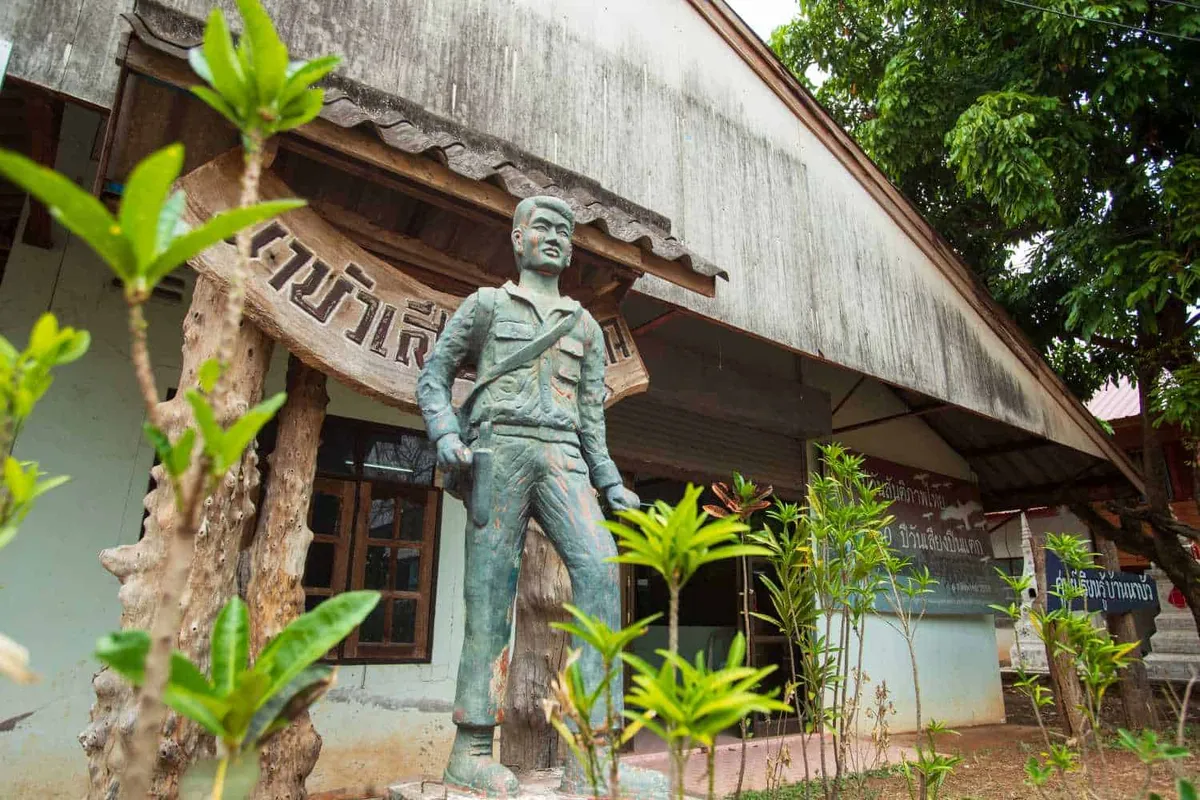
The house itself is a simple raised timber structure in traditional local style, maintained on the site of his residence, with a small collection of period photographs and documents inside that sketch out his daily routine and connections to the village. A Vietnamese cemetery from the same era lies nearby, and the wider village is sometimes referred to as a “Thai-Vietnamese Friendship Village” in recognition of the historical tie. Descendants of the Thai and Vietnamese families who knew him during that period have had a hand in maintaining the site over the decades, which gives the place a lived-in, family-history feel rather than a curated state monument.
The site draws a steady trickle of Vietnamese visitors for whom it’s something closer to a pilgrimage than a tourist stop, alongside history-minded travellers passing through Nakhon Phanom. There’s no grand monument here — the house is genuinely modest, the garden is quiet, and the whole experience runs closer to visiting a preserved family home than a national historical site. That contrast is largely the point: it’s a more human-scale way into a figure usually encountered only through statues and textbooks, and it says as much about the Vietnamese diaspora in Isan as it does about the man himself.
Insider Tip: Combine the visit with a bike ride — Ban Na Chok is flat, rural, and an easy 15-20 minute pedal from central Nakhon Phanom, past rice paddies and small Vietnamese-Thai family homes.
Watch out: Facilities are minimal — no café, limited shade, and no shop. Bring water, and don’t expect English-language signage to go much beyond the basics.
- Entry fee: Free
- Hours: Daily, 08:00-18:00
- Distance from Nakhon Phanom town: About 4 km west
- Historical period: Ho Chi Minh’s residence, 1928-1929
- What’s on site: Preserved wooden house, small photo/document display, nearby Vietnamese cemetery
It’s an easy half-day add-on to a stop in Nakhon Phanom, best paired with the town’s Mekong riverside promenade rather than treated as a standalone destination.
Location & Directions
Mueang Nakhon Phanom, Nakhon Phanom
Nakhon Phanom, Thailand
Show your taxi or Grab driver
บ้านลุงโฮจิมินห์ (บ้านนาจอก)
Frequently Asked Questions
When did Ho Chi Minh actually live in this house?
Is this the same as the Ho Chi Minh Museum in Nakhon Phanom town?
Is entry free?
What's actually on site?
How do I get there from Nakhon Phanom town?
Spotted something out of date or incorrect? Let us know
Stay Near Ho Chi Minh’s House (Ban Na Chok)
Live prices for places closest to Ho Chi Minh’s House (Ban Na Chok) — tap a pin to compare.