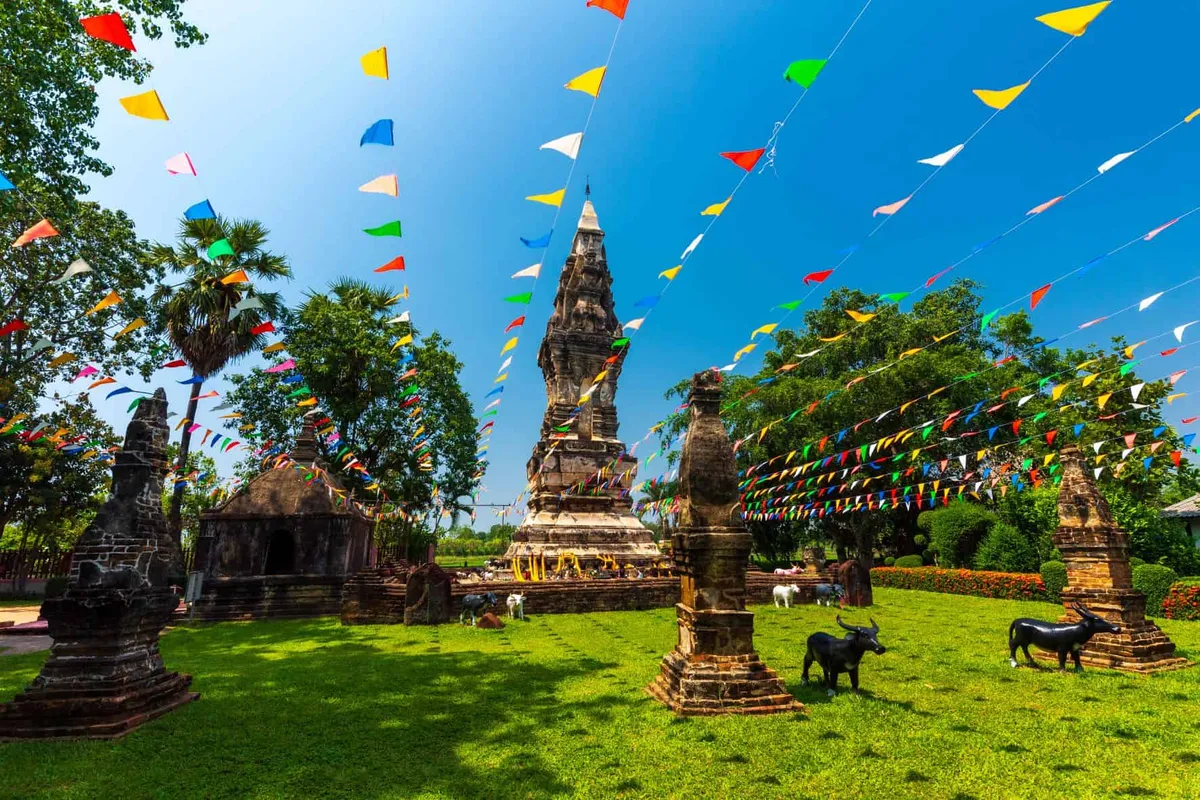




Phra That Ku Chan is a 15-metre brick chedi at Wat Ku Chan in Kham Khuean Kaeo district, Yasothon — not a Khmer ruin despite the “prang” look some listings give it. The tapering, lotus-bud (bua liam) profile links it stylistically to That Phanom across the Mekong in Nakhon Phanom, and locals date its construction to roughly the same 12th Buddhist-century period. Entry is free, and outside of festival week it’s a quiet stop on the way through rural Isan.
The chedi itself is compact: 5.1 metres wide at the base, rising to 15 metres, wrapped in two tiers of low brick boundary walls. Unlike the sandstone Khmer prangs found further south in Buriram or Surin, Ku Chan is built of brick and plastered in the Lao-Isan Buddhist style, closer in form to a Lao that (reliquary stupa) than to a Hindu shrine tower. For decades no one recorded who built it or why — the story attached to it today traces back to 1978, when a novice monk at the temple, Samanen Thaworn Inkai, recounted a version of its origin linking the relics inside to Phra Maha Kassapa, who according to local tradition distributed the Buddha’s remains through this part of Isan seven years after the Buddha’s death. Treat that as temple lore rather than an archaeologically dated fact — the Fine Arts Department has not published an excavation report fixing the date.
More concrete evidence sits scattered around Ku Chan village and the nearby Don Pu Ta ancestor-spirit grove: 17 sandstone boundary markers (bai sema), carved from red sandstone, have been catalogued at various points around the site. Sema stones like these usually mark consecrated ground for ordination halls, so their presence suggests religious use here predates the chedi in its current brick form.
- Entry: Free, no fixed gate hours — open temple grounds
- Structure: Brick chedi, 5.1m wide, 15m tall, lotus-bud spire, two-tier boundary wall
- Era: Roughly 12th Buddhist century, contemporary in style with That Phanom
- Annual festival: 14th waxing moon to 3rd waning moon, month 3 (mid-February)
- Nearby: 17 sandstone sema markers at the village and Don Pu Ta grove
Insider Tip: Outside the February festival week the temple grounds are nearly empty — good if you want a slow look at the sema stones without crowds, but there’s no vendor or shade nearby, so bring water if you’re stopping between other Yasothon sights.
Watch out: There’s no on-site information panel in English, and the chedi’s history rests mostly on a single monk’s 1978 account rather than an inscription or Fine Arts Department dating — worth knowing before repeating it as settled history.
Phra That Ku Chan sits about 20km from central Yasothon, reachable by car or local songthaew. Pair it with Phra That Kong Khao Noi, the province’s better-known hilltop chedi with its own origin legend, or Wat Maha That Yasothorn in town for a fuller look at the province’s Buddhist heritage beyond the Isan temple-fair circuit.
Location & Directions
Kham Khuean Kaeo, Yasothon
Yasothon, Thailand
Show your taxi or Grab driver
พระธาตุกู่จาน
Frequently Asked Questions
Is Phra That Ku Chan a Khmer ruin?
What does the chedi look like?
Is there an entry fee?
When is the annual festival?
Is there anything else to see nearby?
Spotted something out of date or incorrect? Let us know
Stay Near Phra That Ku Chan
Live prices for places closest to Phra That Ku Chan — tap a pin to compare.