




Mueang Trai Trueng is an ancient walled town on the right bank of the Ping River in Kamphaeng Phet province — older than the Sukhothai kingdom it’s often filed under. Pottery excavated on site dates habitation back to the Dvaravati period, roughly the 6th to 11th centuries CE, and the town stayed continuously occupied through the Sukhothai era as a secondary settlement on the trade route linking Ayutthaya to the northern city of Hariphunchai. It wasn’t abandoned until the early Rattanakosin period, during the reign of King Rama III in the first half of the 19th century — a working town for well over a thousand years before it went quiet.
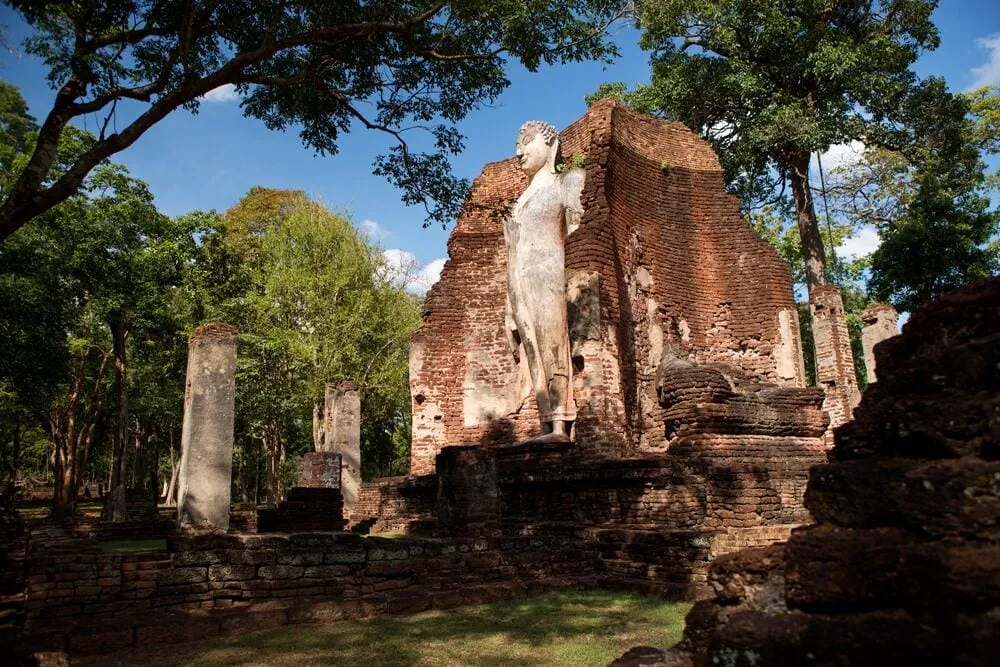
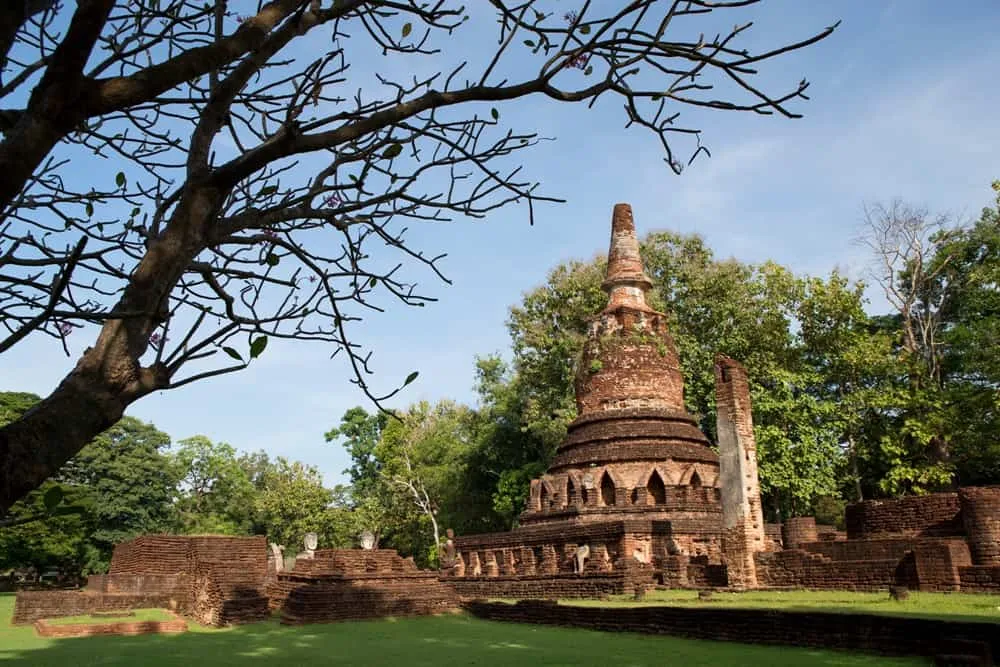
The old city was compact and rectangular, roughly 800 by 840 metres, ringed by three concentric earthen ramparts and water channels — traces of which are still visible in the landscape around the two surviving brick monuments. Chedi Jet Yod, the Seven-Spired Chedi, is built in Sukhothai style with an eastern entrance portico. A short walk away, Wat Phra That holds a large lotus-bud chedi that’s reckoned the biggest example of that shape in either Kamphaeng Phet or Sukhothai province — a genuinely significant piece of Sukhothai-era religious architecture, not a minor provincial copy.
The site’s other claim to fame is folklore rather than archaeology: this is the setting of the Thao Saen Pom legend, one of central Thailand’s best-known origin myths. A prince disguised himself as an ugly, wart-covered commoner and worked as a vegetable grower near the old palace; the local princess, Usa, fell for him after noticing a prize eggplant growing suspiciously well in his garden. Their son was raised in a golden cradle — “u thong” in Thai — and the legend holds that he grew up to found Ayutthaya as King U Thong, the dynasty’s first ruler. It’s a story still told locally, and King Rama VI later adapted it into a royal stage play.
Insider Tip: Visit Chedi Jet Yod first, then walk the short distance to Wat Phra That — most visitors only see one of the two monuments and miss the better-preserved lotus-bud chedi entirely.
Facilities are minimal: no ticket booth, no shop, and little shade once you’re away from the two main structures, so bring water and sun protection. Public transport doesn’t reliably reach the site, so a car or motorbike from Kamphaeng Phet town is the practical way in.
- Entry fee: Free
- Founded: Dvaravati period (6th-11th c. CE); abandoned under Rama III (19th c.)
- Key remains: Chedi Jet Yod (Seven-Spired Chedi), Wat Phra That’s lotus-bud chedi
- City plan: ~800 x 840 m, three earthen ramparts and moats
- Legend: Birthplace setting of the Thao Saen Pom / King U Thong origin myth
Location & Directions
Mueang Kamphaeng Phet, Kamphaeng Phet
Kamphaeng Phet, Thailand
Show your taxi or Grab driver
เมืองไตรตรึงษ์
Frequently Asked Questions
How old is Mueang Trai Trueng?
What can you actually see on site today?
What's the legend connected to this place?
Is there an entry fee?
How do I get there from Kamphaeng Phet town?
Spotted something out of date or incorrect? Let us know
Stay Near Muang Trai Trung
Live prices for places closest to Muang Trai Trung — tap a pin to compare.