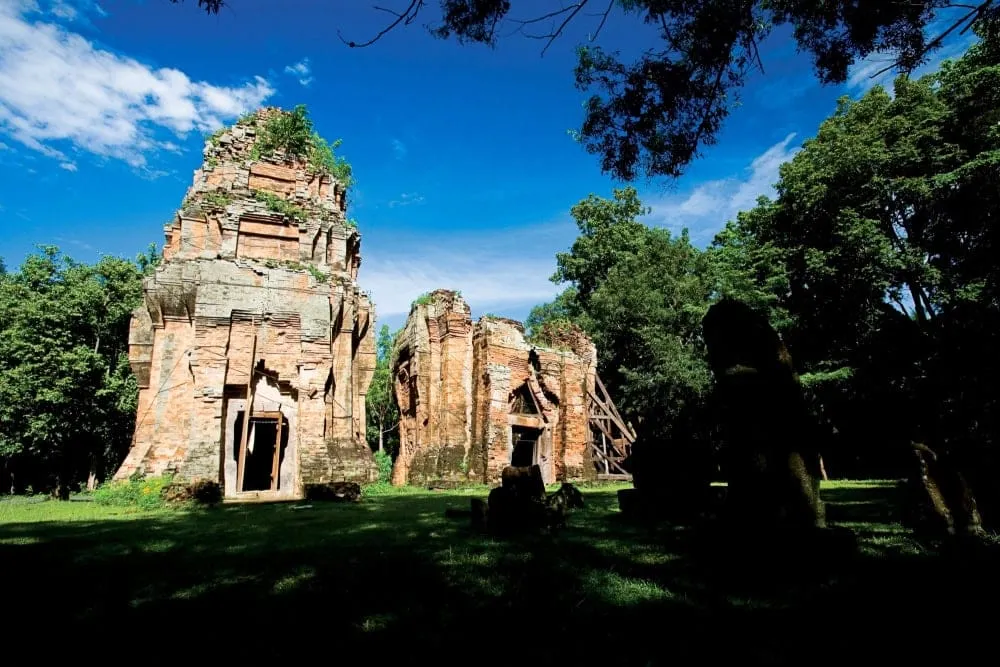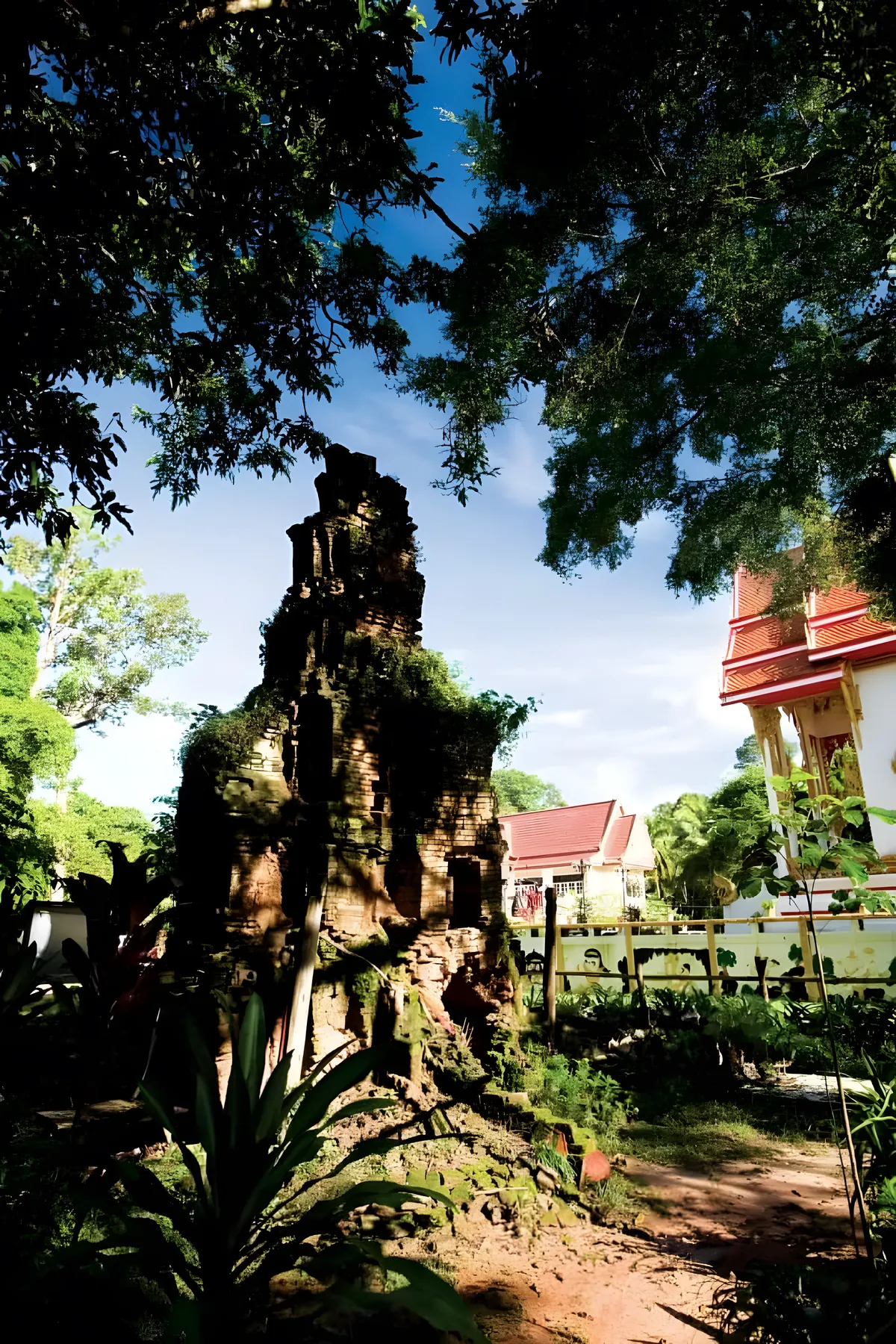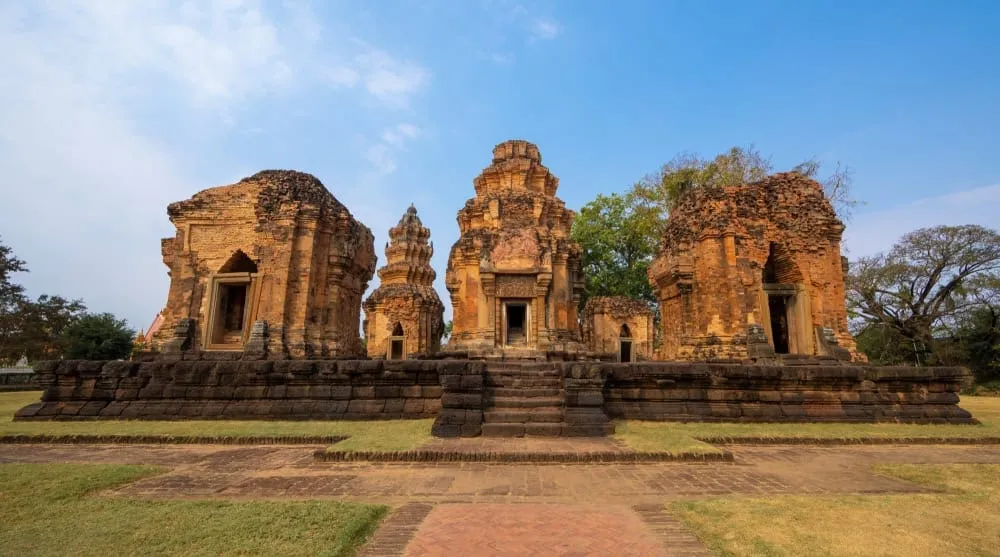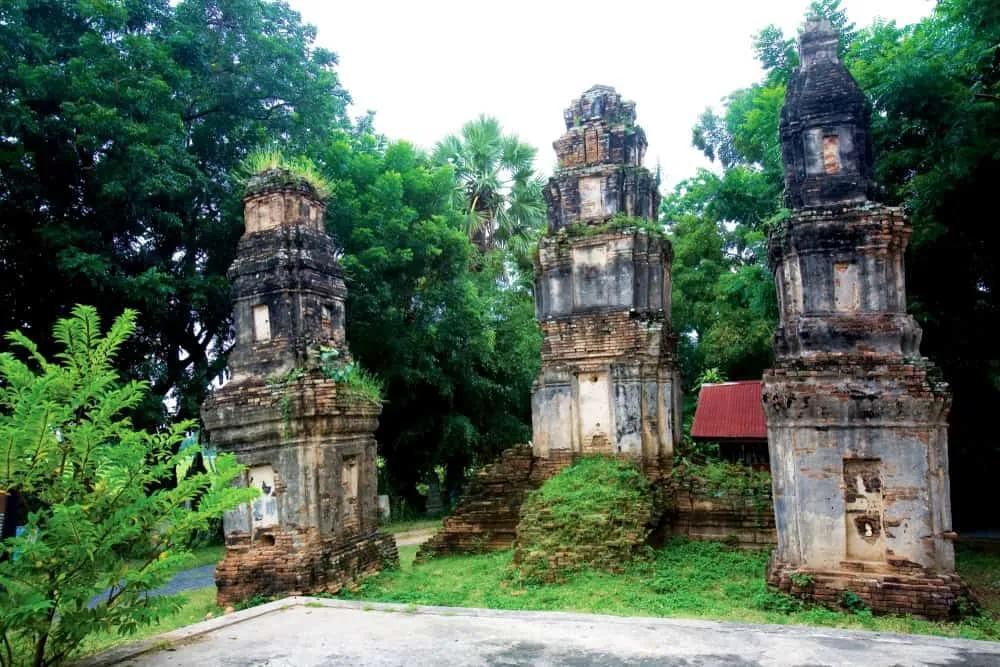





Prasat Phumpon is a cluster of three brick Khmer sanctuary towers on a laterite base in Sangkha district, rural Surin province — not a European-style castle, despite the “castle” in its common English name. Thailand’s Fine Arts Department dates it to around the 7th century CE, making it the oldest surviving Khmer-built brick structure in the country, older than Angkor Wat by several centuries. Entry is free, roughly 08:30-16:30 daily, about 59 km from Surin town.
The name itself gives a clue to what this is: “phum” means land or realm, “pon” means hidden or concealed — “the hidden realm.” That’s fitting for a sanctuary tucked into farmland well off Surin’s main tourist circuit. Three brick towers stand in a north-south line, with a fourth base built from laterite rather than brick. The largest and southernmost tower, the main prang, was built using a construction technique now considered a hallmark of the earliest Khmer builders in Thailand: the bricks are fitted together dry, without mortar, relying on precise cutting rather than a binding paste. Sandstone frames the doorways, carved into colonnettes, and above the lintel a rolled-leaf motif decorates the pediment — an early decorative style that predates the more elaborate carving seen at later, better-known Angkorian sites.
Like most early Khmer prasat in this region, Phumpon began life as a Hindu shrine rather than a Buddhist temple or royal residence — the towers originally housed images tied to Brahmanic worship, later absorbed into local Buddhist practice as the region’s religion shifted. A local folk tale, the legend of Neang Doh Thom, tells of a Khmer king who built a hidden city in the forest here; Phumpon is identified in the story as the remains of that settlement. There’s no evidence connecting the site to any royal residence in the way older signage sometimes implies — it was built and used as a religious sanctuary.
Because it sits well outside Surin’s main Khmer temple loop (Prasat Sikhoraphum, Prasat Hin Ban Phluang), Phumpon rarely gets crowds. The setting is plain rural Isan: rice paddies, a scatter of houses, and the brick towers standing alone in the open. There’s no visitor centre to speak of, just the towers and a small information sign.
Insider Tip: Combine the drive with Sangkha district’s other Khmer sites rather than making a special trip just for Phumpon alone — the 59 km from Surin town is a fair distance for one small site on its own.
Watch out: There’s no shade or facilities on site. Bring water and sun protection, especially if visiting during the hot season (March-May).
- Entry fee: Free
- Hours: Daily, approximately 08:30-16:30
- Age: ~7th century CE — oldest surviving Khmer brick structure in Thailand
- Structure: 3 brick prasat towers + 1 laterite base, built without mortar
- Distance: About 59 km from Surin town via Highway 2077 and 2124
Pair the visit with Prasat Hin Ban Phluang, a more architecturally elaborate 10th-century Khmer sanctuary elsewhere in Surin province, or Sikornpoom Castle (Prasat Sikhoraphum), the province’s best-known Khmer temple. Both fall under Surin province’s cluster of pre-Angkorian and Angkorian-era ruins.
Location & Directions
Mu 5
Surin, Thailand
Show your taxi or Grab driver
ปราสาทภูมิโปน
Frequently Asked Questions
Is Phumpon Castle actually a European-style castle?
How old is it?
What's actually on site?
Is there an entrance fee?
How far is it from Surin town?
Spotted something out of date or incorrect? Let us know
Stay Near Phumpon Castle
Live prices for places closest to Phumpon Castle — tap a pin to compare.