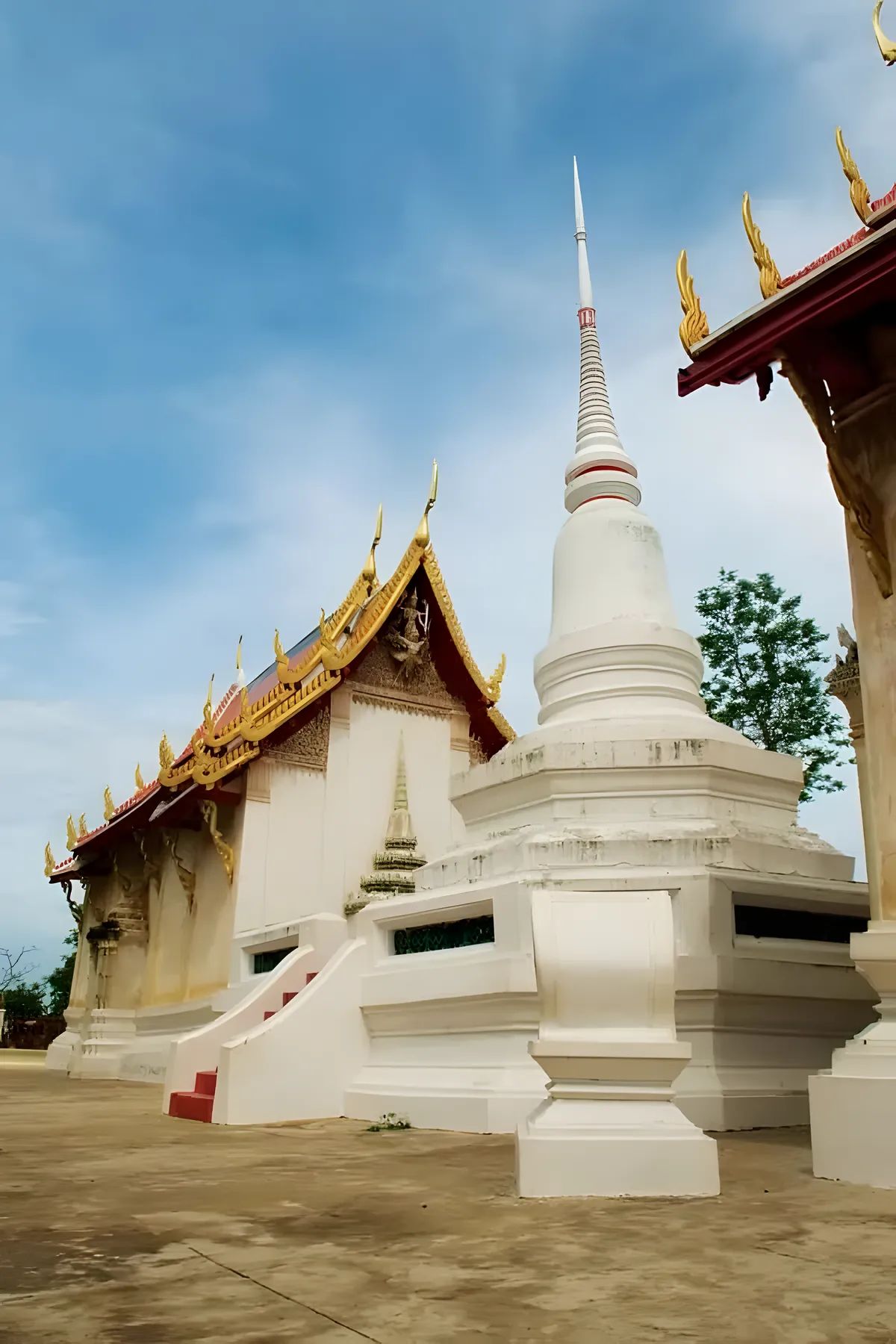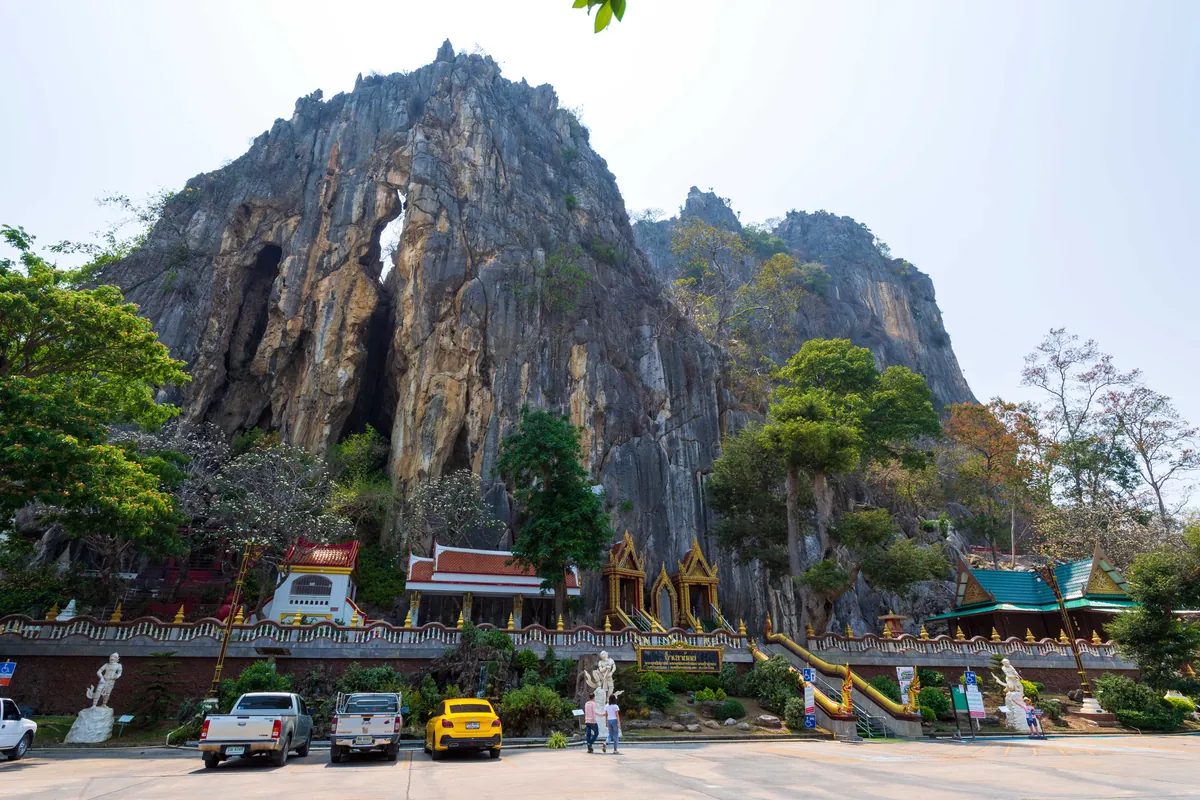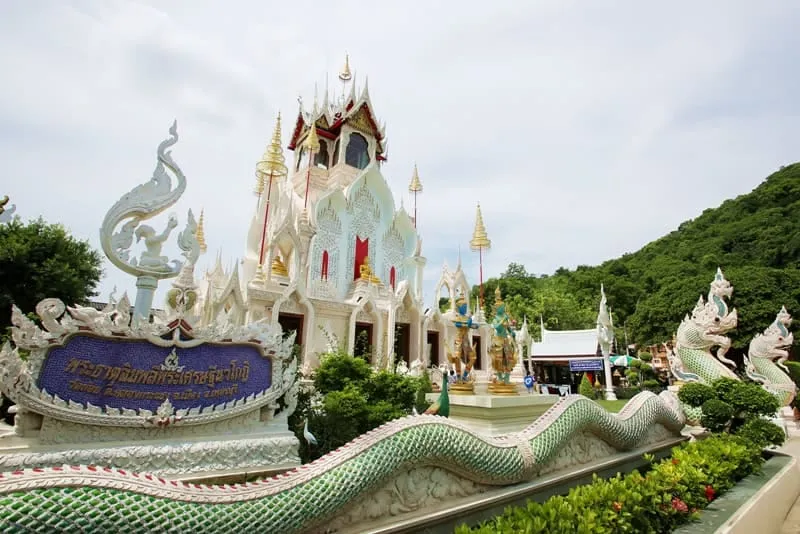
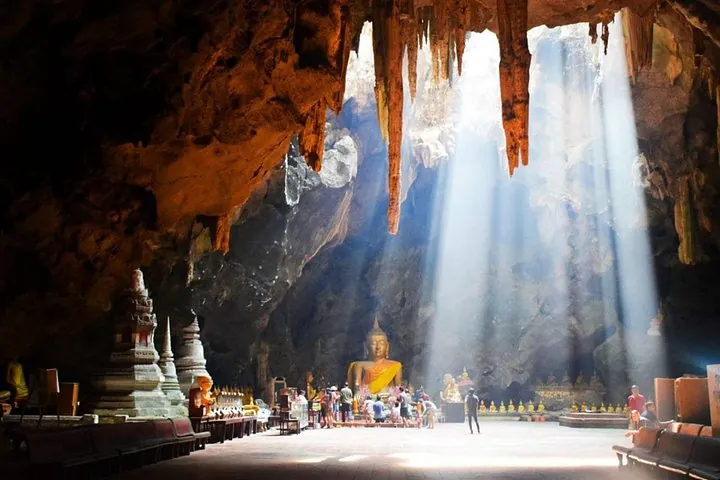
Sunlight drops through a natural opening in the roof of Tham Khao Luang, a limestone cave on a nearly 100-metre hill just north of Phetchaburi town, landing on rows of golden Buddha images below. King Mongkut (Rama IV) used the cave as a meditation retreat during his reign (1851-1868) and had Buddha images installed inside; his son Rama V later added a 4-metre seated Buddha near the entrance, dedicated to both Rama III and Rama IV. Entry is free, daily 09:00-16:00.
A paved staircase climbs from the car park to the cave mouth, no ropes or scrambling needed, just steps and a slightly uneven floor once you’re inside. The main chamber holds roughly 170 Buddha images altogether: Ayutthaya-period pieces restored under royal patronage, a reclining Buddha along the back wall, and smaller votive figures tucked into stalactite recesses. The skylight opening sits almost directly overhead, and between about 9 AM and noon the beam falls close to vertical, lighting the gilded statues against the dark limestone, the reason most photographers plan their visit for that window rather than later in the day. Beyond the main hall, a couple of smaller side chambers hold additional images and rougher, unlit rock formations, stalactites still forming drip by drip.
The name Khao Luang, “Royal Mountain,” isn’t an exaggeration of the site’s importance so much as a literal description of who used it. Rama IV came to this specific hill repeatedly during his reign, not as a ceremonial stop but as a working retreat for study and meditation, and the Buddha images he placed here reflect that personal use rather than a single grand commissioning project. Rama V’s addition decades later, a four-metre seated Buddha dedicated jointly to Rama III and Rama IV, reads as a deliberate act of dynastic memory as much as devotion, tying three reigns to one cave. That layered history is part of why the site still functions as an active place of worship rather than a purely archaeological one: Phetchaburi residents visit to make merit here the way they would at any working temple, cave setting aside.
- Entry fee: Free
- Hours: Daily 09:00-16:00
- Buddha images: ~170, plus a reclining Buddha and Rama V’s 4m seated Buddha
- Best light: Roughly 9 AM-noon, when the skylight beam is most vertical
- Royal connection: King Mongkut (Rama IV) meditated here; Rama V added the large Buddha statue
Incense smoke drifts through the light shaft most mornings. Local worshippers come to make merit before the tour groups arrive, and the cave stays noticeably cooler than the streets outside even at midday. Watch out: troops of monkeys live around the entrance steps and go straight for anything that smells like food, bags included. Keep zippers closed and think twice before buying the vendor bananas at the bottom of the stairs.
Insider Tip: Arrive right at 09:00 opening if you want the beam without a crowd blocking the shot: by 10:30 the cave floor near the reclining Buddha fills with tour groups working the same angle.
Wear shoes with real grip; the cave floor is stone, sometimes damp, and slippery in spots even without rain. Tham Khao Luang sits an easy drive or motorbike ride from central Phetchaburi, and pairs naturally with a half-day loop taking in Phra Nakhon Khiri Historical Park (Rama IV’s hilltop palace, the reason he was in Phetchaburi so often) and Wat Phra Phut Saiyat in town.
Location & Directions
Mueang Phetchaburi, Phetchaburi
Phetchaburi, Thailand
Show your taxi or Grab driver
ถ้ำเขาหลวง
Frequently Asked Questions
Is Tham Khao Luang free to enter?
What time should I go to see the light beam?
What's the King Rama IV connection?
How many Buddha statues are inside?
Are the cave monkeys a problem?
Spotted something out of date or incorrect? Let us know
Tours visiting Tham Khao Luang

Stay Near Tham Khao Luang
Live prices for places closest to Tham Khao Luang: tap a pin to compare.