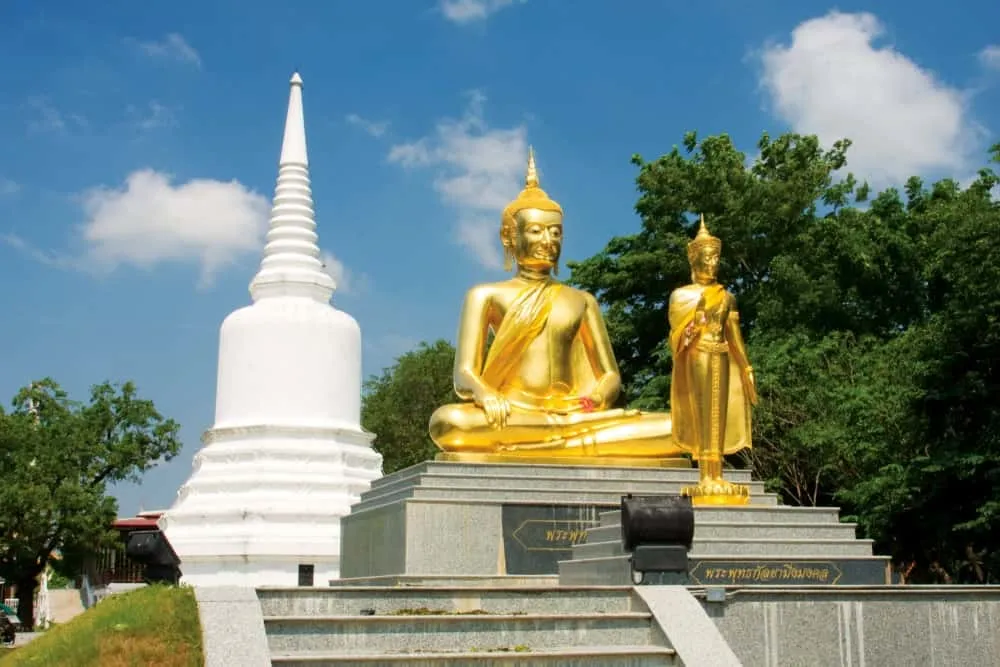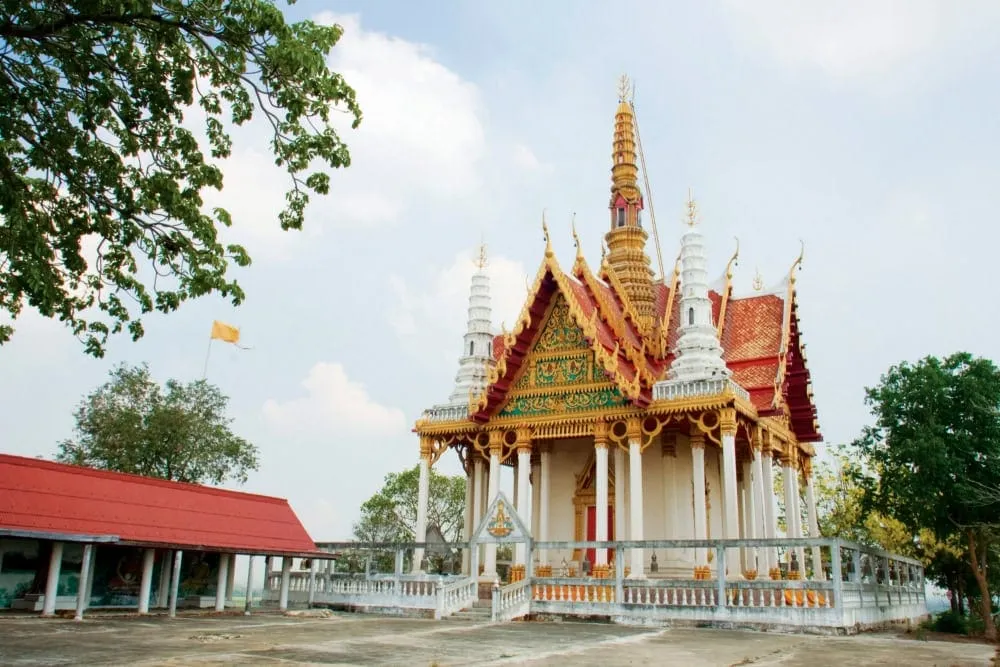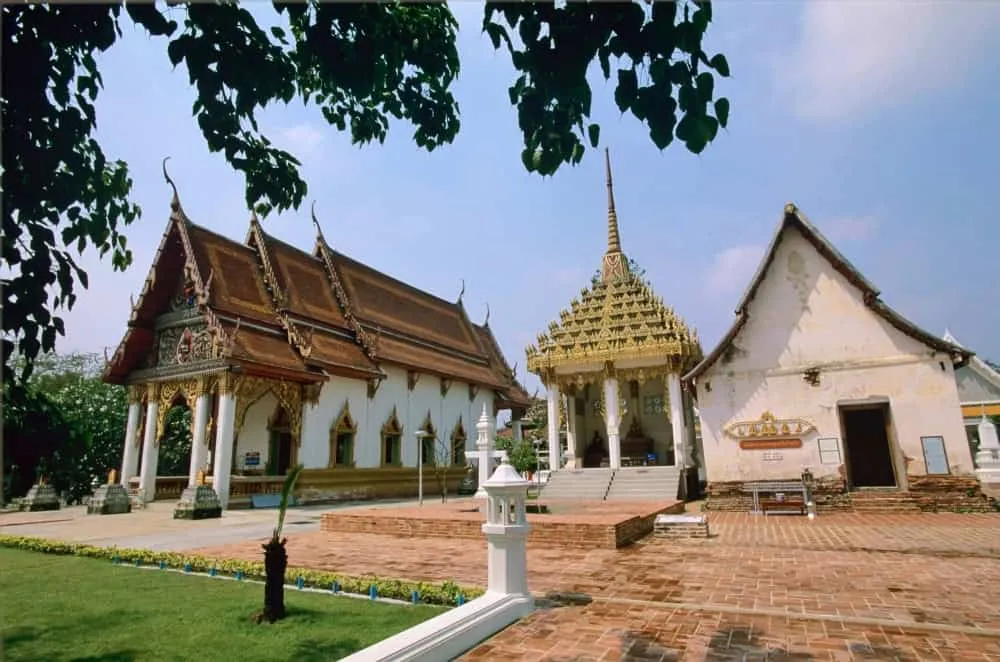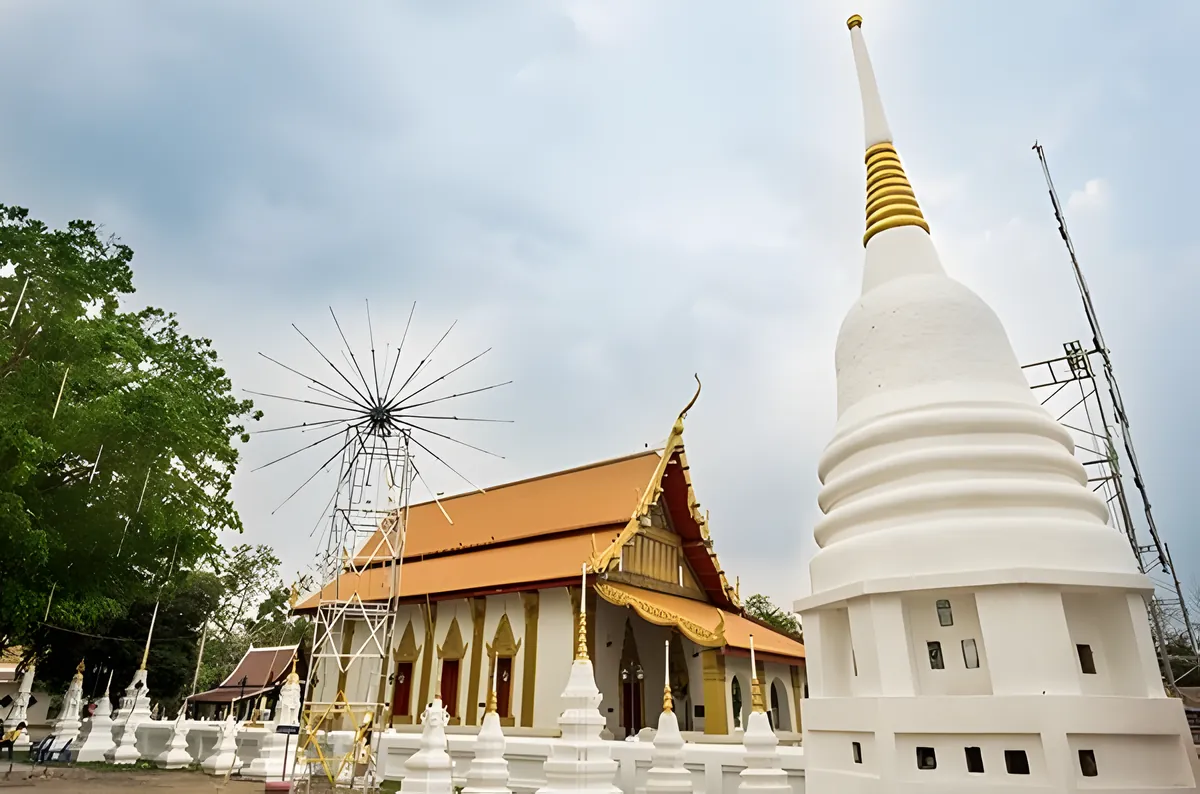



Wat Sam Chuk is a working village temple in Suphan Buri’s Sam Chuk district, built around 1757 under the name Wat Amphawan and renamed only in 1938, when it received its official visungkhamsima (royal temple-boundary consecration). It sits about 600 metres off the Suphan Buri–Chai Nat road, roughly 34km north of Suphan Buri town, and is a separate site from the district’s well-known Sam Chuk 100-year riverside market about 2km away.
The temple’s most notable feature is a weathered brick mondop, dating to the Rattanakosin period, that shelters a carved sandstone Buddha footprint — a slab showing the overlapping impressions of four Buddhas surrounded by 108 traditional auspicious symbols (mongkol 108), now registered as an ancient artifact rather than a modern devotional piece. The mondop itself shows its age: brickwork has crumbled in places, and restoration work continues under the temple’s abbot. Nearby, a sandstone Buddha image dated to the Ayutthaya period is undergoing its own conservation, and a smaller stupa near the temple entrance has similarly weathered over the centuries. A modest community museum on the grounds, set up in 2004, holds local artifacts gathered from the temple and surrounding villages — nothing curated to tourist standards, but a genuine record of the area’s history rather than a gift-shop add-on.
What sets Wat Sam Chuk apart from a purely local parish temple is a documented royal visit: in 1955, King Bhumibol Adulyadej and Queen Sirikit stopped here by boat en route to the Sam Chuk floodgate, an inspection trip that’s still part of the temple’s oral and written history. Day to day, though, the pace is unhurried village-temple business — locals dropping in to make merit, monks going about morning rounds, none of the organised-tour rhythm of the market down the road.
Insider Tip: Pair the temple with Sam Chuk’s 100-year market rather than treating either as a full day out — a songthaew or short drive covers the roughly 2km between them, and the market’s food stalls make a natural lunch stop either side of the temple visit.
Watch out: The mondop housing the Buddha footprint is a genuine antiquity under active restoration; some areas may be roped off or scaffolded depending on works in progress.
- Entry fee: Free
- Founded: c. 1757 as Wat Amphawan; renamed Wat Sam Chuk in 1938
- Highlight: Sandstone Buddha footprint (four overlapping impressions, 108 mongkol symbols) inside a Rattanakosin-era mondop
- Royal history: Visited by King Bhumibol and Queen Sirikit in 1955
- Distance from Sam Chuk Old Market: About 2km — a separate site, not the same attraction
Getting there is easiest by car or motorbike from Sam Chuk town, following the Suphan Buri–Chai Nat road and turning off at the temple’s signposted lane. Dress modestly — covered shoulders and knees — and remove shoes before entering the mondop or any prayer hall. There’s no need to book ahead; this remains a functioning neighbourhood temple, not a managed tourist site, and visits are self-guided.
Location & Directions
3 Mu 1
Suphan Buri, Thailand
Show your taxi or Grab driver
วัดสามชุก
Frequently Asked Questions
Is Wat Sam Chuk the same place as Sam Chuk's famous 100-year market?
What is the Buddha footprint at Wat Sam Chuk?
Why is it called Wat Sam Chuk if it was originally Wat Amphawan?
Did a Thai king ever visit Wat Sam Chuk?
Is there an entrance fee for Wat Sam Chuk?
Spotted something out of date or incorrect? Let us know
Stay Near Wat Sam Chuk
Live prices for places closest to Wat Sam Chuk — tap a pin to compare.