




Mueang Phaniat Historic Park
โบราณสถานเมืองเพนียด
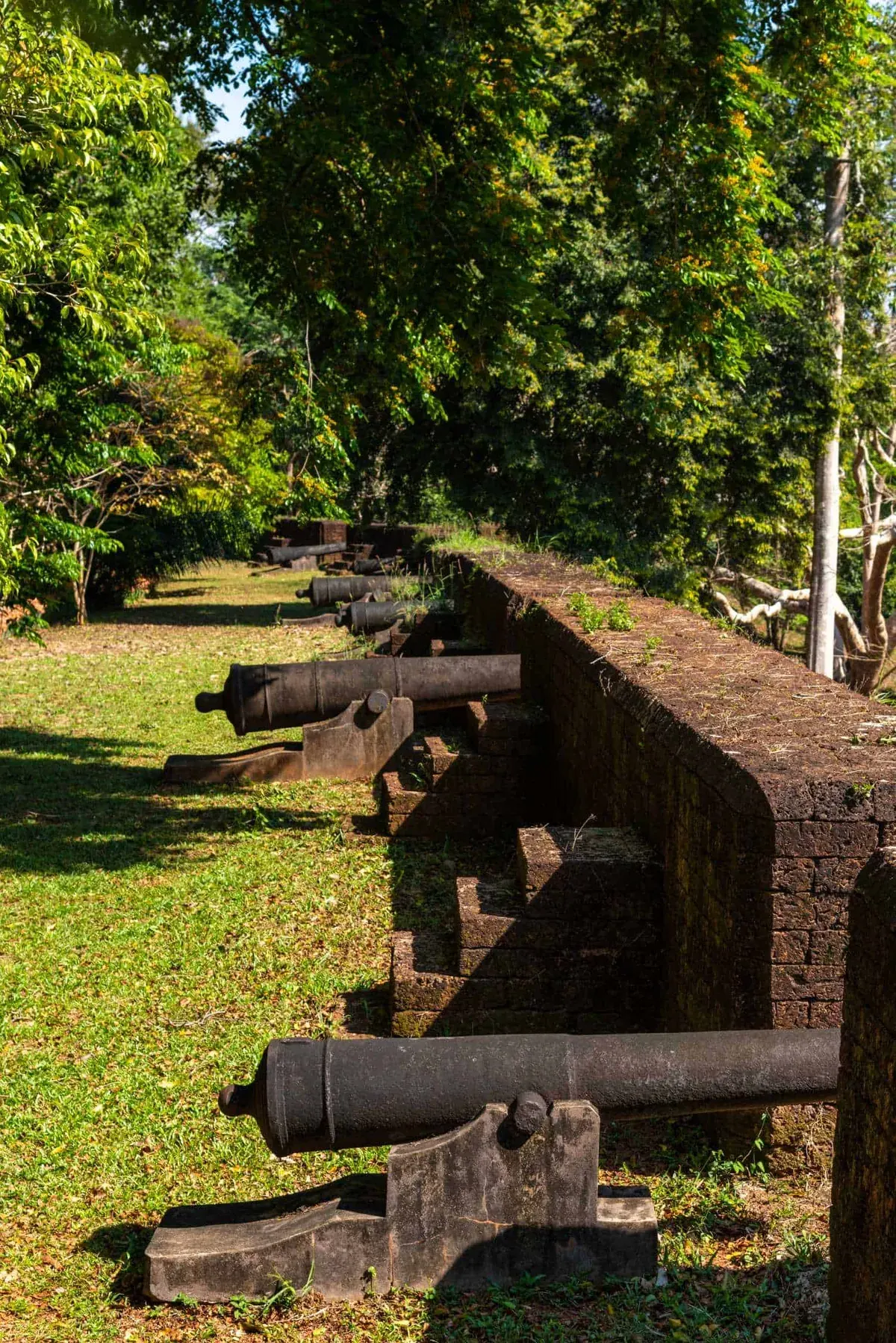
Mueang Phaniat is a moated ancient settlement on the lower western slope of Khao Sa Bap in Chanthaburi’s Khlong Narai subdistrict, dated by the Fine Arts Department to roughly the 6th to 13th century CE. Entry is free. What survives above ground is modest — sections of earthen rampart, a laterite wall, and two old reservoirs — rather than a reconstructed temple complex, so set expectations accordingly.
The site’s rectangular layout, enclosed by earthen embankments, covers about 1,600 rai (2.6 sq km), large enough that early surveyors read it as a fortified town rather than a single religious compound. The clearest built feature is a laterite wall section registered by the Fine Arts Department in 1935 — roughly 16 metres wide, 26 metres long, and 3 metres high. Nearby, archaeologists have mapped two rectangular reservoirs, each about 60 by 40 metres, lined with stone and fitted with staircases down to the water. Finds recovered from the site include a Hindu Harihara sculpture carved in the Phnom Da style associated with pre-Angkorian Cambodian art, three inscriptions in Khmer script, and — in a 2017 excavation — pottery shards from the Dvaravati period. Taken together, the evidence points to a settlement that started under Dvaravati-era Mon influence and later absorbed strong Khmer and Indian cultural contact, likely as a port town linking the coast to inland trade routes.
Watch out: this is a working archaeological site, not a landscaped park — paths are gravel or bare earth, signage is sparse in English, and there’s very little shade over the exposed rampart sections.
The associated finds — the Harihara statue and other excavated pieces — are housed in a small museum at Wat Thong Thua, about 400 metres from the ruins. The original temple that once stood on the settlement itself, Wat Phaniat, is now defunct; Wat Thong Thua took over as the local temple and now doubles as the site’s informal visitor centre. The museum is free and open daily.
Insider Tip: Combine the ruins with Wat Thong Thua in one stop — the walk between them is flat and takes under ten minutes, and the museum is the only place on site with any real interpretation of what you’re looking at.
- Entry: Free (ruins and Wat Thong Thua museum)
- Age: Roughly 6th-13th century CE, Fine Arts Department dating
- Size: ~1,600 rai (2.6 sq km) moated settlement
- Key finds: Harihara statue (Phnom Da style), Khmer inscriptions, Dvaravati pottery (2017)
- Location: Khlong Narai subdistrict, Mueang Chanthaburi district
Early morning avoids both the heat and the worst of the humidity on the exposed rampart walk; bring water and sun protection either way. Pair a visit with the Chanthaburi old town circuit — the Chanthaburi City Pillar Shrine and The National Maritime Museum cover the province’s other pre-modern and coastal history in a single day out.
Location & Directions
Mueang Chanthaburi, Chanthaburi
Chanthaburi, Thailand
Show your taxi or Grab driver
โบราณสถานเมืองเพนียด
Frequently Asked Questions
Is Mueang Phaniat free to visit?
What exactly is Mueang Phaniat?
How old are the ruins?
Is there a museum on site?
How long does a visit take?
Spotted something out of date or incorrect? Let us know
Stay Near Mueang Phaniat Historic Park
Live prices for places closest to Mueang Phaniat Historic Park — tap a pin to compare.