
Phraya Thukkharat (Chuai) Monument
อนุสาวรีย์พระยาทุกขราษฎร์ (ช่วย)
The bronze figure on Ramesuan Road commemorates a local hero most Thais outside Phatthalung have never heard of, and that’s part of what makes him worth knowing about. Phraya Thukkharat, born Chuai around 1739 at Ban Nam Leuad in what’s now Tha Mihram subdistrict, started out as a monk rather than a soldier. He ordained at 20 at Wat Khao Or in Khuan Khanun district, a temple still known today for its tradition of Saiyasart, the old southern Thai school of protective and healing knowledge that Chuai studied seriously during his years in robes.
That background matters to the story. When Burmese forces pushed into the south during the Nine Armies War of 1785–86, early in the reign of Rama I, Chuai (still a monk at the time) helped the Phatthalung governor rally local villagers to repel the incursion. It’s an unusual episode in Thai royal-era history: the resistance here came from a monastic figure rather than a standing military commander. After disrobing, Rama I recognised his role by granting him the title Phraya Thukkharat and appointing him assistant to the governance of Phatthalung, a title that roughly translates as protector of a troubled people.
Insider Tip: The monument sits opposite Kanchanapisek Park at the Tha Mihram three-way junction, and a nearby street (Chuai Thukkharat Road, running between Khuha Sawan Road and Chaiyaburi Road) is also named in his honour. Locals treat both as a package: a quick stop at the monument, then a walk in the park.
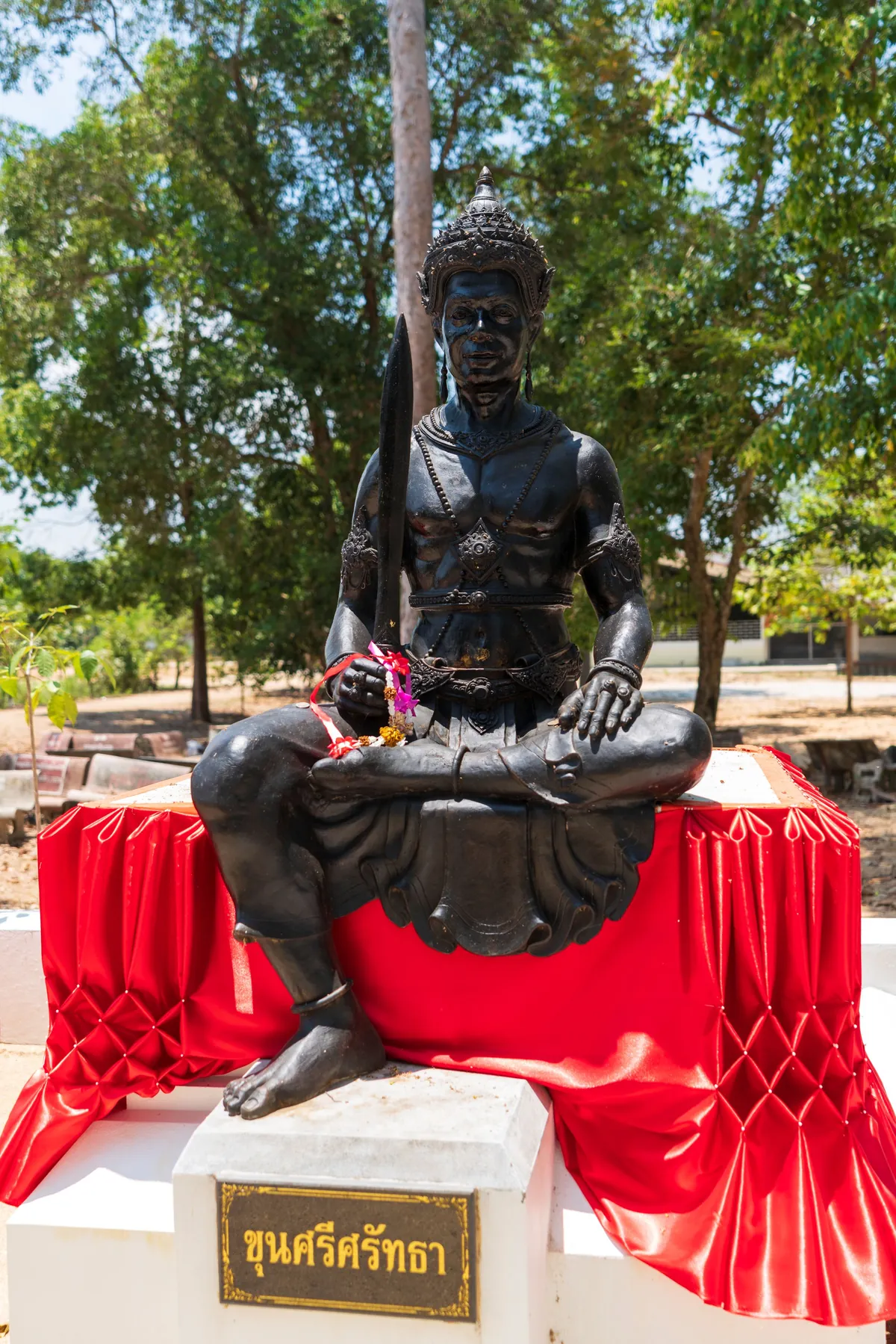
The monument itself is modest in scale: a half-life-size black-patinated bronze statue of Chuai, flanked by two bronze bas-relief panels depicting scenes from the resistance. It was formally established with a foundation-stone ceremony on 16 August 1993, making it a relatively recent addition to the town rather than an old royal-era monument. Bilingual plaques give a condensed version of his story in Thai and English.
Visits here are brief and low-key. Locals stop to leave flowers or light incense on auspicious days, and school groups occasionally pass through on history trips, but there’s no queue, no ticket booth, and no crowd to manage. The setting is functional rather than scenic (a paved municipal junction rather than a garden) so most people fold it into a wider loop of central Phatthalung, pairing it with Wat Khuha Sawan in the old town or the bird sanctuary at Thale Noi further out.
There’s no entrance fee, and the monument is accessible around the clock as a piece of public streetscape. Early morning avoids both the heat and Phatthalung’s midday traffic through the junction, and gives the best light for photos of the bronze relief work.
- Entry: Free, publicly accessible
- Location: Ramesuan Road at the Tha Mihram junction, opposite Kanchanapisek Park, Mueang Phatthalung
- Erected: Foundation stone laid 16 August 1993 (BE 2536)
- Who he was: Chuai, a monk-turned-provincial-official who helped repel a Burmese incursion during the 1785–86 Nine Armies War
- Nearby: Chuai Thukkharat Road, named in his honour, and Kanchanapisek Park directly opposite
Location & Directions
Ramet Road
Phatthalung, Thailand
Show your taxi or Grab driver
อนุสาวรีย์พระยาทุกขราษฎร์ (ช่วย)
Frequently Asked Questions
Who was Phraya Thukkharat?
Was he a military general?
Is there an entrance fee?
What does the monument actually show?
What else is nearby?
Spotted something out of date or incorrect? Let us know
Stay Near Phraya Thukkharat (Chuai) Monument
Live prices for places closest to Phraya Thukkharat (Chuai) Monument: tap a pin to compare.