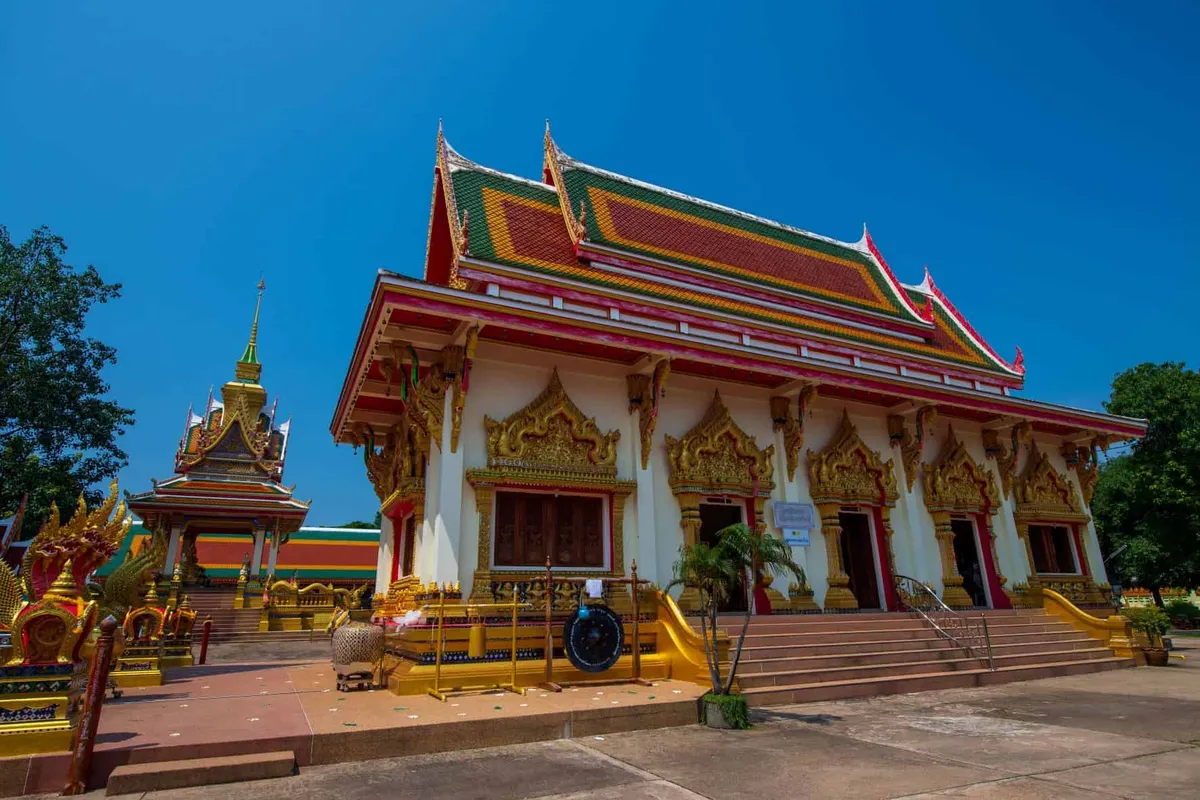





Wat Ahong Silawat sits on the Mekong riverbank in Ban Ahong village, Bueng Kan province, at a stretch of river locals call the “Mekong’s Navel” — the reputed deepest point along this section of the border river, directly below the temple’s ordination hall. The temple was originally named Wat Pa Lelai, founded by a monk known as Luang Pho Lun. It fell into disrepair after his death and stayed that way until 1974, when it was restored and renamed after the nearby Kaeng Ahong rapids.
What draws visitors is the river itself rather than the temple buildings. Local accounts describe the water here reaching extraordinary depths — figures of around 200 metres, measured by lowering a stone on a rope, get repeated often, though that’s tradition rather than a modern survey. What’s easier to verify by eye is the seasonal change: during the rainy season, roughly July through October, the current picks up speed over a submerged rock shelf and forms a visible, cone-shaped whirlpool that locals point to as the navel itself. In the dry season, March through May, water levels drop enough that the underlying rock ledges break the surface directly, giving a clearer look at the geology behind the phenomenon.
Local folklore adds a layer on top of the geology: a belief that an underwater cave near the deepest point shelters giant catfish and a gathering of nagas, said to surface and produce mysterious lights on the water during the Buddhist Rains Retreat each year. It’s worth hearing as a genuine piece of local tradition tied to this stretch of the Mekong — not as a claim this guide is verifying as fact.
Insider Tip: Time a visit to the rainy season, roughly July to October, if the whirlpool itself is what you’ve come to see — the dry-season view shows the rock formations but not the dramatic swirl of water above them.
Watch out: This is a working riverbank, not a fenced viewing platform. Keep a sensible distance from the ordination hall’s edge, especially when the current is running fast during high water.
- Entry fee: Free
- Hours: Daily, 08:00–17:00
- Location: Ban Ahong village, Khai Si subdistrict, Mueang Bueng Kan district
- Known for: The “Mekong’s Navel” — the river’s reputed deepest point, with a seasonal whirlpool
- Best time for the whirlpool: Rainy season, roughly July–October
For more on the rapids and rock formations themselves — the seasonal whirlpool, the river’s width, and when the dry-season ledges are exposed instead — see Kaeng Ahong, the natural feature directly below the ordination hall. Wat Ahong Silawat works well as one stop on a Bueng Kan riverside and karst circuit — pair it with Phu Thok for the province’s signature mountain viewpoint, or Bueng Khong Long and Chao Mae Song Nang Shrine for two more of the province’s low-key, rarely-crowded sights.
Location & Directions
Ban Ahong
Bueng Kan, Thailand
Show your taxi or Grab driver
วัดอาฮงศิลาวาส
Frequently Asked Questions
What is the Mekong's Navel?
Is the whirlpool visible year-round?
What is the naga legend associated with this spot?
Was Wat Ahong Silawat always called that?
Is it free to visit and how do I get there?
Spotted something out of date or incorrect? Let us know
Stay Near Wat Ahong Silawat
Live prices for places closest to Wat Ahong Silawat — tap a pin to compare.