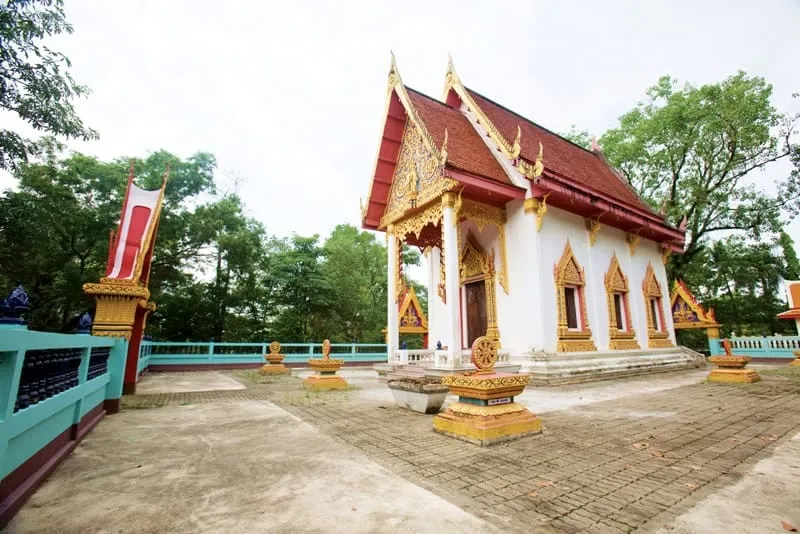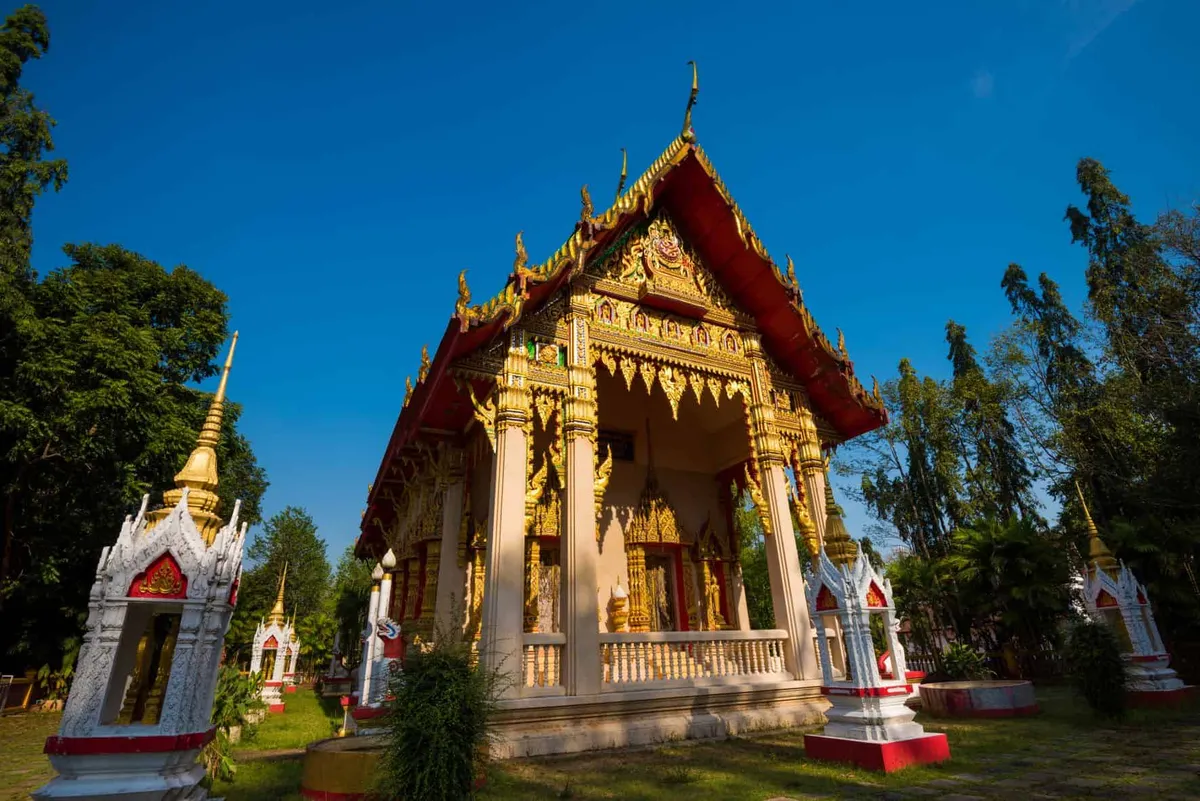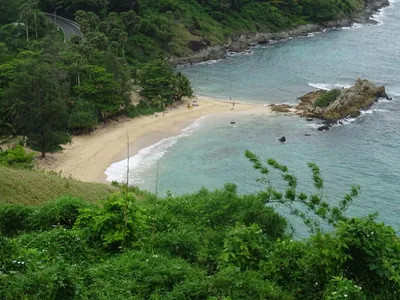






Wat Khiri Wihan climbs a forested ridge in Chamrak subdistrict, just outside Mueang Trat on the road toward the Cambodian border. It holds the rank of Phra Aram Luang — a temple under royal patronage — and its hilltop ordination hall looks out over old-growth forest toward the Gulf of Thailand. Entry is free, and the grounds are open daily from roughly 08:00 to 17:00.
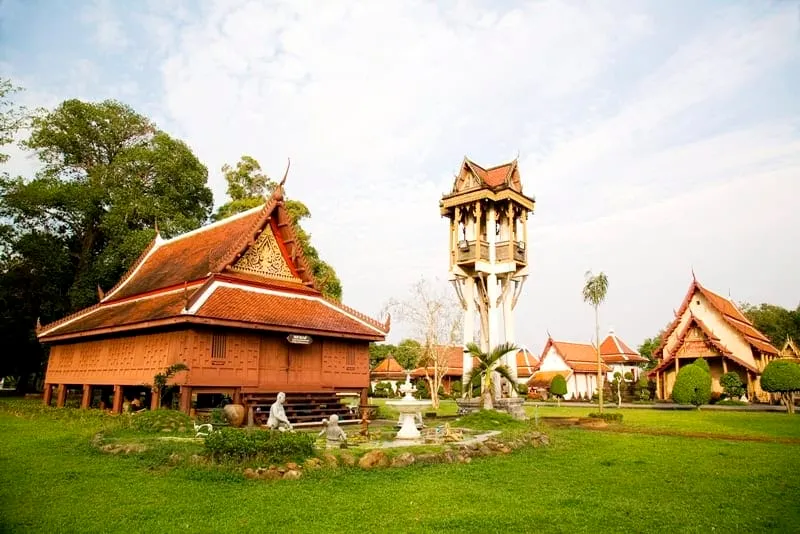
Founded in 1886 under two earlier names, Wat Tha Luen and Wat Phu Khao Yuan, the temple takes its current name from the hill it sits on (khiri means “hill” in Pali-derived Thai). A staircase cut into the slope leads up through stands of teak and other old-growth trees to the ubosot at the summit; a rear access road serves anyone who’d rather not climb. Two structures anchor the hilltop compound: a two-storey, open-sided bell tower roofed in overlapping bamboo tile, and a white chedi roughly 20 metres tall, built in Rattanakosin style with a bell-shaped dome visible from the coast road below. A short walk away stands a separate viharn with Sino-Vietnamese detailing — gilded wooden doors, a two-tier roof with upturned eaves — enshrining a Guanyin (Avalokitesvara) statue and a seated Phra Sangkajai figure alongside the temple’s principal Buddha image, Phra Phuttha Udom Sombun. A reception hall in the lower grounds was built for a royal visit by Princess Sirindhorn, a detail the temple’s understated signage doesn’t make much of.
Insider Tip: Go before 9 AM. The staircase has no shade for the first stretch, and the hilltop stonework holds heat fast once the sun clears the treeline — mornings are markedly cooler and the light through the old trees is better for photos.
Morning is when the hill earns its keep. Mist tends to sit in the valley below, the bell tower catches the first light, and the walk up through teak canopy stays noticeably cooler than an afternoon visit. Local devotees come to make merit at the viharn shrines and light incense near the chedi rather than crowd the summit ubosot, so the two halves of the temple have distinctly different rhythms — quiet devotional traffic below, near-silence up top outside of festival days. Watch out: the staircase has uneven, worn steps in places, and there’s minimal handrail; take it slowly if you’re carrying camera gear or visiting with older relatives.
- Entry: Free for everyone, no ticket required
- Hours: Daily, roughly 08:00-17:00
- Getting there: On Trat-Khlong Yai Road (the coast road toward Hat Lek and the Cambodian border), a short drive or songthaew ride from Mueang Trat
- Dress code: Covered shoulders and knees for the ubosot and viharn; remove shoes before entering either building
- Time needed: 30-45 minutes for the hilltop buildings and viharn
The temple sits directly on Trat-Khlong Yai Road, so it’s an easy stop by car, motorbike, or a Hat Lek-bound songthaew rather than a dedicated trip. Dress modestly — covered shoulders and knees — and expect to remove your shoes at both the ubosot and the viharn. There’s no restaurant on site, so bring water for the climb; the nearest food stalls are back toward central Trat. Wat Khiri Wihan works well paired with Trat’s other temples or as a short detour on the way to the Hat Lek border crossing, rather than as a full-day destination on its own.
Trat’s temple circuit continues at Wat Bubpharam and Wat Plai Khlong and at Wat Saphan Hin, both a short drive from here. For the wider area, the Trat destination guide covers where to stay and what else to see along the coast.
Location & Directions
Trat-Khlong Yai Road
Trat, Thailand
Show your taxi or Grab driver
วัดคีรีวิหาร
Frequently Asked Questions
Is Wat Khiri Wihan free to visit?
Why is it called a royal temple?
Do you have to climb to see the temple?
What's inside the Chinese-style viharn?
Can you actually see Koh Chang from the hill?
Spotted something out of date or incorrect? Let us know
Popular tours in Trat

Stay Near Wat Khiri Wihan
Live prices for places closest to Wat Khiri Wihan — tap a pin to compare.