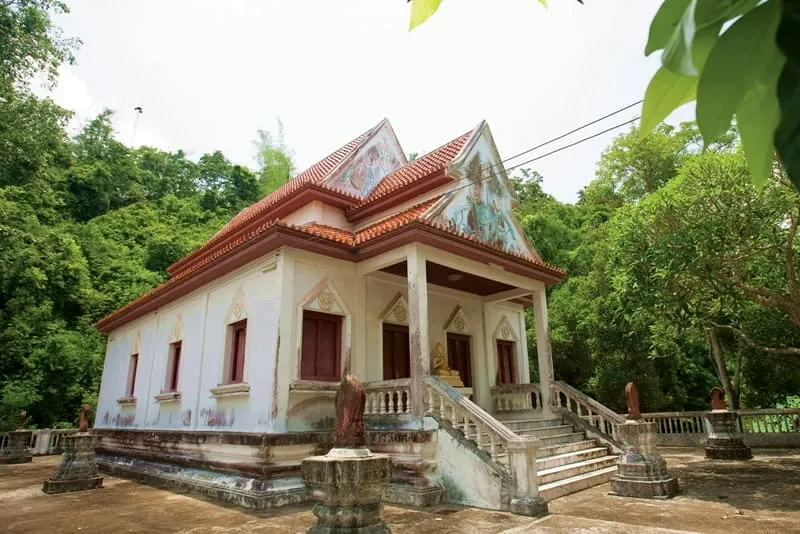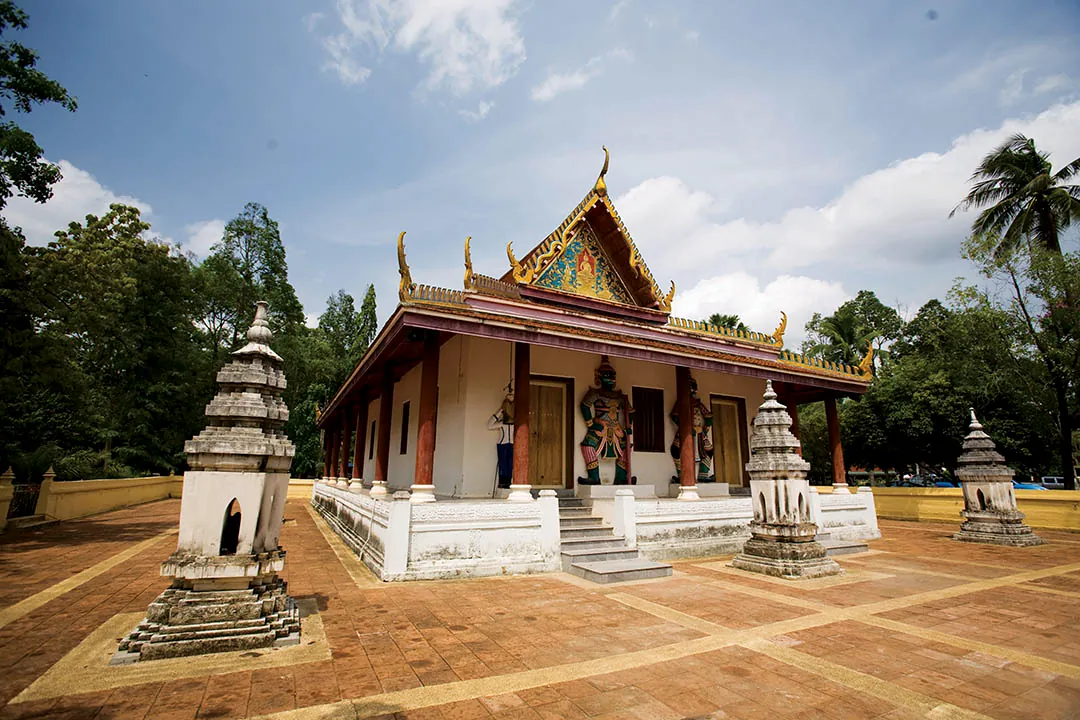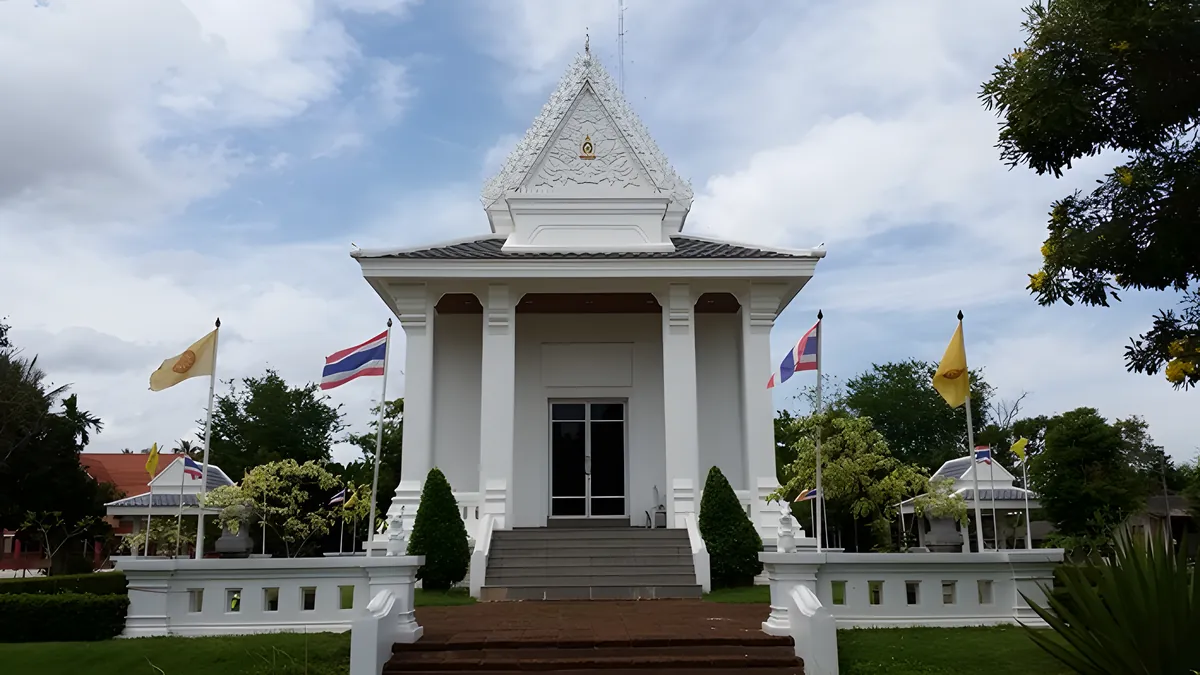

Wat Phra Borommathat Chaiya Ratchaworawihan
วัดพระบรมธาตุไชยาราชวรวิหาร
The chedi at Wat Phra Borommathat Chaiya Ratchaworawihan dates to the late 8th or early 9th century CE, built when Chaiya was a prosperous regional centre of the Srivijaya maritime empire. It’s regarded as the most completely preserved Srivijayan structure left standing in Thailand, the reason this small district temple in Chaiya, Surat Thani, ranks alongside Nakhon Si Thammarat’s Wat Phra Mahathat as one of southern Thailand’s most important Buddhist relic sites. Entry is free, open daily 07:00-17:00.
The chedi itself rises about 24 metres from a cruciform base with four porticoes, its lower tiers square and decorated with pilasters and lotus motifs before stepping up into an octagonal plan and finally a bell-shaped stupa spire, a design that owes as much to Javanese temple building as to anything typically Thai. Six smaller companion stupas sit on hexagonal bases around the main tower, each topped with miniature round stupas at every tier. The whole structure is brick bonded with a vegetable-based mortar rather than modern cement, which is part of why conservators handle restoration so carefully. Major restoration passes came in the early 20th century and again in the 1970s, adding the gold leaf and multi-tiered umbrella finial visible today without altering the underlying Srivijayan form.
Srivijaya’s influence here faded after Chola naval raids around 1025 CE, and by the 13th century the site had passed into Theravada practice under the Tambralinga kingdom based in what’s now Nakhon Si Thammarat, the same lineage that shaped the Mahathat chedi there. What survives today is a working temple, not a ruin: monks live on the grounds, locals circle the chedi to make merit, and the courtyard still smells of incense from active shrines rather than feeling like an open-air museum.
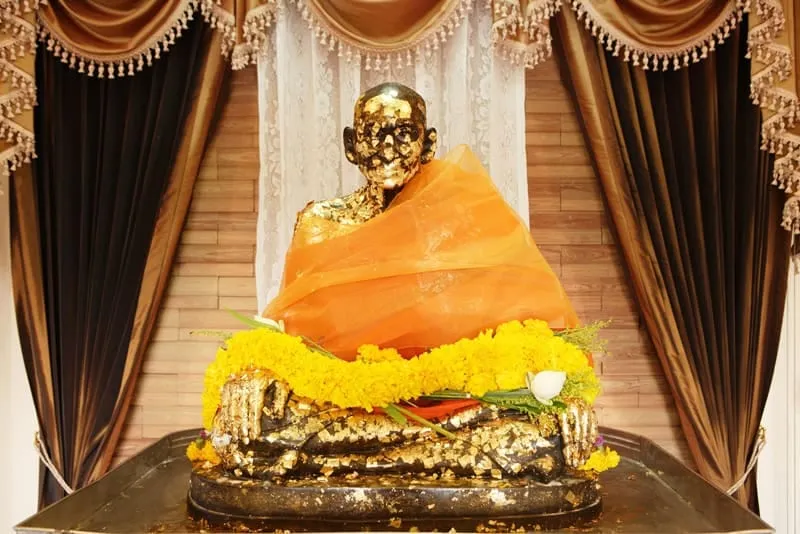
Insider Tip: The Chaiya National Museum sits inside the temple compound, founded in 1935 by the monk Phra Kru Sophon Jitsikaram (originally under the name Surat Thani National Museum) to house bronze Buddha images, stone inscriptions, and ceramics recovered from digs around Chaiya. It’s a separate ticketed building from the free temple grounds, but worth the short stop if you want context for what you’ve just walked around.
Chaiya’s importance in this period wasn’t purely religious. As a Srivijaya-era port town, it sat on maritime trade routes linking India, mainland Southeast Asia, and China, and the chedi’s mixed Mahayana Buddhist and Hindu decorative elements reflect that cosmopolitan trade culture rather than a single imported style. That’s also why the site draws a different crowd than most Thai temples: as many archaeology-minded visitors and art historians as pilgrims making merit, even though the working shrine areas keep it a living temple rather than a museum piece behind glass.
Watch out: Photography of the chedi itself is fine, but keep a respectful distance and lower voices near the active shrine areas where locals are making offerings: this is a functioning place of worship, not a static ruin.
Chaiya town itself is compact and walkable from the temple. Around 4 km northeast is Suan Mokkhaphalaram (Suan Mokkh), the forest monastery founded in 1932 by Buddhadasa Bhikkhu, one of modern Thailand’s most influential Buddhist teachers. Many visitors pair the two sites on the same day trip out from Surat Thani, about 50 km southeast. Dress modestly (covered shoulders, long trousers) for both.
- Entry fee: Free (Chaiya National Museum on-site is separately ticketed)
- Hours: Daily 07:00-17:00
- Chedi age: Late 8th-early 9th century CE, Srivijaya period
- Chedi height: Approximately 24 metres
- Getting there: ~50 km northwest of Surat Thani city by bus or minivan
Location & Directions
50 Mu 3, Rak Norakit Road
Surat Thani, Thailand
Show your taxi or Grab driver
วัดพระบรมธาตุไชยาราชวรวิหาร
Frequently Asked Questions
How old is the chedi at Wat Phra Borommathat Chaiya?
Is Wat Phra Borommathat Chaiya free to enter?
How tall is the chedi?
What's nearby worth combining with a visit?
How do I get to Wat Phra Borommathat Chaiya from Surat Thani?
Spotted something out of date or incorrect? Let us know
Tours visiting Wat Phra Borommathat Chaiya Ratchaworawihan



Stay Near Wat Phra Borommathat Chaiya Ratchaworawihan
Live prices for places closest to Wat Phra Borommathat Chaiya Ratchaworawihan: tap a pin to compare.