




Wat Phrabarommathat Sawi centres on a bell-shaped chedi that’s been a registered national ancient monument since 2001 — a rare piece of pre-Bangkok southern Thai architecture, not a hilltop viewpoint or coastal landmark. The temple was founded in 1782 in Sawi subdistrict, and entry is free.
Local tradition explains the chedi’s origin: soldiers under King Sri Thammasokarat came across a ruined brick mound with crows perched on it, and digging into it uncovered a chedi’s foundation along with an urn holding a Buddha relic. The king ordered the chedi rebuilt over the find. Whatever the legend’s exact accuracy, the structure itself is real and well documented — a bell-shaped stupa set on a two-tier square base roughly 8.5 metres wide at the bottom, decorated with niches alternating elephant-head figures and yaksha (giant) figures holding clubs, ringed by six cast pillars. The design closely follows the Phra Borommathat chedi in Nakhon Si Thammarat, one of the defining templates for southern Thai stupas, and is presumed to date from the Ayutthaya period. The Fine Arts Department carried out the most recent major restoration in 1996.
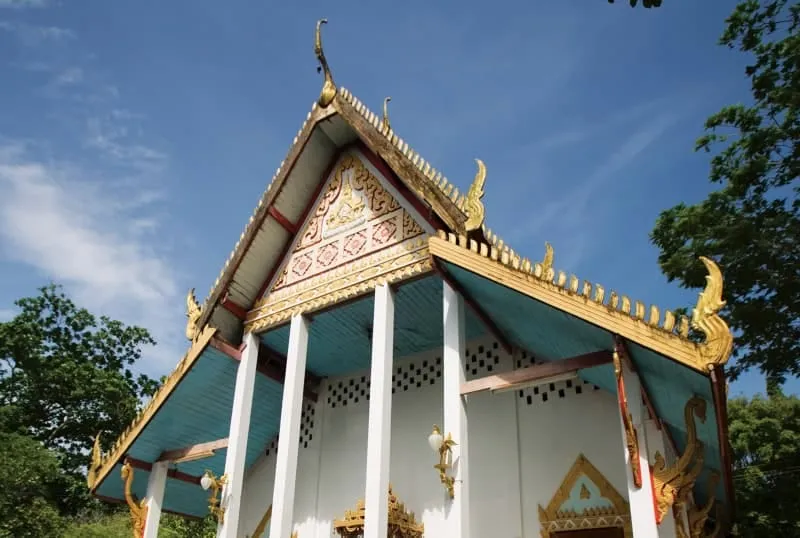
The temple functions as a working monastery around the chedi — an ordination hall, monks’ quarters, the usual smaller shrines — but the chedi itself, not the grounds, is the reason to stop here. It sits in flat countryside typical of Sawi district, well south of Chumphon’s town centre but nowhere near the Kraburi River or the Myanmar border, both of which lie much further south.
The elephant-head and yaksha niches around the base reward a slow circuit on foot — each pair alternates around the structure, a decorative rhythm shared with several other southern Thai chedis from the same design lineage. Because the site sees relatively few visitors compared with Nakhon Si Thammarat’s original, you can generally walk the full circumference without waiting for a gap in a tour group, which is rare for a national monument of this significance.
Watch out: A few older travel write-ups place this temple near the Kraburi estuary — that’s a different part of the province entirely. If you’re navigating by landmark rather than GPS, confirm you’re headed to Sawi subdistrict, not Kraburi district in neighbouring Ranong.
Visit in the morning if you want cooler temperatures and a chance to see monks going about routine duties; the site has little tree cover, so midday sun is intense. Dress modestly and remove shoes before entering any building. The temple is roughly 30-40 minutes from central Chumphon town by car or local transport.
- Entry fee: Free
- Hours: Approximately 09:00-17:00 daily
- Founded: 1782; registered national ancient monument 21 December 2001
- Style: Bell-shaped chedi on a two-tier base, modelled on Nakhon Si Thammarat’s Phra Borommathat
- Location: Sawi subdistrict, Sawi district — not near the Myanmar border
Location & Directions
Sawi, Chumphon
Chumphon, Thailand
Show your taxi or Grab driver
วัดพระบรมธาตุสวี
Frequently Asked Questions
Is Wat Phrabarommathat Sawi free to visit?
How old is the chedi?
What's the legend behind the temple's name?
Is this connected to the famous Phra Borommathat in Nakhon Si Thammarat?
How do I get to Wat Phrabarommathat Sawi?
Spotted something out of date or incorrect? Let us know
Stay Near Wat Phrabarommathat Sawi
Live prices for places closest to Wat Phrabarommathat Sawi — tap a pin to compare.