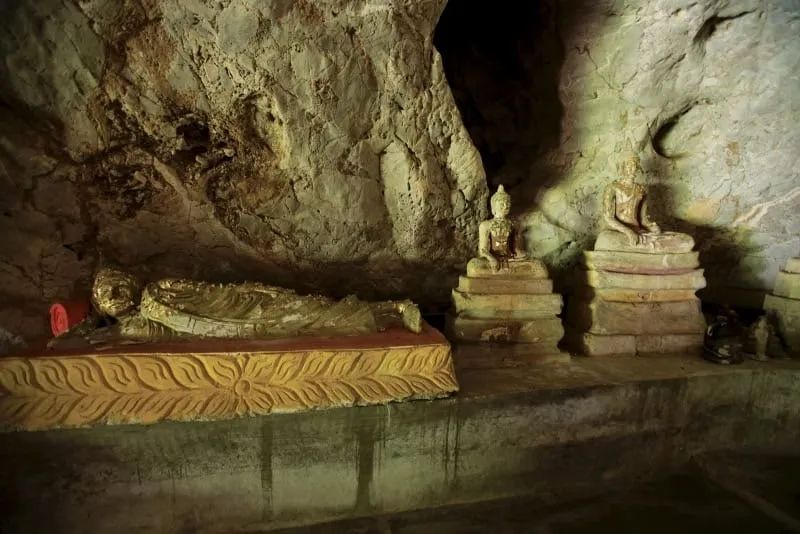
Wat Thum Kwan Meung sits inside a limestone outcrop in Sawi district, Chumphon — a single cave chamber on the temple’s eastern side, not a network of chambers, holds the site’s three founding Buddha images: a 1.66-metre metal figure in the Subduing Mara pose, a carved wooden standing Buddha, and a smaller brass image around 1.15 metres tall in the Restraining Relatives pose. All three predate the temple’s official registration in 1906. Entry is free.
Land for the temple was donated by a local kamnan, Khun Phrom Kaew Thongkham, and village elder Phrayai Sorn Janchaew, and the cave had already served as a dwelling for wandering monks and novices before the site was formally recognised. In 1967, under pioneering teacher Phra Khru Phavana Phirom (Luang Por Suang Parisutho), the temple became a kammathana (meditation-practice) monastery — the National Office of Buddhism later designated it Chumphon’s first official provincial meditation centre, and it has run training for monks, officials and the public ever since. The temple is affiliated with the Dhammayut order.
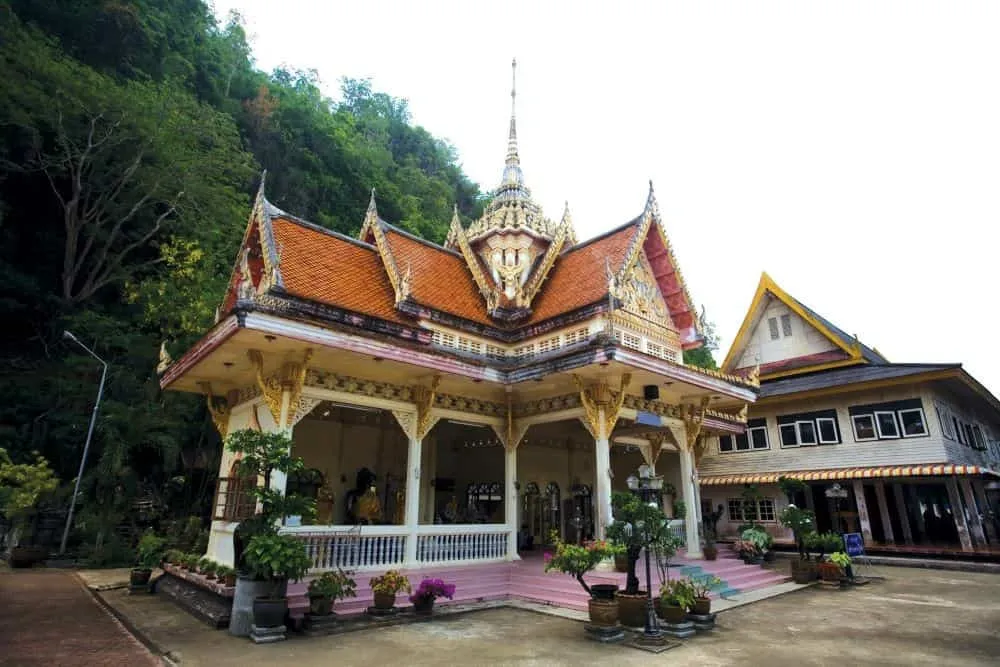
Inside the cave, the air stays noticeably cooler than the tropical heat outside, and the three Buddha images sit lit by whatever daylight filters through the entrance and by electric lamps deeper in. Outside, the temple grounds are modest — a scatter of monastic buildings and shaded walking paths rather than a sprawling complex — reflecting the site’s identity as a working practice monastery rather than a tourist temple. Visits tend to be quiet: this isn’t a stop with tour buses or souvenir stalls, and the atmosphere is set by resident monks going about ordinary duties rather than any staged spectacle.
Insider Tip: Because this is an active meditation centre, mornings before 9am are the best time to see monks in the cave without disturbing practice sessions — afternoons can be quiet to the point of feeling closed, even though the temple is open.
Watch out: There’s no printed dress code posted on site, but treat it like any working Thai temple — cover shoulders and knees, and remove your shoes before stepping into the cave shrine.
Getting there means driving into Sawi district on local roads off Highway 41; there’s no direct public transport to the temple gate, so a rental car, motorbike, or a taxi arranged from Chumphon town is the practical option. Sawi’s rainy season runs with the rest of the Gulf coast — heaviest roughly October to December — so a poncho or umbrella is worth carrying outside the cool season.
- Entry fee: Free
- Founded: Registered as a temple in 1906; meditation-practice centre since 1967
- Inside the cave: Three Buddha images (1.66m metal, wooden standing figure, ~1.15m brass)
- Affiliation: Dhammayut order; Chumphon’s first official provincial meditation centre
- Getting there: Local roads off Highway 41 in Sawi district — no direct public transport
Location & Directions
Sawi, Chumphon
Chumphon, Thailand
Show your taxi or Grab driver
วัดถ้ำขวัญเมือง
Frequently Asked Questions
Is Wat Thum Kwan Meung free to enter?
What's inside the cave?
Is this a meditation retreat centre?
How do I get to Wat Thum Kwan Meung?
What's the best time to visit?
Spotted something out of date or incorrect? Let us know
Stay Near Wat Thum Kwan Meung
Live prices for places closest to Wat Thum Kwan Meung — tap a pin to compare.