



You can eat pad thai at home from a jar. What you can’t replicate is a Thai grandmother showing you how to pound a curry paste from scratch, or the moment you realise green curry is actually easy once someone walks you through it. A cooking class is one of the few tourist activities in Thailand that gives you something genuinely useful to take home.
Most classes run half a day. You’ll learn 3-5 dishes and usually receive recipes to use at home. Some sessions include a market visit, while others start at the school. The food you cook is your lunch or dinner. It’s good value and works even if you’re not an experienced cook.
This guide covers the schools worth booking in Bangkok, Chiang Mai, Phuket, and the islands, plus honest notes on which ones are overrated.
Quick answer
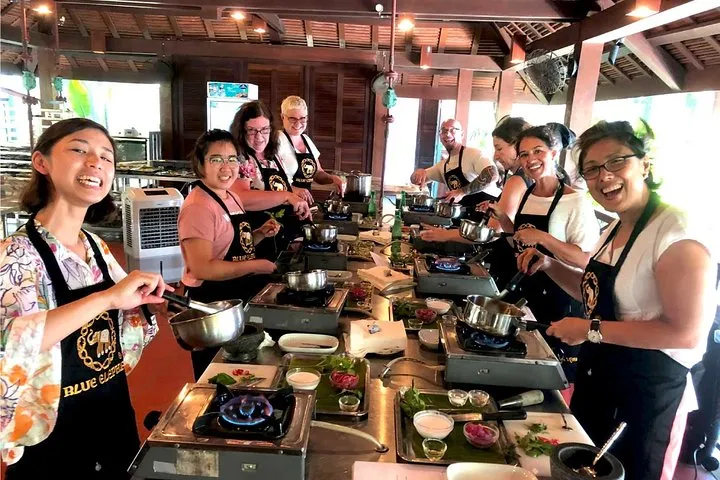
Chiang Mai is the cooking-class capital, with Asia Scenic, Zabb E Lee and Thai Farm Cooking School at roughly 1,000-1,500 THB against 1,500-3,500 THB in Bangkok. In Bangkok, Silom Thai Cooking School (1,200 THB, market tour in the morning) is the hands-on pick and Blue Elephant the upscale one.
How we picked these options
The classes here are the ones this guide describes in detail, compared on market-tour inclusion, dish count and variety, class size, setting and dietary flexibility. Menus and schedules rotate. Confirm the day’s dishes and pickup arrangements when you book.
Bangkok Cooking Classes
Bangkok has plenty of cooking schools, but the quality varies. Some are genuine teaching kitchens; others are conveyor belts running three groups a day through the same script. Here are the ones that actually deliver. If you’d rather book online with free cancellation, the market tour and cooking class with Aoy folds a longtail boat ride into the market run.
Silom Thai Cooking School
Silom Thai Cooking School runs small, hands-on classes with individual cooking work. The morning session includes a local market tour; afternoon and evening sessions cover ingredients at the school instead. Students prepare a five-course meal, and classes are capped at 9-10 people.
Cost: 1,200 THB per person at the time of review. Duration: About 3-3.5 hours. Book: Direct with the school and confirm the current session details.
Maliwan Thai Cooking Class
Smaller operation, maximum 8-10 students per class. More hands-on time than the bigger schools: you’re doing everything yourself rather than watching a demo and replicating it. The instructor adjusts spice levels to your preference as you go. Good for people who actually want to improve their cooking rather than just tick a box.
Cost: Around 1,500 THB. Duration: About 4 hours.
Blue Elephant Cooking School
This is the upscale option, set in a colonial-era building on Sathorn Road, attached to the Blue Elephant restaurant. The kitchen is well-equipped, the ingredients are premium, and the recipes lean more refined than street-food. You’ll cook dishes like massaman curry and pomelo salad. It feels more like a culinary workshop than a backpacker activity.
The downside: it’s significantly more expensive and the atmosphere is more polished than personal. If you want the raw, market-stall-to-kitchen experience, this isn’t it.
Cost: Standard classes are 2,800 THB plus service charge and VAT, or 3,296 THB net, at the time of review. Duration: About 3.5-4 hours. Includes: Market visit with the morning session.
Baipai Thai Cooking School
This school is outside central Bangkok in a residential neighbourhood with a garden setting. The journey there, about 30 minutes by taxi from Sukhumvit, filters out the crowds, so classes are quieter. Expect good instruction, solid facilities, and a more relaxed pace than the downtown schools.
Cost: Around 2,200 THB. Duration: Half day.
Chiang Mai: Thailand’s Cooking Class Capital
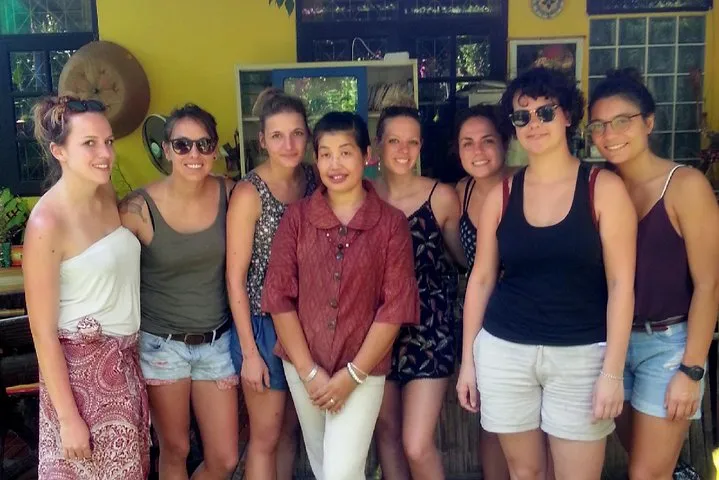
Chiang Mai has a large choice of cooking schools, including several set on organic farms outside the city. Prices are often lower than in Bangkok, and the farm settings make it a useful choice if a cooking class is a priority for your trip.
Asia Scenic Thai Cooking School
It’s the safe default if you want a polished, well-run class in the city centre. Morning sessions start with a walk to a local market, then you cook a menu you pick yourself, with a small kitchen garden on site showing the herbs growing. It runs like clockwork; the trade-off for that volume is that it feels a little less intimate than the smaller farm schools. There’s also a full-day option at their farm outside town.
Cost: Around 1,000-1,200 THB half day, a little more for the farm day. Duration: Half or full day. Book: Direct via their website.
Zabb E Lee Thai Cooking School
Run by “Anne” on lush grounds with bamboo salas, rice fields and a lake about 20 minutes from the Old Town. Smaller groups mean more one-on-one time than the big city schools, and the setting is the draw: you cook in the open air looking over the paddies. A market visit is included.
Cost: Around 1,000-1,200 THB. Duration: Half day, full-day options available. Book: Direct.
Thai Farm Cooking School
A full-day class on an organic farm about 30 minutes outside the city. You start at a market in town, then drive to the farm where ingredients are growing right there: you’ll pick herbs and vegetables yourself. The setting is open-air under a thatched roof surrounded by rice paddies. You cook 5-6 dishes plus a dessert.
This is the one most people rave about, and it lives up to it. The farm context means you understand where ingredients come from, not just how to cook them.
Cost: Around 1,500 THB for the full day (still excellent value). Duration: 8-9 hours including transport. Book: Their website. Book at least 2-3 days ahead in high season.
Mama Noi Thai Cookery School
Mama Noi is a purpose-built cooking school on six acres of organic gardens rather than a class in the instructor’s home. Classes have a maximum of ten students and include transport, a market tour, a garden walk and individual cooking stations. Tell the school about dietary restrictions when booking.
Cost: Around 1,000-1,200 THB. Duration: Half day.
Why Chiang Mai Dominates
- Price: Classes run 1,000-1,500 THB vs 1,500-3,500 THB in Bangkok
- Farm settings: Multiple schools operate on working farms, a format that doesn’t exist in Bangkok. The cooking class with farm visit is the bookable-online version
- Weather: Northern Thailand is cooler, especially November-February, making outdoor cooking comfortable
- Variety: A broad mix of city kitchens and farm-based schools
- Full-day options: Many Chiang Mai schools run 7-9 hour full-day classes that cover more dishes at barely higher prices than a Bangkok half-day
Booking Tips for Chiang Mai
Platforms like Cookly and Viator aggregate multiple schools and let you compare schedules and reviews. Booking direct is usually the same price or cheaper. Avoid schools that run more than 2 sessions per day; that’s a volume operation and the instruction suffers.
Phuket Cooking Classes
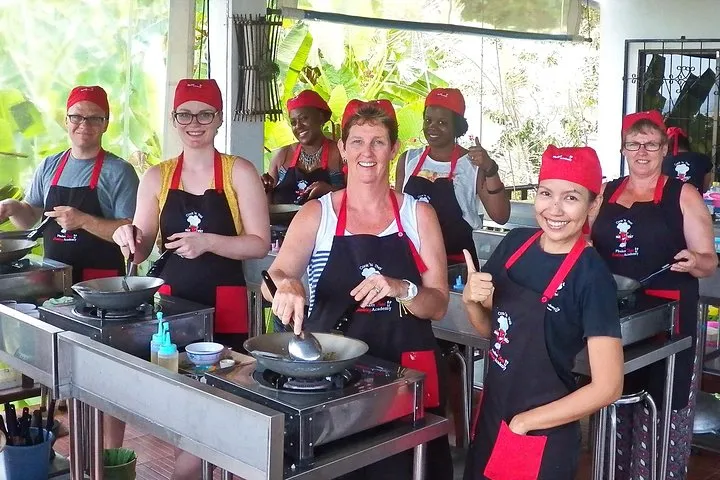
Phuket cooking classes tend to lean into southern Thai cuisine, which is distinct from what you’ll learn in Bangkok or Chiang Mai. Southern curries are spicier, use more turmeric, and rely heavily on seafood. If you’ve only cooked central Thai food before, a Phuket class adds real variety to your recipe collection. One option is the choose-your-own-dishes class with market tour.
Phuket Thai Cooking Academy
This hands-on school lets students choose four dishes and includes individual cooking stations, hotel pickup in covered areas and a local market tour with both morning and afternoon classes. Check the menu before booking if you specifically want southern dishes.
Cost: 2,300 THB at the time of review. Duration: About 3.5 hours.
Blue Elephant Phuket
The Phuket branch of Blue Elephant operates from a Sino-Portuguese mansion in Old Town. Similar premium format to the Bangkok school: well-produced, clean kitchen, refined recipes. Good if you’re staying in Phuket Town, but the same caveat applies: it’s pricier and less personal than smaller schools.
Cost: Standard classes are 2,800 THB plus service charge and VAT, or 3,296 THB net, at the time of review. Duration: About 3.5-4 hours.
Southern vs Central Thai Cooking
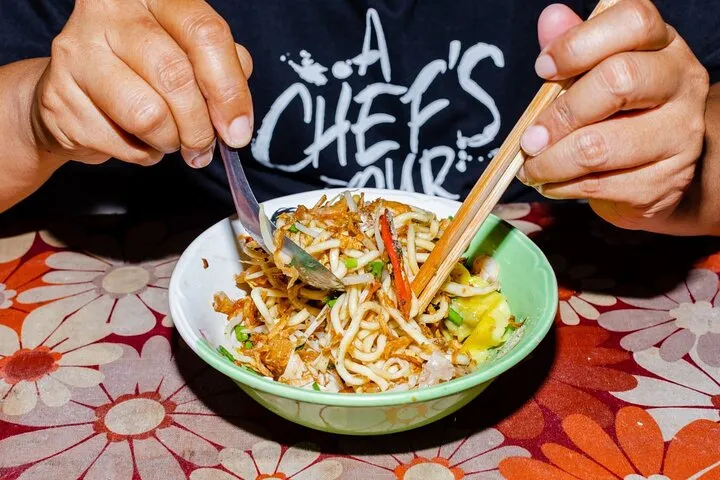
Most cooking classes in Thailand teach central Thai dishes: green curry, pad thai, tom yum. In Phuket, look specifically for classes that include southern specialties:
- Gaeng som: sour curry with fish, sharper than tom yum
- Massaman curry: technically southern, richer and nuttier than green curry
- Khua kling: dry-fried curry mince, seriously spicy
- Sataw (stink beans): a southern staple, polarising but worth trying
Island Cooking Classes
Koh Samui
Koh Samui has established cooking schools plus smaller classes run by resorts and independent instructors. Samui Institute of Thai Culinary Arts, commonly shortened to SITCA, is one of the longer-running names; the class with local market tour caps groups at six.
Cost: 1,500-2,000 THB. Some resort classes charge more but aren’t necessarily better.
Koh Phangan & Koh Lanta
On smaller islands, cooking classes are typically informal: a local cook, a handful of students, whatever’s fresh at the market that day. Less polished, more spontaneous. You might learn dishes that aren’t on any restaurant menu. These are often booked through your accommodation or found on a handwritten sign by the road.
Cost: 800-1,500 THB. Duration: 2-4 hours.
The trade-off: island classes rarely include market visits (markets are smaller and further away), and instruction quality varies widely. Ask other travellers at your hostel or guesthouse for recent recommendations rather than relying on old reviews.
Price Comparison
| Location | Typical Cost (THB) | Duration | Market Visit | Class Size |
|---|---|---|---|---|
| Chiang Mai (farm) | 1,000-1,500 | Full day | Yes | 8-14 |
| Chiang Mai (city) | 1,000-1,300 | Half day | Usually | 8-12 |
| Bangkok (mid-range) | 1,500-2,000 | Half day | Morning only | 10-14 |
| Bangkok (upscale) | 2,800-3,800 | Half day | Some | 8-12 |
| Phuket | 1,500-2,500 | Half day | Morning only | 10-12 |
| Koh Samui | 1,500-2,000 | Half day | Rarely | 6-10 |
| Smaller islands | 800-1,500 | 2-4 hours | No | 4-8 |
How to Choose the Right Class
- Morning classes include market tours, worth it for the education alone
- Private classes cost roughly double but let you choose exactly what to cook
- Most schools handle vegetarian/vegan requests without fuss
- Half-day classes teach 3-5 dishes; full-day classes teach 5-7 plus dessert
- Book direct for the best price; aggregator platforms charge the same or add a small markup
Budget: Under 1,500 THB → Chiang Mai. Under 2,000 THB → Bangkok mid-range or Phuket. Over 2,500 THB → Blue Elephant or private classes.
Group size: If you want personal attention, look for schools capping at 8-10 people. Anything over 14 starts to feel like a production line.
Market visit: Always choose the option with a market tour if one is available. You learn more about Thai ingredients in 45 minutes at a market than in hours of reading recipes.
Dietary needs: Tell the school about every allergy or dietary restriction before booking. Gluten can appear in sauces, stock and prepared curry pastes, while nuts, shellfish and other allergens vary by dish. Ask how the school handles substitutions and cross-contact rather than assuming a class can adapt safely on the day.
Cuisine type: Want classic central Thai? Bangkok or Chiang Mai. Want southern Thai? Phuket. Want a relaxed island experience? Koh Samui or Koh Lanta.
What You’ll Actually Cook
A typical class lets you pick one dish from each category:
- Curry: Green, red, massaman, or panang. You’ll pound the paste by hand in a mortar and pestle
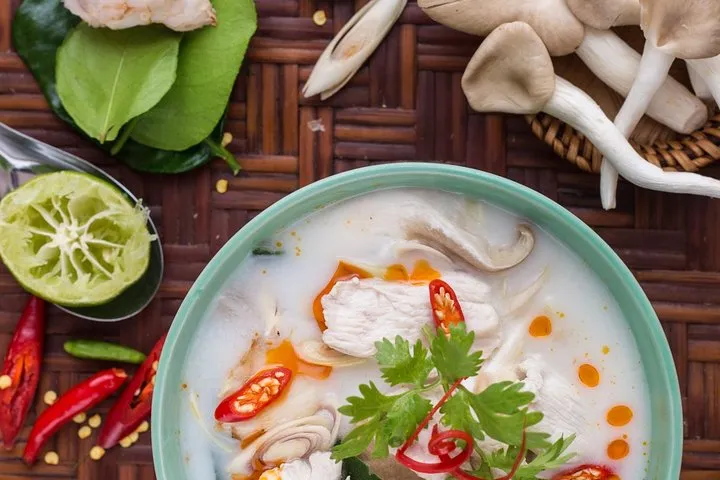
- Soup: Tom yum or tom kha
- Stir-fry: Pad thai, pad kra pao (holy basil stir-fry), or cashew chicken
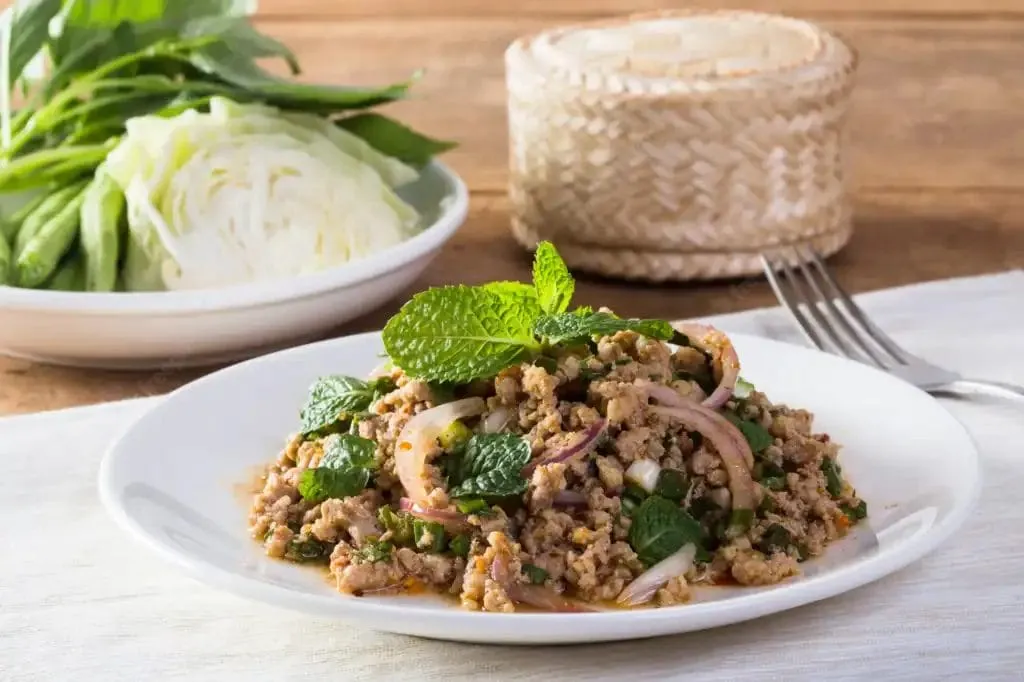
- Salad: Som tam (papaya salad) or larb
- Dessert: Mango sticky rice or coconut milk desserts (seasonal)
The curry paste is the highlight. It takes 15-20 minutes of pounding, your arm will ache, and the difference between fresh paste and the stuff in a tin is massive. This alone justifies the class.
Dishes worth requesting if you get a choice: pad kra pao (the most-eaten dish in Thailand, rarely taught well outside the country), tom kha gai (coconut soup, subtler than tom yum and harder to replicate at home), and som tam (once you learn the technique, you’ll make it weekly).
For more on what to eat across the country, see our guide to popular Thai dishes.
Practical Booking Tips
When to book: 2-3 days ahead in high season (November-February), especially Chiang Mai. Low season you can often book the day before.
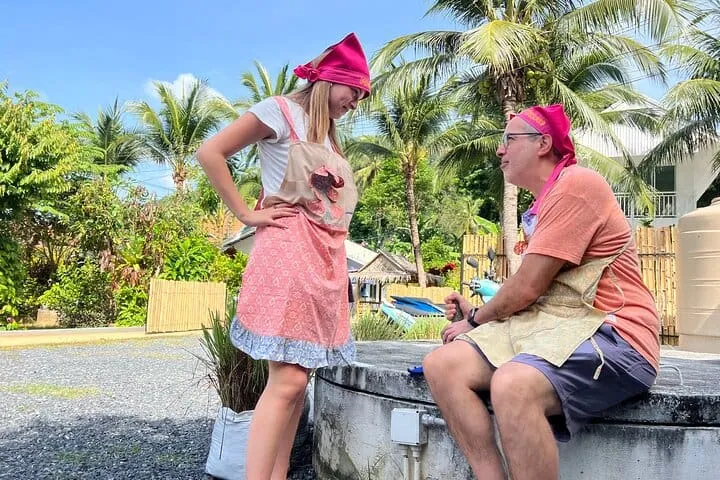
What to wear: Closed-toe shoes (some schools require it), comfortable clothes you don’t mind getting splashed with curry paste. Schools provide aprons.
What’s included: All ingredients, recipes to take home, the meal you cook, water and sometimes a welcome drink. Some include transport.
How to get there: Bangkok schools are near BTS stations. Chiang Mai farm schools provide hotel pickup. Phuket schools are usually in Phuket Town. Factor in travel time: a farm class 30 minutes outside the city needs transport both ways.
Children: Most schools accept kids aged 6+ and some offer family-specific sessions. Check when booking.
If you’re planning your route between cities, our getting around Thailand guide covers the transport options.
How to choose the right option
Choose by what you want handled for you: transport, timing, equipment, safety, or local context. The cheapest option is not always the best value if it leaves the hard logistics to you.