



Phra Prathon Chedi
พระประโทณเจดีย์
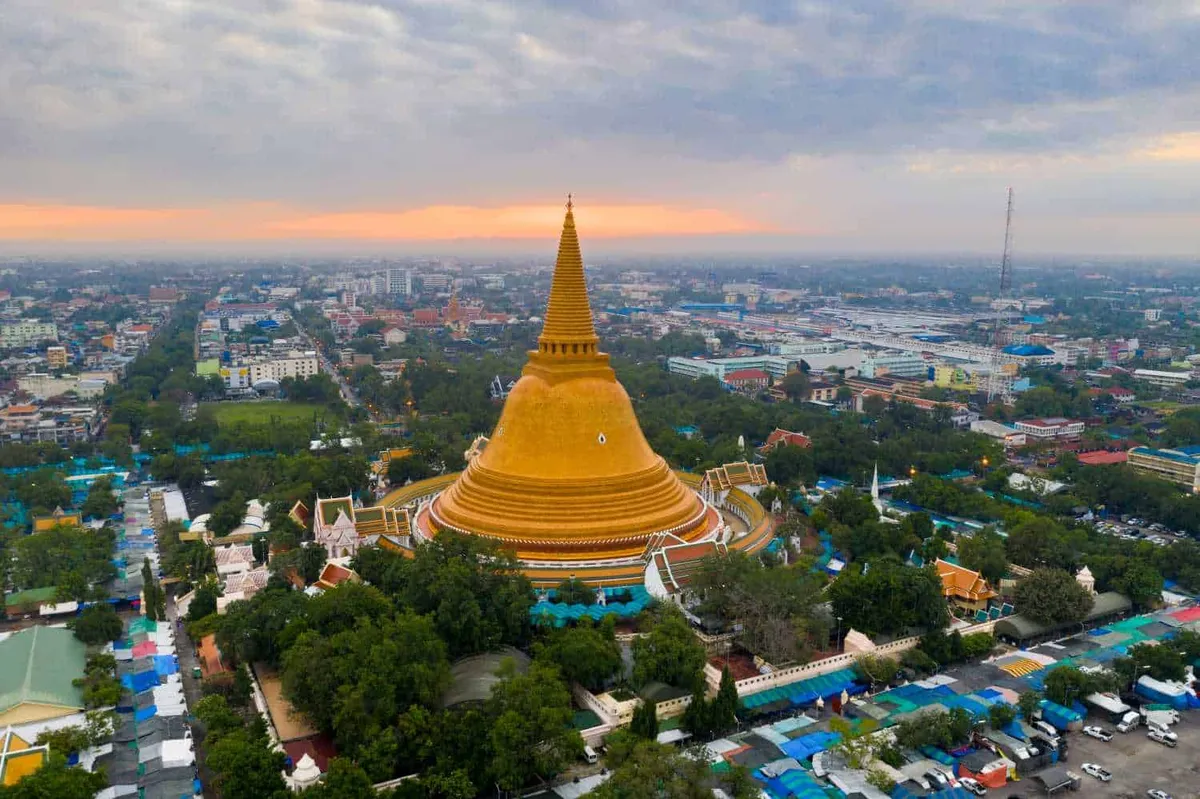
Wat Phra Prathon Chedi Worawihan sits on the site of what archaeologists believe was the centre of ancient Nakhon Chai Si, the Dvaravati-period settlement that once occupied present-day Nakhon Pathom. It should not be confused with Phra Pathom Chedi, the far larger and more famous stupa roughly three kilometres to the west — the two share almost identical names in English but are separate monuments with separate histories.
Archaeological surveys date the original stupa to the Dvaravati period, roughly the 6th to 8th centuries CE, when Nakhon Pathom was among the largest Dvaravati settlements in the region. The structure was rebuilt in brick using the multi-tiered Dvaravati style, later modified with a Khmer-influenced prang during the period of Khmer control over the area, and restored again under King Mongkut (Rama IV) in the 19th century — the form visible on-site today reflects that later restoration rather than the original 6th-century build.
The base of the chedi carries carved brick and stucco decoration from its various restoration phases, and the temple grounds around it function as an active monastery — monks conduct chanting and morning ceremonies, and Thai visitors walk clockwise around the chedi’s base as an act of merit-making (circumambulation). Because it sits within Wat Phra Prathon Chedi Worawihan rather than as a standalone monument, expect the everyday rhythm of a working temple: incense stalls, a viharn hall, and monks going about their routine rather than a roped-off historical site.
Insider Tip: If you’re combining this with the far larger Phra Pathom Chedi, visit Phra Prathon Chedi first — it’s quieter and takes 20-30 minutes, so you won’t feel rushed before tackling the bigger site.
Watch out: GPS directions and taxi drivers sometimes default to the more famous Phra Pathom Chedi when you say “Prathon” or “Pathom” — confirm the address (Phra Prathon subdistrict) or share the map link before you set off.
- Free entry; open daily 06:00-18:00
- Dvaravati-era origins (6th-8th centuries CE), restored under King Mongkut
- Located within Wat Phra Prathon Chedi Worawihan, Phra Prathon subdistrict
- Distinct from — and roughly 3 km east of — the much larger Phra Pathom Chedi
- Cover shoulders and knees; remove shoes before entering the viharn
Getting There
Phra Prathon Chedi is located at Moo 1, Phra Prathon subdistrict, Nakhon Pathom 73000. View on Google Maps. For comparison, the well-known Phra Pathom Chedi sits about three kilometres west, in the town centre.
Location & Directions
Moo 1
Nakhon Pathom, Thailand
Show your taxi or Grab driver
พระประโทณเจดีย์
Within Walking Distance

Frequently Asked Questions
Is Phra Prathon Chedi the same as the famous Phra Pathom Chedi?
Is there an entry fee?
What period does the chedi date from?
What should I wear to visit?
Spotted something out of date or incorrect? Let us know
Stay Near Phra Prathon Chedi
Compare places to stay in Nakhon Pathom, or open the map for options closest to the attraction.