





Phra Wihan Sung (Ho Phra Sung)
พระวิหารสูง (หอพระสูง)
Ho Phra Sung — also known as Phra Wihan Sung — is a brick shrine hall raised on an earthen mound at Sanam Na Mueang, just outside the old city wall of Nakhon Si Thammarat, a few minutes’ walk from the city pillar shrine on Ratchadamnoen Road. The name means “tall hall”: the mound sits roughly 2.1 metres above the surrounding ground, and the structure itself dates to around 1834, built by then-governor Chao Phraya Nakhon (Noi) to lift community morale. Entry is free and the site has no gate or fixed hours — it’s an open monument you can walk through at any daylight time.
The mound has its own backstory, separate from the shrine on top of it. Local tradition holds that it was built up from soil dug out of the city’s defensive canal, used as a cannon platform against Burmese forces during the 1785 Burmese-Siamese war. Once the immediate military threat had passed, the site was repurposed for a Buddha image and given a proper hall — a common pattern in Thai provincial towns where old defensive earthworks became religious ground.
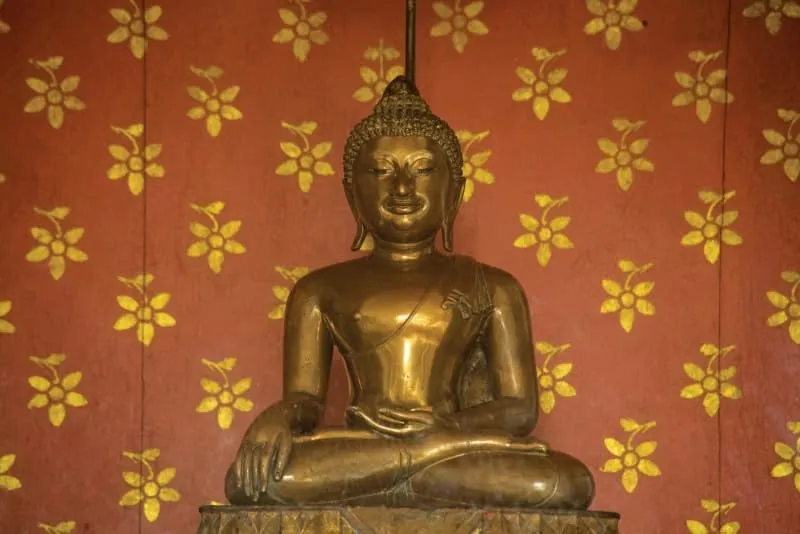
The hall itself measures roughly 5.9 by 13.2 metres and stands about 3.5 metres tall, with plastered brick walls, a tiled roof, and a four-tiered base leading up from the mound. Inside sits a clay-core stucco Buddha image in the Maravijaya (subduing Mara) pose, about 2.4 metres wide and 2.8 metres tall — art historians date it to the late Ayutthaya or early Rattanakosin period based on its style. Some of the site’s original artifacts, including red sandstone Buddha images and carved coral-stone fragments, have since been moved to the National Museum rather than staying on display here, so what you see on-site today is the hall and its central image rather than a full collection.
Insider Tip: Come in the early morning before the heat builds — there’s no shade over the open mound, and the stone stairway up gets uncomfortable by midday. Pair the stop with the nearby city pillar shrine and a short stretch of the old city wall for a compact half-hour loop through Nakhon Si Thammarat’s oldest quarter.
Watch out: This is a bare archaeological site, not a maintained temple complex — there’s no shop, no restroom, and no staff on hand. Bring water if you’re combining it with a longer walk around Sanam Na Mueang.
- Entry fee: Free, no fixed hours
- What it is: Rattanakosin-era shrine hall (built c. 1834) on a raised mound at Sanam Na Mueang
- Protected status: Registered as a national ancient monument by the Fine Arts Department, 1981
- Main Buddha image: Clay-core stucco figure, Maravijaya posture, dated late Ayutthaya-early Rattanakosin
- Location: Ratchadamnoen Road, a few minutes from Nakhon Si Thammarat’s city pillar shrine
Location & Directions
Mueang Nakhon Si Thammarat, Nakhon Si Thammarat
Nakhon Si Thammarat, Thailand
Show your taxi or Grab driver
พระวิหารสูง (หอพระสูง)
Frequently Asked Questions
Is Ho Phra Sung free to visit?
Why is it called "the tall hall"?
How old is the site?
What's the connection to a cannon-mound legend?
Can I combine it with other nearby sights?
Spotted something out of date or incorrect? Let us know
Stay Near Phra Wihan Sung (Ho Phra Sung)
Live prices for places closest to Phra Wihan Sung (Ho Phra Sung) — tap a pin to compare.