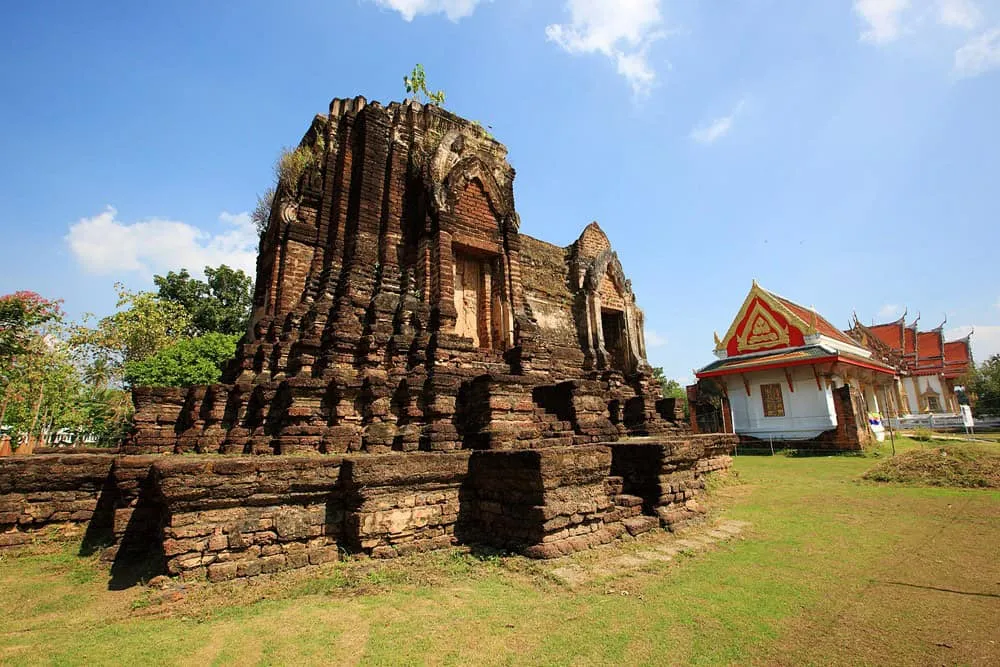


Wat Chedi Thong’s main chedi is the only Sukhothai-era “lotus-bud” style stupa left in Phitsanulok. Every other example of that distinctive tapered, corn-cob-shaped design sits inside Sukhothai itself, which makes this one an architectural outlier worth the short trip. It stands about 1km east of Phitsanulok’s old city walls on the Nan River’s east bank, along Phaya Suea Road. Entry is free and the temple is open daily 06:00-18:00.
The chedi is believed to date from the reign of Maha Thammaracha I (known as Phaya Lithai before he became King of Sukhothai) who governed Phitsanulok as a Sukhothai vassal city in the 14th century. That royal connection explains the architectural style: Phitsanulok’s other historic temples (Wat Yai, Wat Nang Phaya) follow later Ayutthaya conventions, while Wat Chedi Thong’s chedi belongs to an earlier Sukhothai idiom. The Fine Arts Department has restored the structure several times; the base now measures 13.08m across and the chedi rises 22.70m, larger than its estimated original dimensions of roughly 9m and 21m. A mortar viharn about 25m long stands beside it, rebuilt in stages through the Ayutthaya and Bangkok periods.
Because it’s a working temple rather than a roped-off monument, the grounds carry the usual rhythms of Thai temple life: monks chanting morning and evening, the occasional local family lighting incense at the chedi’s base. The site originally had a moat, a layout shared with several Sukhothai temples (Wat Mahathat, Wat Si Chum, Wat Sa Si), though little of the moat survives visibly today.
Insider Tip: Pair this with Phitsanulok’s riverside temple cluster. Wat Chulamani, another temple with genuine Sukhothai-period roots, sits a short ride further south along the same bank, and the two together give a much better sense of Phitsanulok’s pre-Ayutthaya history than the city’s more famous Wat Yai alone.
The temple sees far fewer visitors than Wat Yai’s Phra Buddha Chinnarat, which makes it a useful stop if you want to see genuine Sukhothai-period architecture without the crowds. There’s rarely more than a handful of other visitors at any one time, even during Phitsanulok’s busier weekend periods. Wear comfortable shoes for the uneven brick surfaces around the base of the chedi, and bring water if you’re visiting midday, since shade is limited on the open terrace around the stupa itself. A short walk or bicycle ride from most riverside guesthouses makes it easy to fold into a morning temple loop before the afternoon heat sets in.
- Chedi style: Sukhothai-era lotus-bud (song phum khao bin), the only surviving example in Phitsanulok
- Dimensions: 13.08m base, 22.70m height (post-restoration)
- Believed built: Reign of Maha Thammaracha I (Phaya Lithai), 14th century
- Location: Phaya Suea Road, Nan River east bank, ~1km from the old city walls
- Entry: Free, daily 06:00-18:00
Location & Directions
26/16 Phaya Suea Road
Phitsanulok, Thailand
Show your taxi or Grab driver
วัดเจดีย์ยอดทอง
Frequently Asked Questions
What makes Wat Chedi Thong's chedi unusual?
How old is the chedi?
What are the chedi's dimensions?
Is entry free?
How do you get there from central Phitsanulok?
Spotted something out of date or incorrect? Let us know
Stay Near Wat Chedi Thong
Live prices for places closest to Wat Chedi Thong: tap a pin to compare.