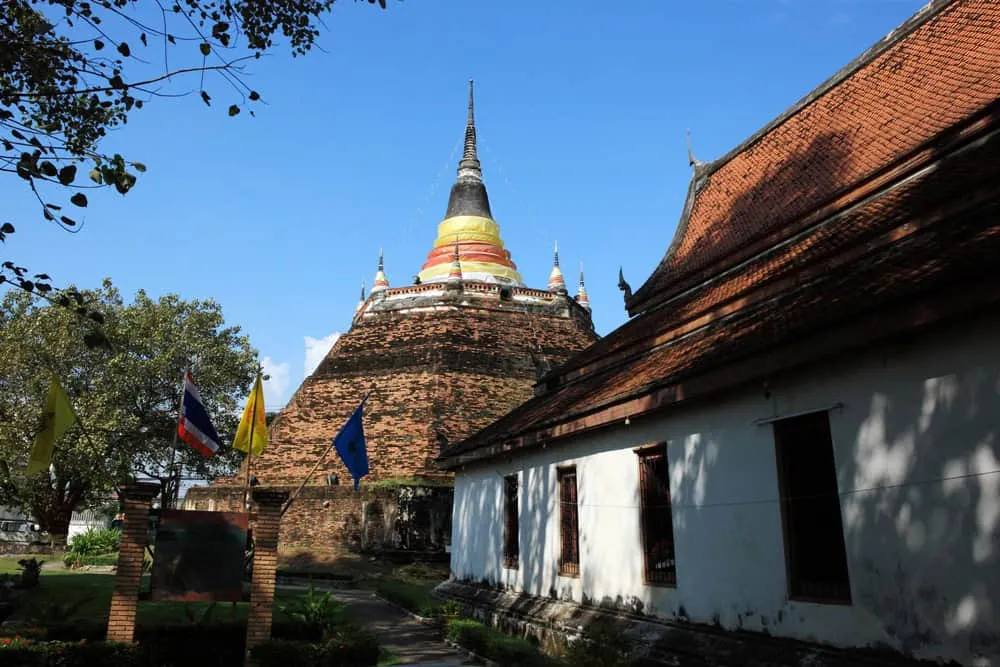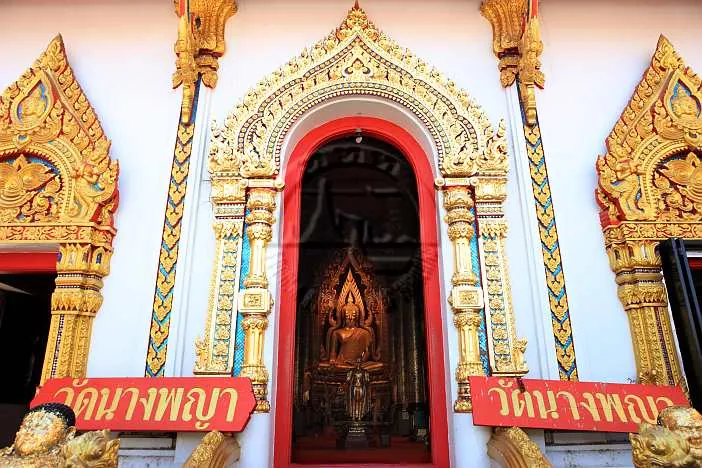

Wat Chulamani sits on the east bank of the Nan River in Phitsanulok, on the site of Song Khwae, the old town that predates the modern city — making it the oldest standing temple in Phitsanulok province. In 1464 (BE 2007), King Borommatrailokanat built a vihara here and had himself ordained as a monk for 8 months and 15 days, taking 2,348 of his court officials into the monkhood alongside him. Entry is free, open daily 07:00-18:00.
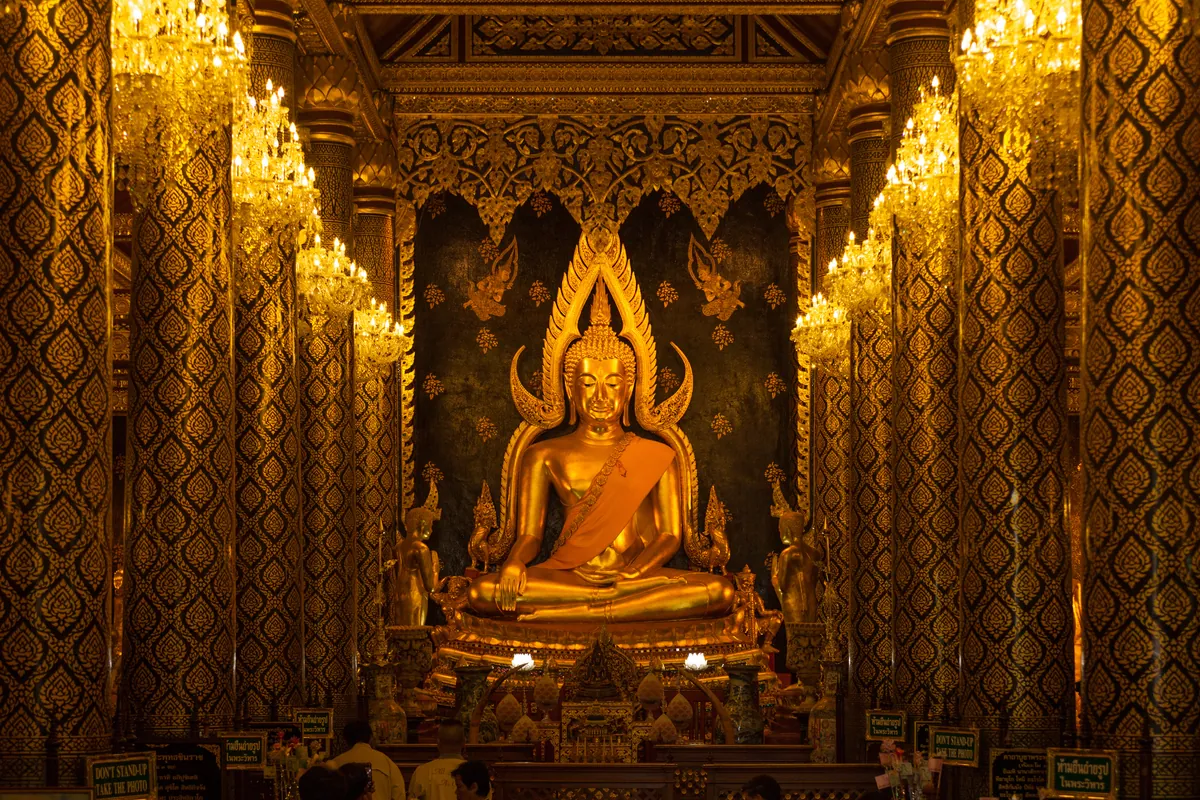
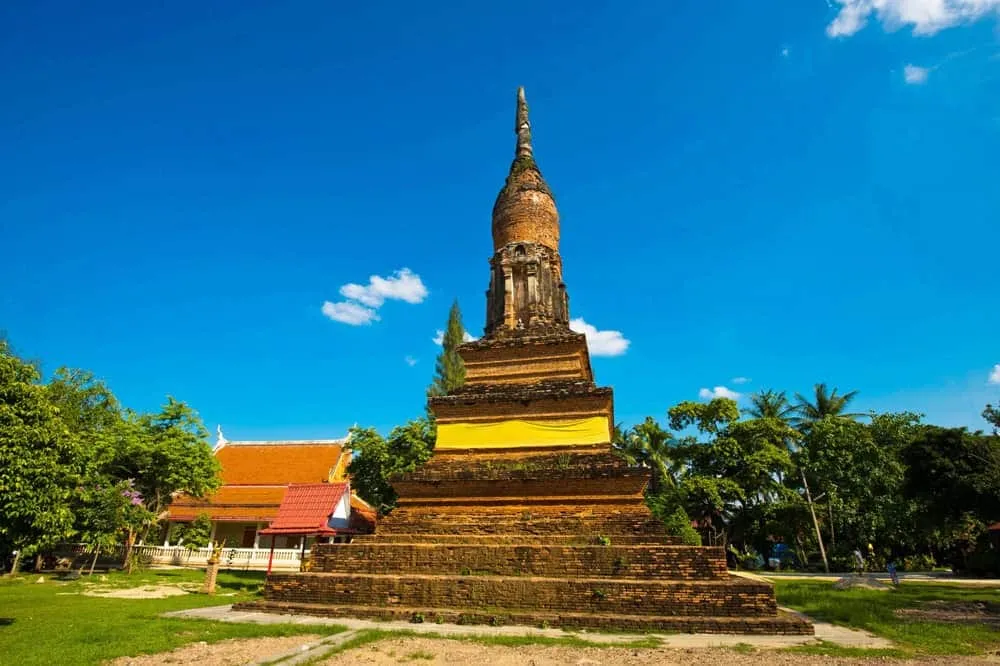
The temple’s oldest surviving structure is a Khmer-style laterite prang — weathered, partially crumbled, and the clearest physical evidence of the site’s age, since the surrounding brick foundations have mostly been reduced to low outlines in the ground. Stucco decoration still clings to sections of the prang in places, softened by centuries of monsoon rain rather than intentionally abstract. Inside the active modern vihara, the principal Buddha image, known locally as Luang Pho Phet (“the Diamond Buddha”), draws a steady trickle of Phitsanulok residents coming to make merit — fresh flowers and incense at the base are usually more recent than the ruins around them. The contrast is part of what makes the site worth a stop: a genuinely ancient prang standing next to an ordinary, still-functioning neighborhood temple, rather than a fenced-off museum piece.
The 1464 ordination wasn’t a routine royal gesture. Borommatrailokanat had spent much of his reign fighting Lan Na to the north and had already shifted his capital from Ayutthaya to Phitsanulok to run that campaign more directly — taking robes for the better part of a year, with thousands of his own officials ordaining alongside him, was as much a political and religious statement to the kingdom as a personal act of faith. That backstory is easy to miss standing in front of a single weathered prang, which is one reason the temple stays quieter than its history would suggest: there’s no plaque doing the storytelling for you, just the structure itself and a working neighborhood shrine built up around it over five and a half centuries.
- Entry fee: Free
- Hours: Daily 07:00-18:00
- Oldest structure: Khmer-style laterite prang
- Historical significance: Site of the 1464 royal ordination of King Borommatrailokanat and 2,348 officials
- Principal Buddha image: Luang Pho Phet
Insider Tip: Pair the visit with Chan Palace, King Naresuan’s birthplace a few minutes’ drive away — together they cover Phitsanulok’s two strongest historical threads (the Sukhothai-era prang and the Ayutthaya-era royal palace) in under two hours.
Mornings are quieter and cooler for walking the grounds; by midday the laterite prang offers little shade. Dress modestly — covered shoulders and knees — since the vihara is an active place of worship, not a roped-off ruin. The temple is a short drive from central Phitsanulok, easily combined with Wat Chedi Thong, another temple with genuine Sukhothai-period roots on the same riverbank, for a half-day loop that skips the crowds at the city’s famous Wat Yai, home of the Phra Buddha Chinnarat image.
Location & Directions
62 Mu 2, Borommatrai Lokkanat Road
Phitsanulok, Thailand
Show your taxi or Grab driver
วัดจุฬามณี
Frequently Asked Questions
Is Wat Chulamani in Sukhothai?
Why is this temple significant?
What's the main thing to see?
Is it free to visit?
How does it compare to Sukhothai's ruins?
Spotted something out of date or incorrect? Let us know
Stay Near Wat Chulamani
Live prices for places closest to Wat Chulamani — tap a pin to compare.