




Wat Phai Rong Wua
วัดไผ่โรงวัว
A 26-metre bronze Buddha coated in white stucco rises out of flat rice country on Highway 3422, visible from a distance before the rest of Suphan Buri’s Wat Phai Rong Wua comes into view. The image, Phra Kakusandho, was once the tallest Buddha statue in Thailand, and it still anchors what is one of the country’s largest — and strangest — single temple complexes, spread across open grounds rather than a compact walled compound.
The temple’s best-known feature sits just beyond the giant Buddha: a section known as the “Land of Hell,” where life-sized statues act out the punishments of Buddhist hell in unfiltered detail. Figures are shown boiled in oil, sawn in half, pecked apart by oversized vultures, and subjected to a catalogue of other gruesome fates, each scene labelled with the transgression it punishes. It reads as shock value to most first-time visitors, but it’s a long-standing Thai Buddhist teaching device — a visual sermon on karma aimed at people who might never sit through an actual one, and Wat Phai Rong Wua’s version is one of the most elaborate in the country.
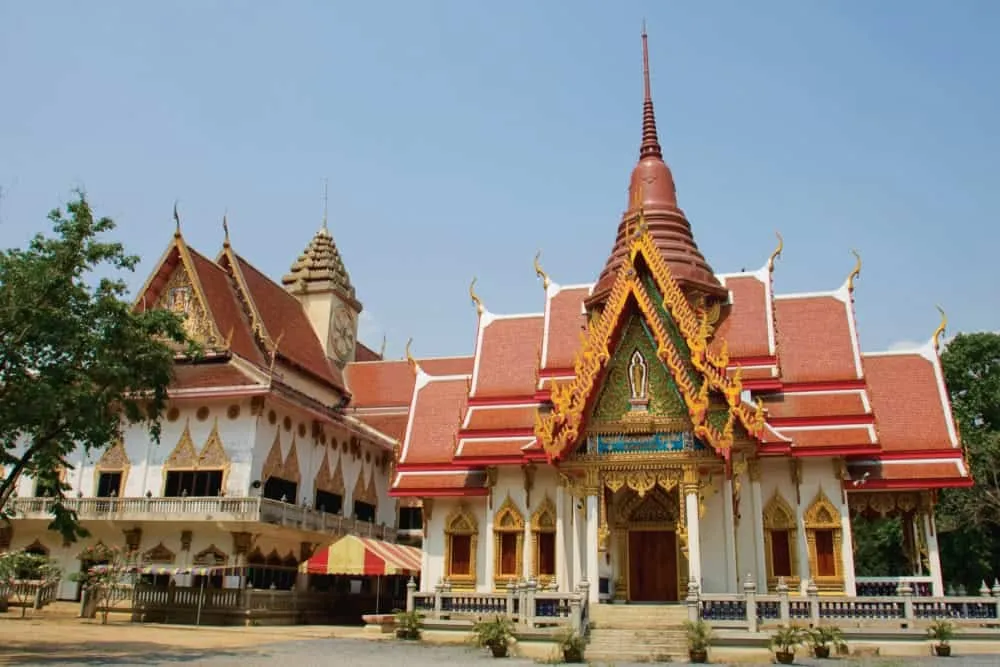
Away from the Hell Garden, the grounds hold a quieter, more conventional side: rows of seated Buddha statues 4-5 metres tall mark family memorial plots, all facing toward a standing Buddha with one open palm raised, itself oriented toward the giant Kakusandho image. Traditional wooden halls elsewhere on the site house Buddha images in the classical meditation and reclining postures, and monks move through the grounds during the temple’s regular chanting sessions. The scale of the place means you’ll likely walk further between sights here than at most Thai temples — this isn’t a single ordination hall you circle in ten minutes.
The temple’s name translates roughly to “temple of the bamboo cattle barn,” a nod to the area’s past as bamboo forest where farmers kept their cows before the temple grew up around it — and that rural setting still frames the whole complex: flat paddy on every side, the giant Buddha visible for kilometres before you reach the gate, and no dense urban clutter to compete with the scale of what’s been built here. It’s a useful landmark for orientation if you’re driving Highway 3422 between Suphan Buri and the Bangkok side of the province, since there’s little else on the route that rises above the tree line.
Insider Tip: Go early on a weekday morning if the Hell Garden’s imagery isn’t for you but you still want the giant Buddha — the crowds and the heat both build fast once the sun is up over the open fields.
Watch out: The Hell Garden’s statues are graphic and not softened for children. If you’re travelling with young kids, decide in advance whether to skip that section or walk them through it with context.
- Entry fee: Free
- Hours: Mon-Sat 08:00-17:00; Sunday open 24 hours
- Giant Buddha: Phra Kakusandho, 26m bronze under white stucco — once Thailand’s tallest Buddha statue
- Signature feature: The “Land of Hell” garden of sculpted Buddhist-hell punishment scenes
- Getting there: Highway 3422, Bang Ta Then subdistrict, Song Phi Nong district — own transport recommended
Dress modestly with shoulders and knees covered. There’s no shade over much of the open ground between the main sights, so bring water and sun protection for what ends up being a fair amount of walking.
Location & Directions
11 Highway 3422
Suphan Buri, Thailand
Show your taxi or Grab driver
วัดไผ่โรงวัว
Frequently Asked Questions
How tall is the giant Buddha at Wat Phai Rong Wua?
What is the "Hell Garden"?
Is there an entrance fee?
What are the opening hours?
Is Wat Phai Rong Wua difficult to reach?
Spotted something out of date or incorrect? Let us know
Stay Near Wat Phai Rong Wua
Compare places to stay in Suphan Buri, or open the map for options closest to the attraction.