
Wat Phra Thaen Dong Rang
วัดพระแท่นดงรังวรวิหาร
Wat Phra Thaen Dong Rang sits not on a riverbank but on a low forested rise in Tha Maka district — “Dong Rang” means “rang forest,” named for the rang trees (Shorea siamensis, a dry-forest cousin of India’s sal tree) that still cover much of the surrounding 2,390-rai reserve. That botanical detail matters here: in Buddhist tradition, the Buddha entered final nirvana (parinibbana) lying between a pair of sal trees at Kushinagar in India. Thai devotional tradition has, for centuries, symbolically re-created that scene on this Kanchanaburi hillside, using the local rang forest to stand in for India’s sal grove — a religious echo, not a claim that the historical event happened here.
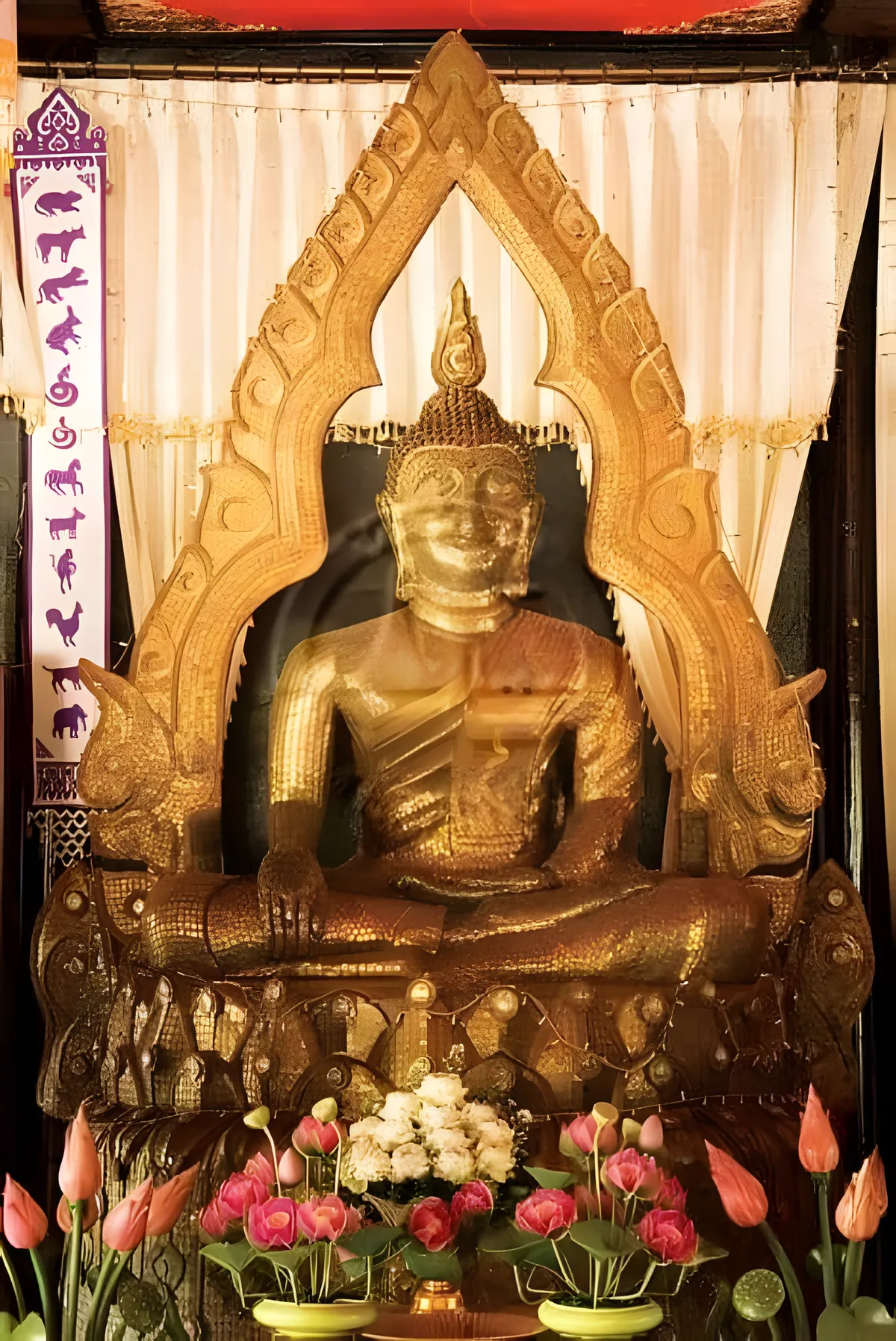
The temple’s centrepiece, and the source of its name, is Phra Thaen — a large, flat, bed-shaped stone slab enshrined inside the main hall. It’s revered as a symbolic re-creation of the platform where the Buddha lay down at the end of his life, not as an archaeological relic; the accepted historical site is in India. A short walk uphill, a 55-metre rise called Khao Thawai Phra Phloeng (“Cremation Offering Hill”) is crowned with a mondop representing the place where the Buddha’s body was cremated — the second half of the same devotional pairing. Exactly when the temple was founded isn’t recorded; historians place it in the reign of King Borommakot of Ayutthaya (1733-1758) based on the surviving architecture. It now holds status as a Phra Aram Luang — a royal temple, third class, worawihan type.
Insider Tip: Time a visit around the annual fair, held each year around the waxing-to-waning turn of the fourth lunar month — typically late February into early March, running about nine days and nine nights. Merit-making, gold-leaf offerings, music, and free folk performances fill the grounds; it’s one of the biggest temple fairs in Kanchanaburi province.
Watch out: Outside the annual fair, this is a genuinely quiet rural temple with basic visitor facilities — don’t expect food vendors or much English signage on an ordinary weekday. Bring water, especially if you’re climbing to Khao Thawai Phra Phloeng in the heat of the day.
The temple grounds cover roughly 100 rai of the wider 2,390-rai forest reserve, so there’s a fair bit of walking between the main hall, the cremation hill, and the surrounding forest paths — wear closed shoes rather than sandals. The temple is reachable by car or motorbike from central Kanchanaburi via Phra Thaen-Tha Ruea Road. Dress respectfully, cover shoulders and knees, and remove shoes before entering the hall housing Phra Thaen.
- Named for: The rang forest surrounding the temple, botanically linked to the sal-tree parinibbana story
- Phra Thaen: A stone slab revered as a symbolic re-creation of the Buddha’s parinibbana platform, not the historical site
- Khao Thawai Phra Phloeng: A 55 m hill topped with a mondop representing the cremation site
- Annual fair: Late February-early March (fourth lunar month), roughly nine days
- Entry: Free, daily roughly 07:00-17:00
Location & Directions
121 Moo 10, Phra Thaen-Tha Ruea Road
Kanchanaburi, Thailand
Show your taxi or Grab driver
วัดพระแท่นดงรังวรวิหาร
Frequently Asked Questions
Did the Buddha actually die at Wat Phra Thaen Dong Rang?
What does "Dong Rang" mean?
When is the temple's annual fair?
Is there an entry fee?
Is the temple on the Kwai River?
Spotted something out of date or incorrect? Let us know
Popular tours in Kanchanaburi

![Erawan Waterfall and Kanchanaburi Private Tour [Optional Luxury]](https://images.thaiholidayguide.com/images/tours/erawan-waterfall-and-kanchanaburi-private-tour-optional-luxury.webp)



Stay Near Wat Phra Thaen Dong Rang
Compare places to stay in Kanchanaburi, or open the map for options closest to the attraction.