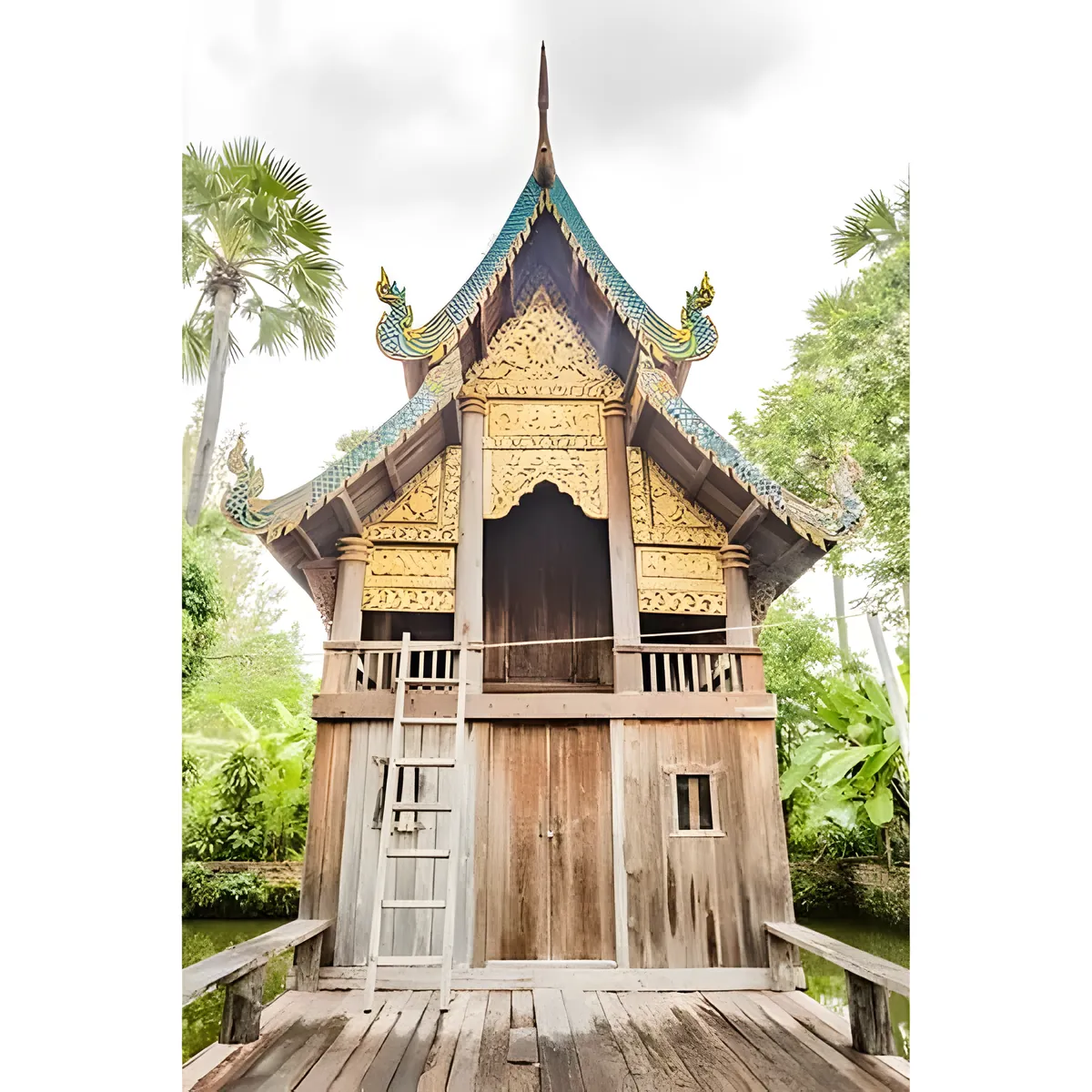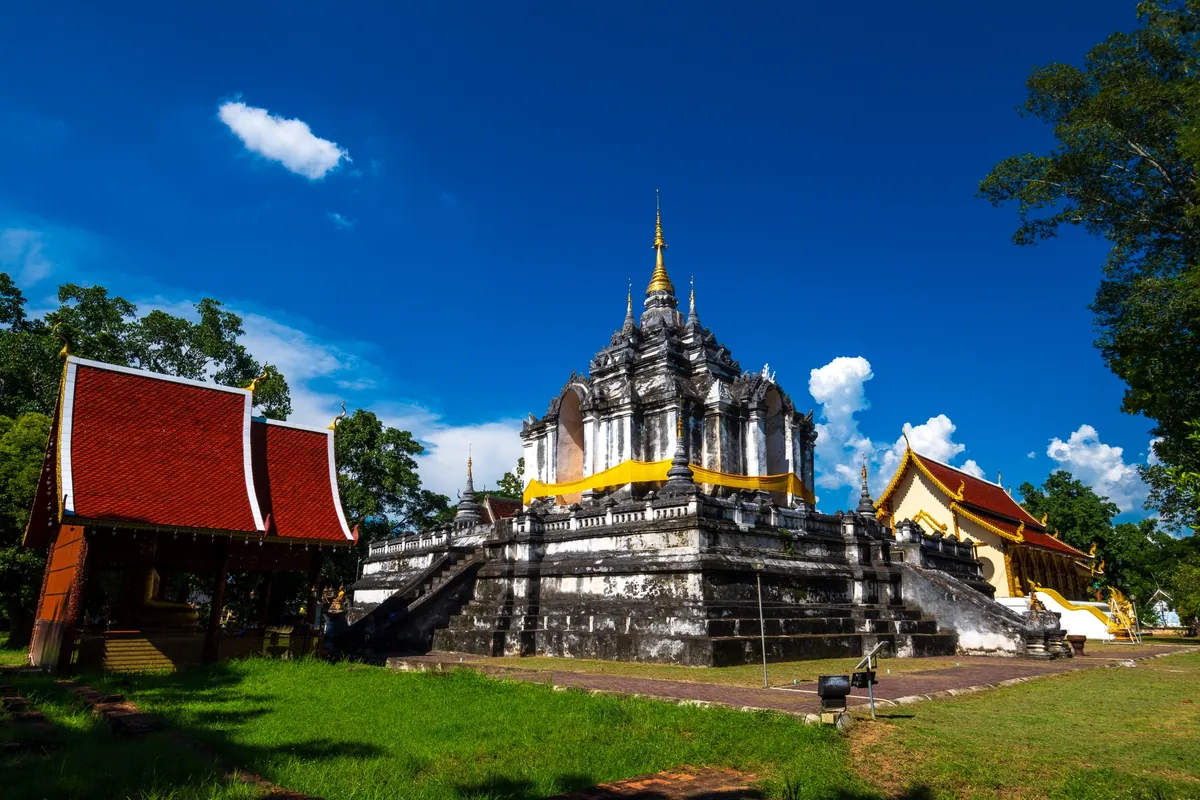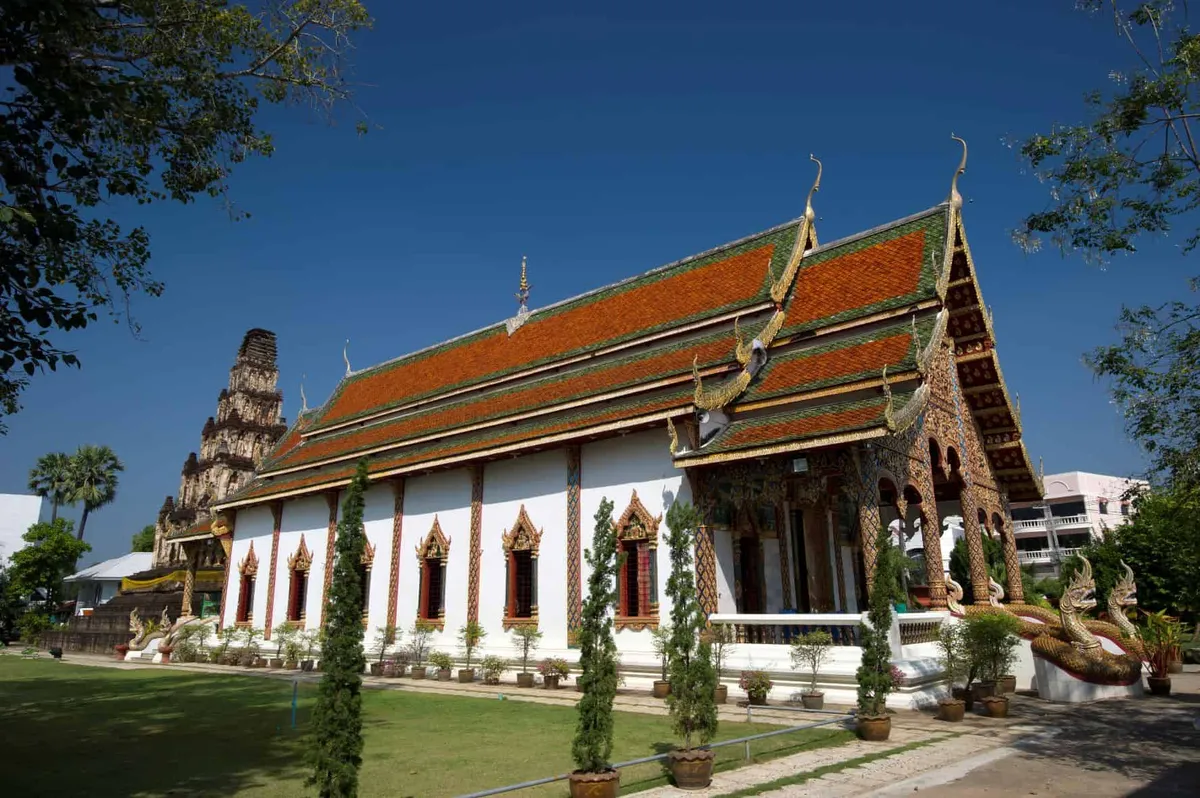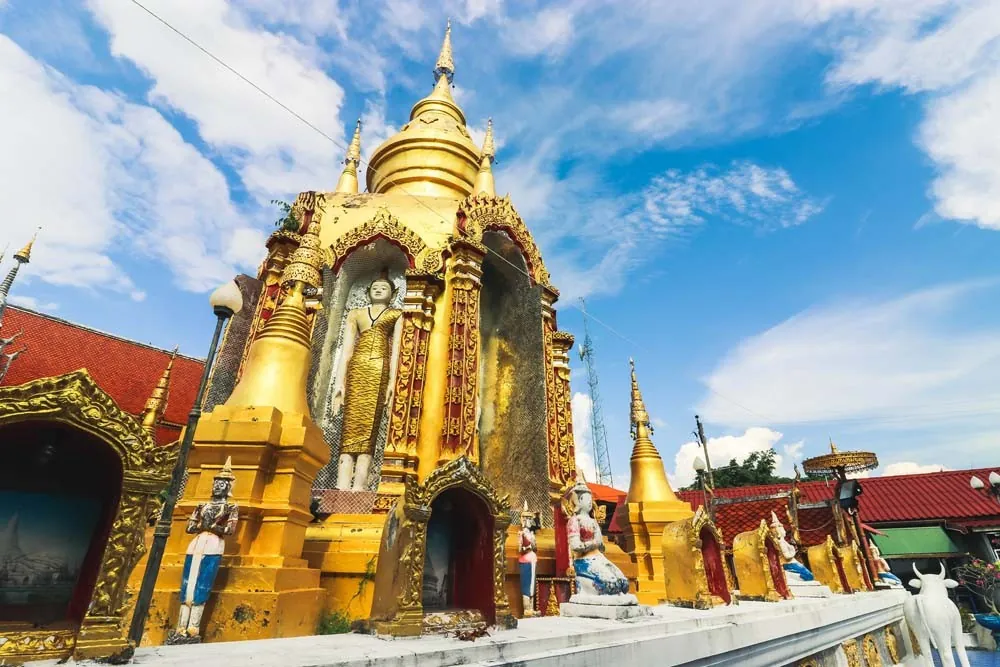






Five whitewashed chedis stand in a row on the site of the old walled town of Li, giving Wat Phra That Ha Duang its name — ha duang means “five orbs.” Entry is free, and there are no posted opening hours; like most rural Lamphun temples it’s a daylight, drop-in site.
The founding legend belongs to Queen Chama Thewi (Chamadevi), the queen of Hariphunchai who ruled from what’s now Lamphun town. Villagers in Li told her that five glowing orbs kept appearing on a patch of ground outside the settlement. She travelled south to see for herself, and found the lights rising from five separate earthen mounds. Local belief held that the spot marked where the Buddha had once washed his hands, the water running off through his five fingers onto the ground below — enough for the queen to order a chedi raised over each of the five mounds. The temple’s older name, Wiang Chedi Ha Lung (“walled town of five stupas”), points to the same story. An annual ceremony is still held every 20 April to mark it.
The grounds themselves carry a second layer of history: remnants of an earthen wall and moat are visible around the temple, believed to be what’s left of the ancient city of Li before it was abandoned. Walking the perimeter between the five chedis, that double history — a vanished walled town wrapped around a five-part relic shrine — is more the draw here than any single dramatic structure. The temple was only formally registered in 1975, but the site and its legend go back to the Hariphunchai kingdom itself.
There’s also a documented link to Wat Phrathat Duang Diaw, a near-namesake about 2.5 km away in the same Li subdistrict. Kruba Apichai Khao Pee — the monk credited with rebuilding Duang Diaw’s chedi in 1967 and restoring Wat Phra Phutthabat Pha Nam elsewhere in Li district — is also recorded as having spent time based at Wat Phra That Ha Duang during his years working across the district’s temples. The two sites are easy to combine into a single half-day loop, and despite the similar names and shared district folklore, they’re genuinely separate temples with separate founding stories, not a double listing of the same place.
Insider Tip: Go around 20 April if the dates line up — that’s the annual ceremony marking the five-orb legend, and the only time the otherwise quiet grounds see a real crowd.
Watch out: There’s minimal English signage on the road into Ban Phra That Ha Duang, and the name is easy to confuse with Wat Phrathat Duang Diaw nearby. Confirm you’re heading to the right pin — the Thai name here is วัดพระธาตุห้าดวง — before setting off.
- Entry: Free
- Hours: No fixed posted hours; daylight visits typical
- Location: Ban Phra That Ha Duang, Li subdistrict, Li district, Lamphun
- Highlights: Five chedis over the five-orb relic mounds, remains of the old walled city of Li, annual 20 April ceremony
Dress modestly, shoulders and knees covered, and remove shoes before entering any of the halls. There’s no ticket booth or gift shop — a small cash donation toward upkeep is customary rather than required.
Location & Directions
Li, Lamphun
Lamphun, Thailand
Show your taxi or Grab driver
วัดพระธาตุห้าดวง
Frequently Asked Questions
What does Wat Phra That Ha Duang mean?
Is this the same temple as Wat Phrathat Duang Diaw nearby?
Is there an entrance fee?
What are the opening hours?
How do I get to Wat Phra That Ha Duang?
Spotted something out of date or incorrect? Let us know
Stay Near Wat Phra That Ha Duang
Live prices for places closest to Wat Phra That Ha Duang — tap a pin to compare.