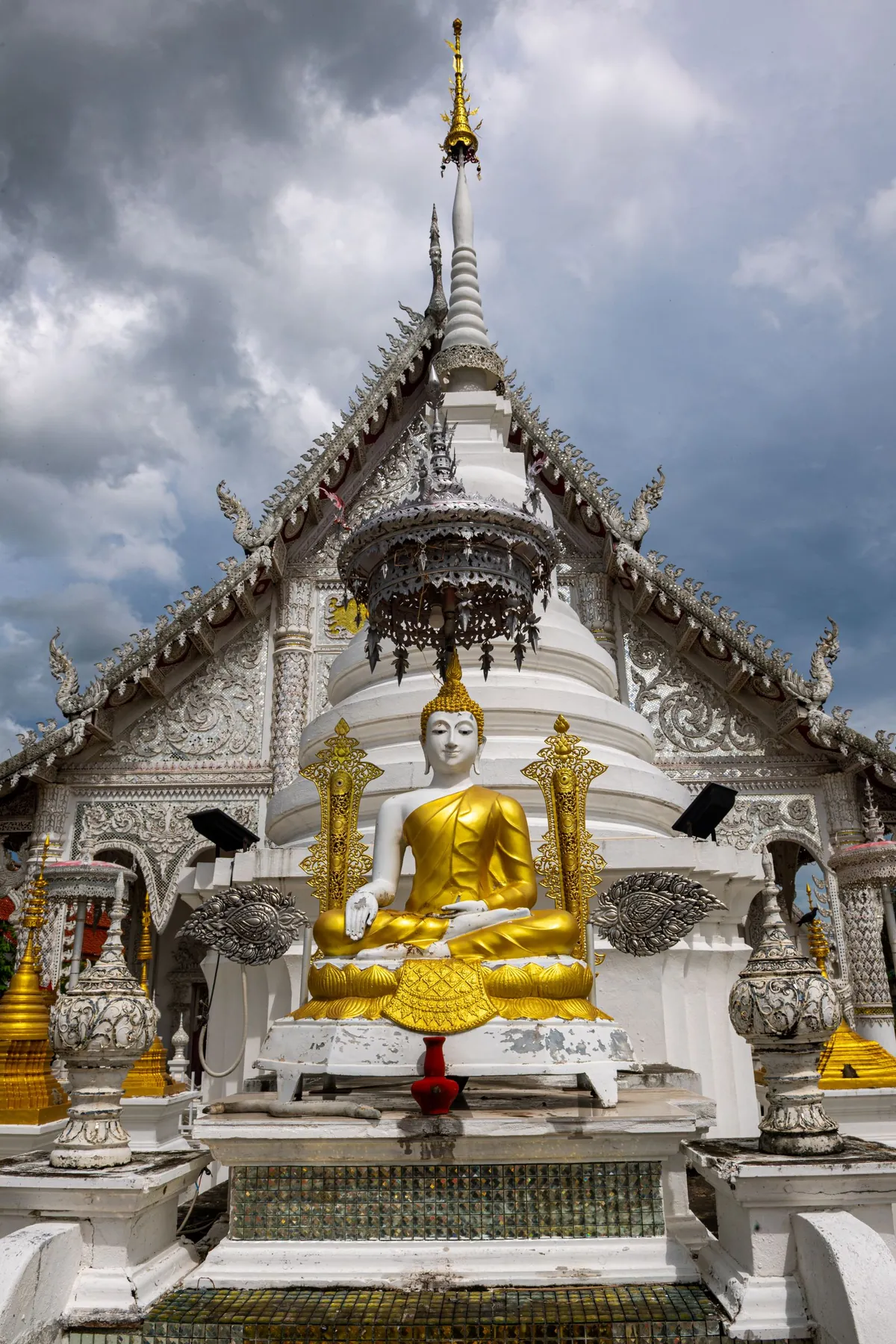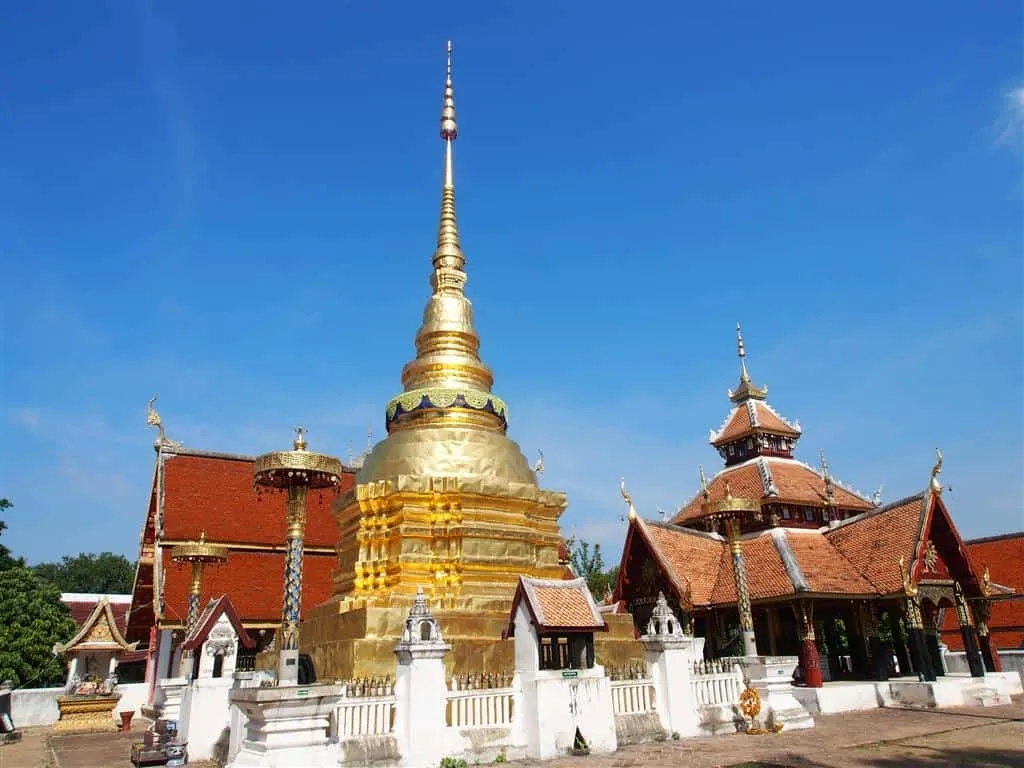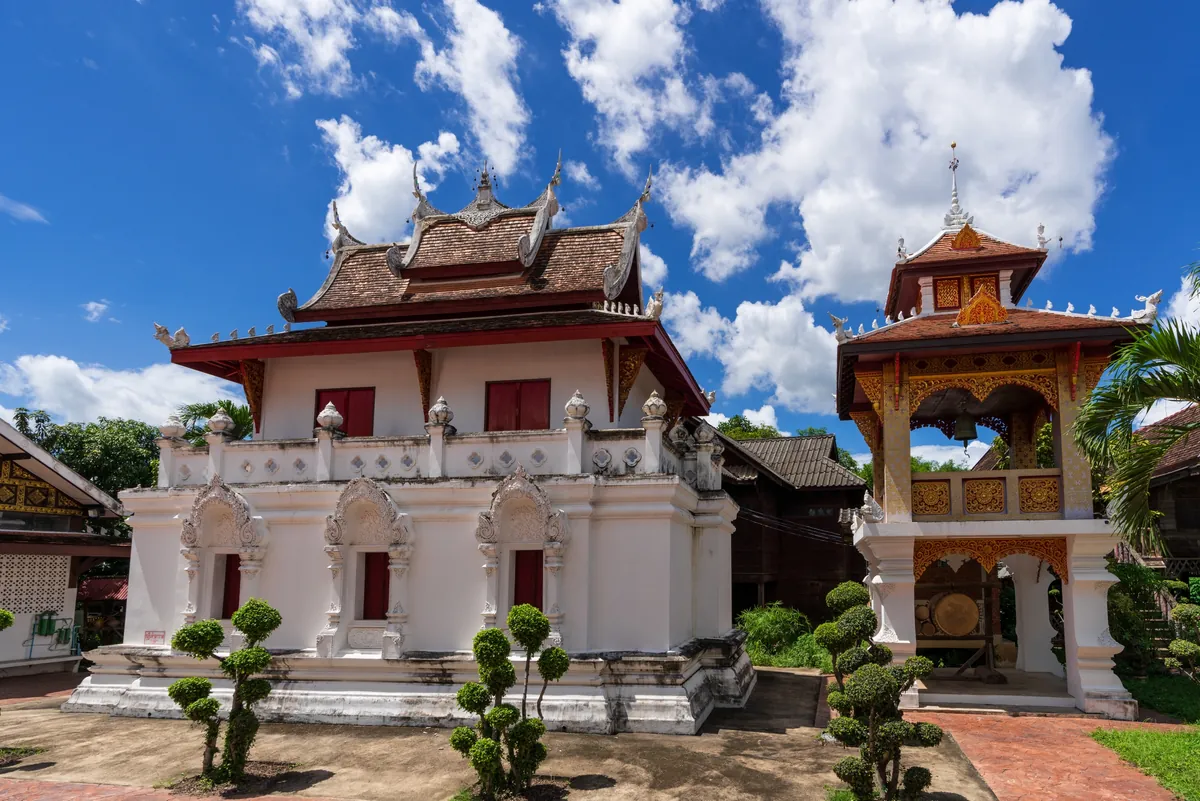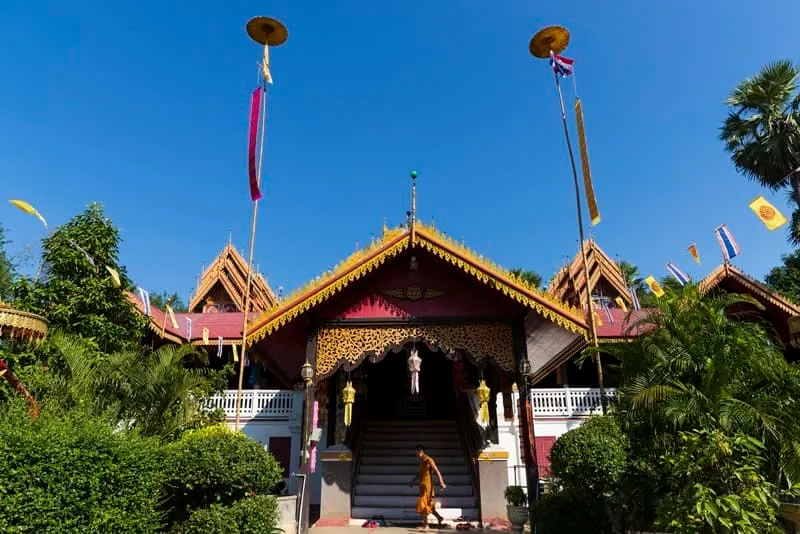



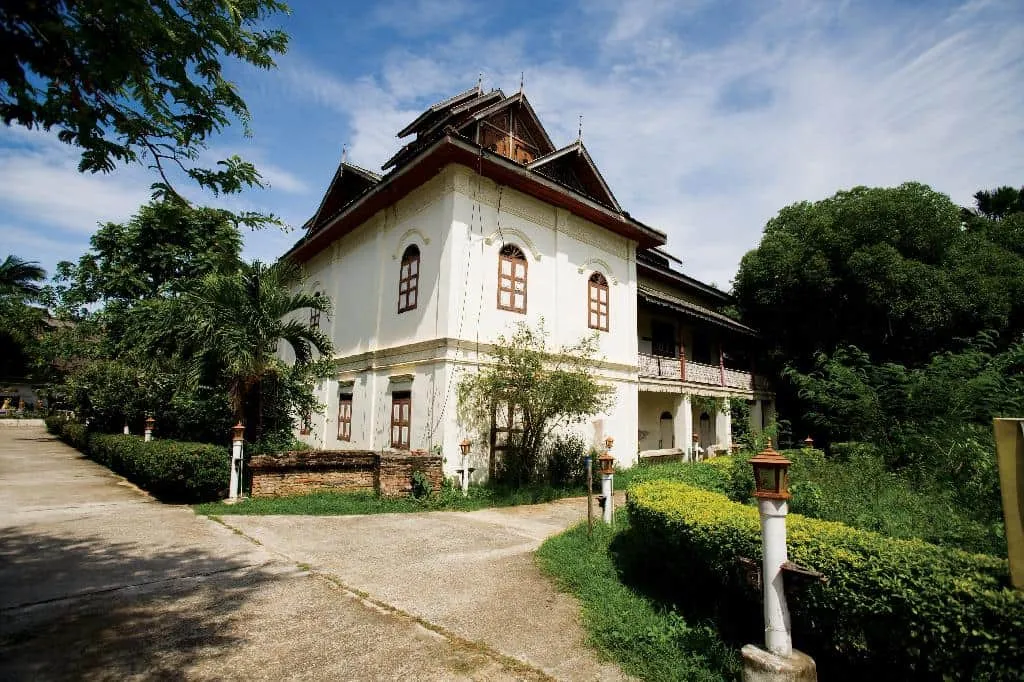
Wat Si Chum in Lampang is a Burmese-style temple, not a Lanna one — a distinction that matters because Thailand has a far more famous Wat Si Chum in Sukhothai Historical Park, home to the giant seated Buddha in a mondop. That is a 14th-century Sukhothai-era ruin roughly 200 km away and has no connection to this temple at all. The Lampang temple was built in 1892 by wealthy Burmese teak traders — Chong Ta Ka U Yo, his son-in-law U Mong Yee, and his mother-in-law Pom Boriboon — who funded it using timber and craftsmen from Myanmar, a common pattern in Lampang given the city’s history as a 19th-century teak-trading hub.
The result is a tiered, gilded roofline that reads as distinctly Burmese rather than northern Thai: multiple layered spires stacked above a white-and-gold viharn, with woodcarving styles closer to temples in Mandalay than to the simpler wooden wats found elsewhere in Lampang. A separate Mon-Burmese chedi on the grounds is said to enshrine Buddha relics brought from Myanmar in 1906. The Fine Arts Department recognised the complex as a national historic site in 1981, cementing its status as one of the best-preserved Burmese temples in northern Thailand.
Watch out: the temple you see today isn’t fully original. A fire destroyed the old wooden viharn in 1992, and while it was rebuilt to the same Burmese design, most of the original carved decorations and statues were lost for good. What stands now is a careful reconstruction rather than 130-year-old woodwork throughout — worth knowing if you’re specifically chasing untouched 19th-century craftsmanship.
Insider Tip: Lampang city has three notable Burmese-influenced temples within a short tuk-tuk ride of each other — Wat Si Chum, Wat Si Rong Mueang, and Wat Chai Mongkon — a legacy of the teak-boom era when Burmese merchants funded much of the city’s religious architecture. Visiting two or three back to back makes the style differences (and the shared history) much clearer than seeing just one.
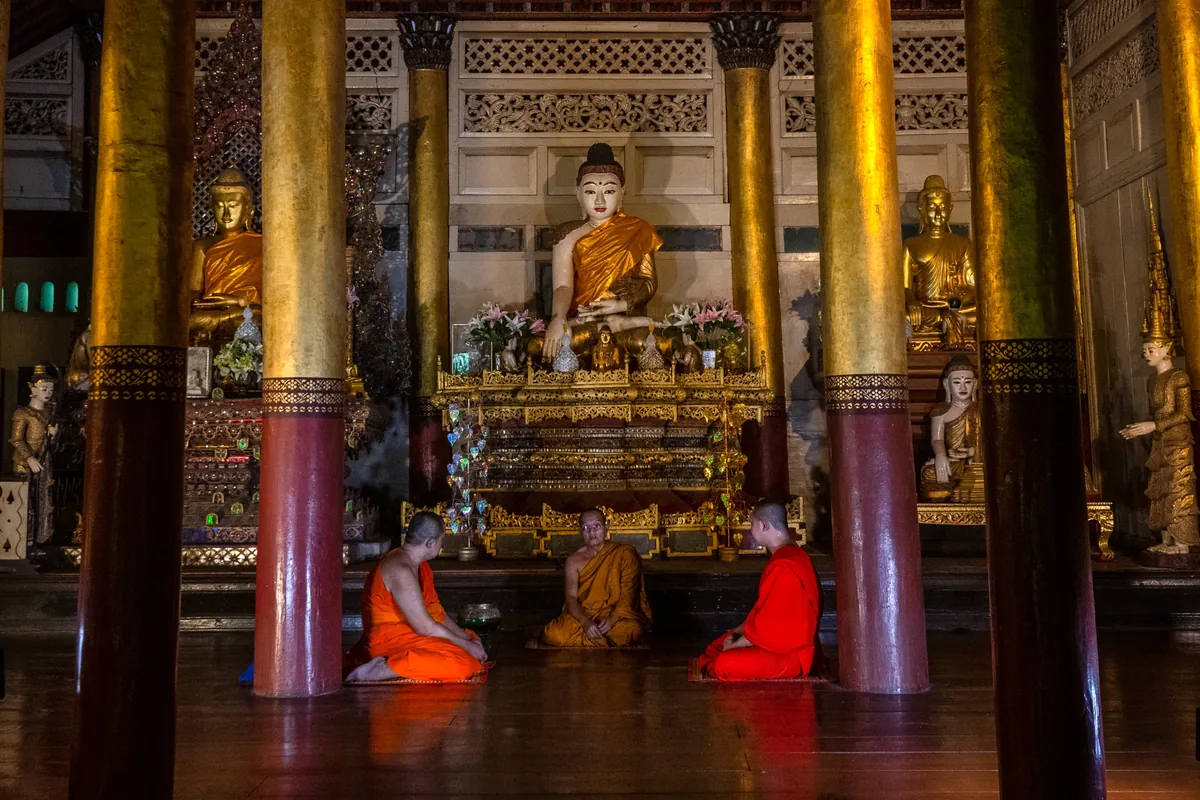
Morning is the quietest time to visit, before the midday heat and any tour groups passing through Lampang on their way north. Dress modestly with shoulders and knees covered, remove your shoes before entering the viharn, and ask before photographing monks or images inside the prayer hall. The temple sits in the Suan Dok subdistrict of central Lampang and is an easy tuk-tuk or songthaew ride from the old town.
- Built: 1892, funded by Burmese teak merchants
- Style: Mon-Burmese, not Lanna — distinct from the Sukhothai temple of the same name
- Historic status: Fine Arts Department national historic site since 1981
- 1992 fire: original viharn destroyed and rebuilt; some decorations irreplaceable
- Entry: Free, open daily 08:00-17:00
Location & Directions
Mueang Lampang, Lampang
Lampang, Thailand
Show your taxi or Grab driver
วัดศรีชุม
Within Walking Distance




Frequently Asked Questions
Is this the same Wat Si Chum as the one in Sukhothai?
What architectural style is Wat Si Chum in Lampang?
Is Wat Si Chum free to enter?
Why does the temple look partly rebuilt?
What's inside the temple?
Spotted something out of date or incorrect? Let us know
Popular tours in Lampang

Stay Near Wat Si Chum
Compare places to stay in Lampang, or open the map for options closest to the attraction.