






Wat Ton Laeng was built by Tai Lue settlers who migrated to this stretch of Nan province from Sipsong Panna (in what’s now southern Yunnan, China) in the early 19th century, making the temple around 200 years old. It sits about 70 km north of Nan town on a spit of land where the Pua and Khuang rivers meet, just off Route 1080, and it’s still the community temple for the surrounding villages rather than a restored showpiece.
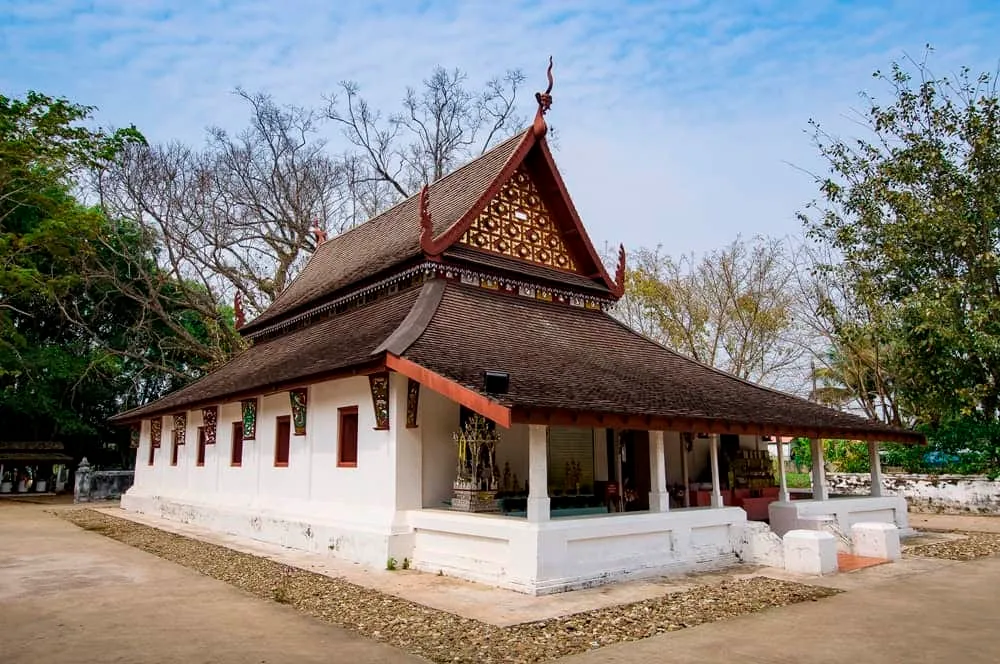
The roof is the reason architecture writers seek this place out. Where a typical Lanna viharn has a simple two-sided gabled roof, Wat Ton Laeng’s roof rises in three overlapping, hipped tiers, wrapping around all four sides of the building; only the topmost tier breaks into a small gable, decorated with a colourful sunburst motif, with triple naga finials tracing the edges of the lower tiers. It’s a Tai Lue building form, distinct from the mainstream Lanna style found across most of Nan and Chiang Mai. Two brightly painted lion statues guard the entrance, and inside, cotton-woven banners hang from the ceiling above a large golden Buddha image in the earth-touching (Bhumisparsha) pose, surrounded by smaller figures.
- Entry: Free
- Notable for: An unusual three-tiered Tai Lue hipped roof, not murals
- Age: Roughly 200 years, built by early Tai Lue migrants from Sipsong Panna
- Hours: Approximately 06:00-18:00 daily; the viharn itself may be locked outside of visits
- Getting there: ~70 km north of Nan town, off Route 1080 in Pua district, songthaew charter or private car
Insider Tip: The viharn is sometimes locked because so few visitors make it out here. If the doors are shut, ask at a house nearby. Locals are used to letting genuinely interested visitors in.
The building’s exterior is plain by design (small windows, little carved decoration) which makes the roofline and the lion guardians stand out even more against it. Few tourists reach this far up Route 1080, so expect a quiet village rather than a curated heritage site: no gift shop, no ticket desk, just a working temple that happens to be architecturally unlike almost anything else in the province. Anyone chasing Nan’s famous mural temples should look instead to Wat Nong Bua or Wat Phumin back toward town. Wat Ton Laeng is a different kind of stop entirely.
Dress modestly (covered shoulders and knees) and remove your shoes before stepping inside. The drive out from Nan town takes over an hour on winding roads, so it pairs well with a wider loop through Pua district rather than a standalone trip.
Location & Directions
Pua, Nan
Nan, Thailand
Show your taxi or Grab driver
วัดต้นแหลง
Frequently Asked Questions
Is Wat Ton Laeng known for its murals, like other Nan temples?
Who built Wat Ton Laeng?
How do I get to Wat Ton Laeng?
Is the temple always open?
What makes the roof design unusual?
Spotted something out of date or incorrect? Let us know
Stay Near Wat Ton Laeng
Live prices for places closest to Wat Ton Laeng: tap a pin to compare.