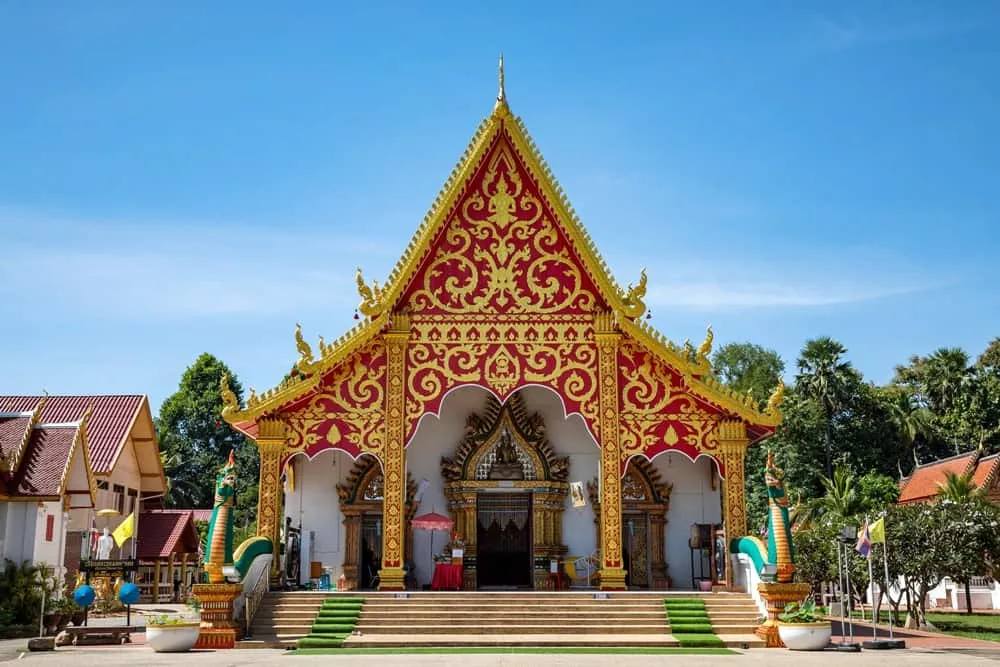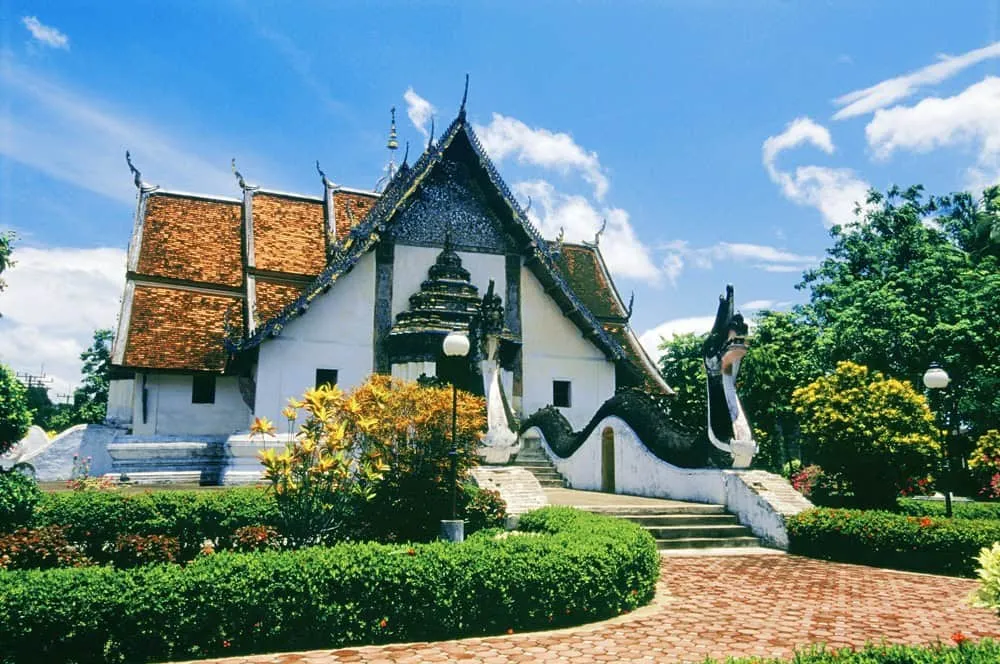






Wat Phumin’s cruciform ordination hall is Nan’s best-known landmark, built so that a single building faces all four directions at once, and its 19th-century murals, especially one whispered “line” between two lovers in a crowd scene, are the reason. Entry is free, the grounds are open daily from roughly 07:00 to 20:00, and the temple sits on Pha Kong Road in the old walled town, a short walk from Nan’s other major temples.
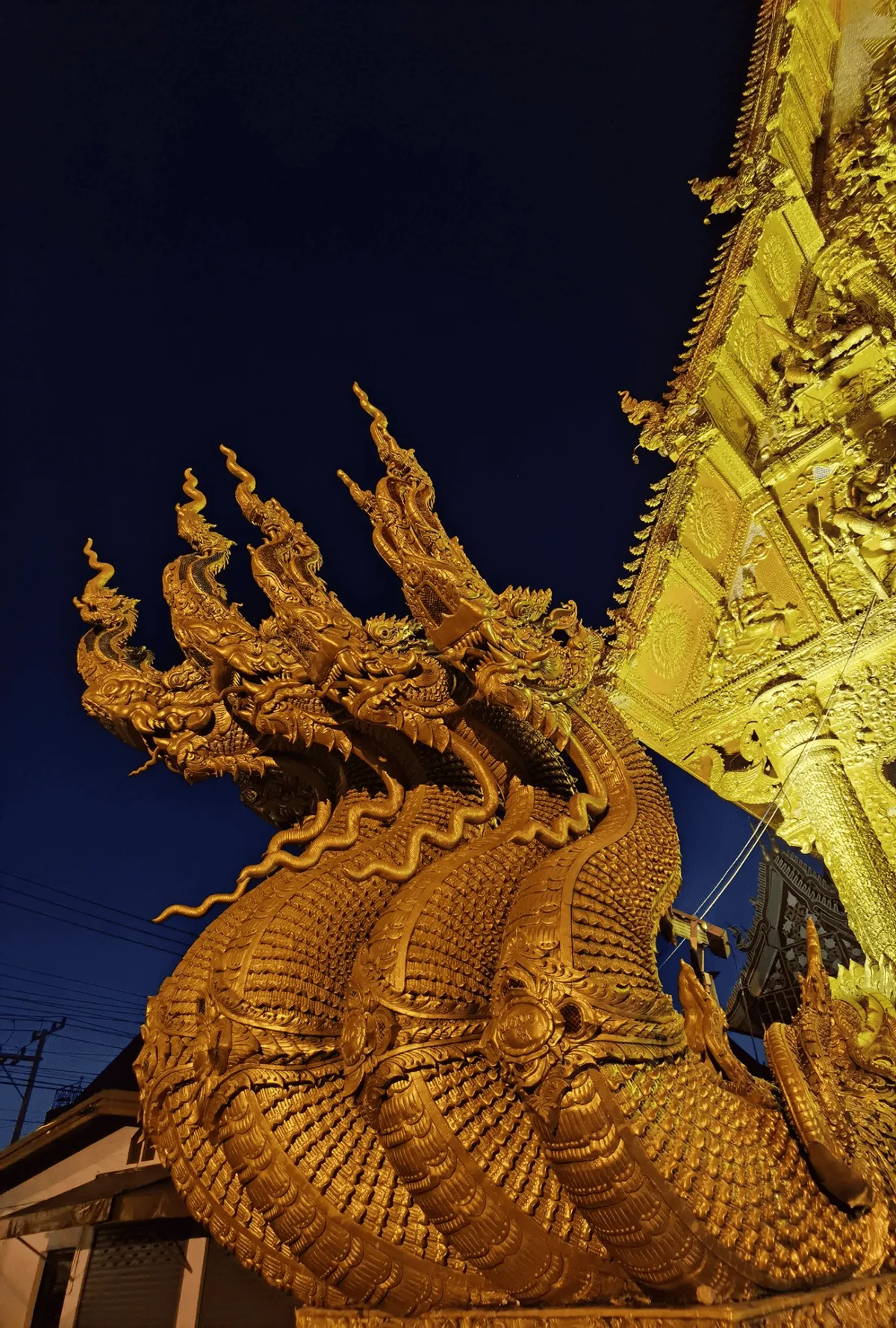
Nan chronicles date the temple’s founding to the reign of Phrachao Chettabut Phrommin, who is said to have built it six years into his rule of the Nan kingdom; a 1596 reference in the Northern Scriptures records it under an earlier name, Wat Phrommin. The building seen today dates largely from a major renovation completed in 1867 under Phrachao Anantaworaritthidet, which took seven years, and it’s from this period that the temple’s murals were almost certainly painted. The Ubosot itself is unusual in Thai temple architecture: a single tetrahedron-shaped hall serving as both ordination hall and viharn, with the wihan axis running east-west and the ordination axis north-south. Two large naga serpents flank the entrance stairways, so the whole structure appears to rest on their backs, the only building of its kind in the country.
The murals, known locally as “Hup Taem,” cover the interior walls in three interwoven layers: Jataka tales from the Buddha’s past lives, folk legends of the Nan characters Pu Man and Ya Man, and, most famously, scenes of everyday 19th-century Lue life in Nan, including the market, the fields, and a crowd where one man leans close to whisper into a woman’s ear. That single gesture, painted by the artist Thit Buaphan sometime between 1867 and 1874, has been reproduced on postcards, murals, and tourism campaigns across northern Thailand, and gives the temple its popular nickname among Thai visitors. Four Buddha images in the Subduing Mara pose sit back-to-back at the centre of the hall, each facing one of the four doors.
Insider Tip: Bring a torch or use your phone’s flashlight. The interior is deliberately dim to protect the pigments, and the whisper mural sits at eye height on the north wall, easy to miss in a quick pass.
The four teak doors are carved from single pieces of golden teak roughly 10 centimetres thick, worked into vine, flower, and leaf patterns by Nan artisans, worth a slow look on the way in, since most visitors walk straight past them toward the murals. During the Second World War, the Thai government printed an image of Wat Phumin on the 1-baht banknote, cementing its status as a national landmark rather than a purely local one. Ancient City in Samut Prakan later built a full-scale replica of the ordination hall as part of its collection of Thailand’s architectural landmarks, a legitimate homage rather than a rival attraction.
Watch out: Photography of the murals is allowed but flash is not. It accelerates fading on pigments already more than 150 years old. Staff will ask you to turn it off if you forget.
Dress modestly, covering shoulders and knees, and remove your shoes before stepping onto the raised floor. The temple pairs naturally with Wat Phrathat Chang Kham Worawihan next door and the National Museum of Nan a few minutes’ walk away, both worth combining into one visit to Nan’s old town.
- Famous for: The 1860s-70s “whisper of love” mural and the cruciform ordination hall
- Entry: Free, daily approx. 07:00-20:00
- Built/renovated: Founded centuries earlier, major rebuild completed 1867
- On the old 1-baht banknote: WWII-era Thai currency
- Nearby: Wat Phrathat Chang Kham Worawihan, National Museum of Nan
Location & Directions
33 Mu 1, Pha Kong Road
Nan, Thailand
Show your taxi or Grab driver
วัดภูมินทร์
Frequently Asked Questions
What is the famous mural at Wat Phumin actually depicting?
Is Wat Phumin free to visit?
Why is the ordination hall shaped like that?
Is the Ancient City replica in Samut Prakan a copy of this exact temple?
How much time should I set aside?
Spotted something out of date or incorrect? Let us know
Stay Near Wat Phumin
Live prices for places closest to Wat Phumin: tap a pin to compare.