





Ban Piang Luang
บ้านเปียงหลวง
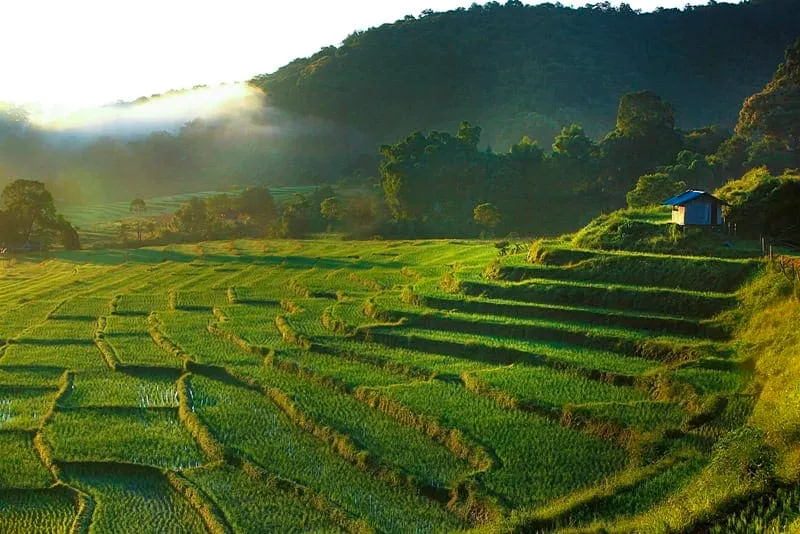
Ban Piang Luang sits at the northern tip of Wiang Haeng district, right against the Thai-Myanmar border, a highland town built by two overlapping communities rather than one. Tai Yai (Shan) families share it with Yunnanese Chinese descendants of the Kuomintang 93rd Division, Chinese Nationalist troops who retreated here after China’s 1949 revolution and eventually settled along this stretch of the border; Lisu and Palaung households round out five distinct sub-communities within the village.
Two temples anchor the town. Wat Piang Luang sits at the main entrance and serves the everyday Shan Buddhist community. Wat Fah Wiang In, at the far edge of the village, is the more unusual site: its grounds straddle the border itself, with the Marn Chana (“Victory over Mara”) chedi standing on Thai soil while the temple’s ordination hall lies across the line in Myanmar. Local tradition ties the site to Chao Kon Jerng, a Shan State independence leader who based operations here, and older ruins that some accounts connect to King Naresuan. A short distance away, the earthen remains of the old 93rd Division military base, built in a distinctive L-shaped layout, are open to walk through as a KMT-history stop, one of the few physical traces of that history left in Thailand.
The Yunnanese side of the town shows in its architecture and food rather than its temples: walled courtyard houses, tea shops, and Yunnanese cooking sit alongside the Shan-style buildings. A small border market near Lak Taeng trades goods with the Myanmar side, though this is a local trade pass rather than an international checkpoint. Don’t plan on crossing into Myanmar here as a foreign visitor.
Insider Tip: Time your visit to Wat Fah Wiang In for the morning, before the day’s motorbike-loop traffic from Chiang Dao and Doi Angkhang arrives.
Watch out: The Lak Taeng pass is a controlled local border crossing for Thai and Myanmar traders, not a checkpoint for foreign tourists to cross. Treat it as a market to browse, not a way into Myanmar.
Getting here means the long way round from Chiang Mai city, roughly four hours by car or motorbike via Chiang Dao and the Wiang Haeng valley, a route popular with riders for its mountain switchbacks alone. The road is passable year-round but easiest in the dry season, November to April; a scooter is fine in good weather, though anything with more clearance helps if it’s been raining. Basic homestays exist in the village, simple rather than set up for tourism, and it’s worth carrying cash: banking services this far from Chiang Mai city are limited.
- Entry fee: Free
- Communities: Shan (Tai Yai), Yunnanese Chinese (KMT 93rd Division descendants), Lisu, Palaung
- Key sights: Wat Piang Luang, Wat Fah Wiang In (border-straddling temple), 93rd Division fort ruins
- Border crossing: Lak Taeng is a local trade pass, not open to foreign tourists
- Getting there: ~4 hours from Chiang Mai via Chiang Dao and Wiang Haeng, dry season easiest
Location & Directions
Wiang Haeng, Chiang Mai
Chiang Mai, Thailand
Show your taxi or Grab driver
บ้านเปียงหลวง
Frequently Asked Questions
Who lives in Ban Piang Luang?
What was the KMT 93rd Division?
Can I cross into Myanmar from Piang Luang?
What makes Wat Fah Wiang In unusual?
How do you get to Ban Piang Luang from Chiang Mai?
Spotted something out of date or incorrect? Let us know
Popular tours in Chiang Mai





Stay Near Ban Piang Luang
Live prices for places closest to Ban Piang Luang: tap a pin to compare.