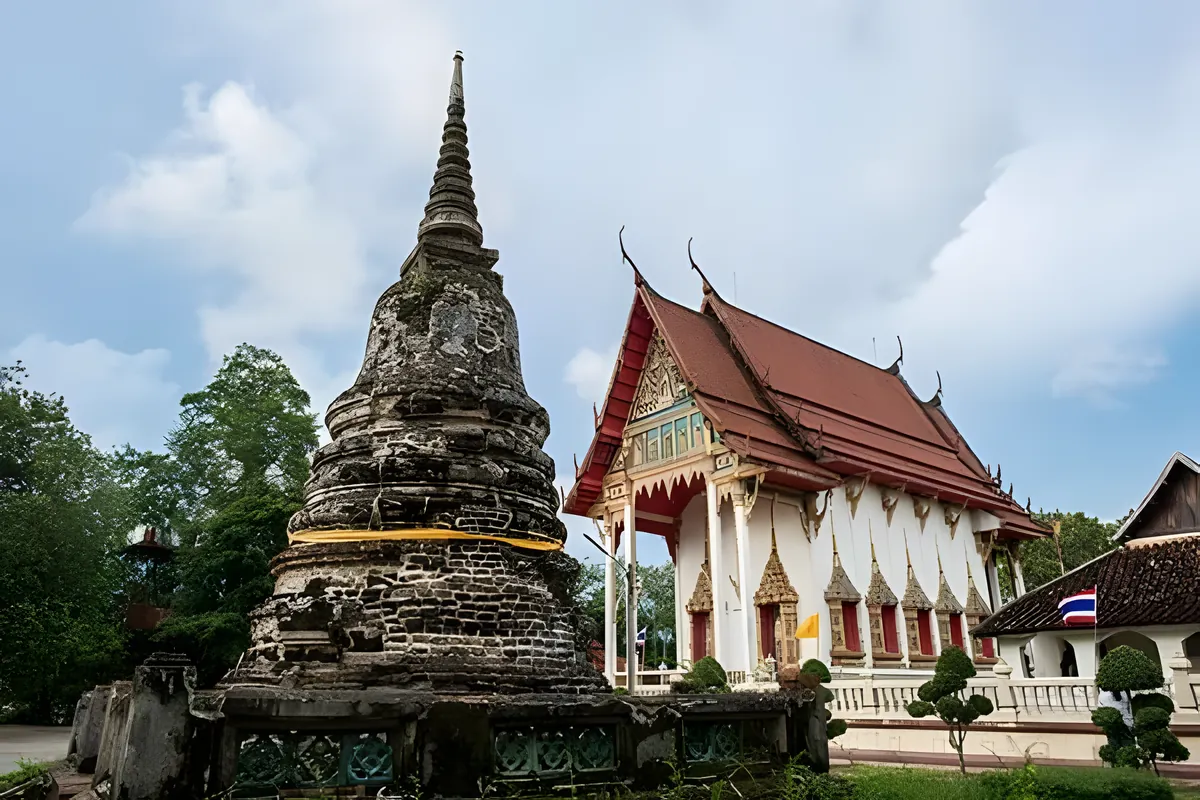

Wat Mangkon Buppharam is a Chinese Mahayana Buddhist temple on Sukhumvit Road in Laem Sing district, Chanthaburi, covering roughly 8 rai (about 1.3 hectares). Built in 1977, it is also known locally as Wat Leng Hua Yi, the “dragon’s tail” temple, third in a lineage that begins with Bangkok’s Wat Mangkon Kamalawat and continues through Wat Chin Prachasomosorn in Chachoengsao. Entry is free and the grounds open daily from 06:00 to 18:00.
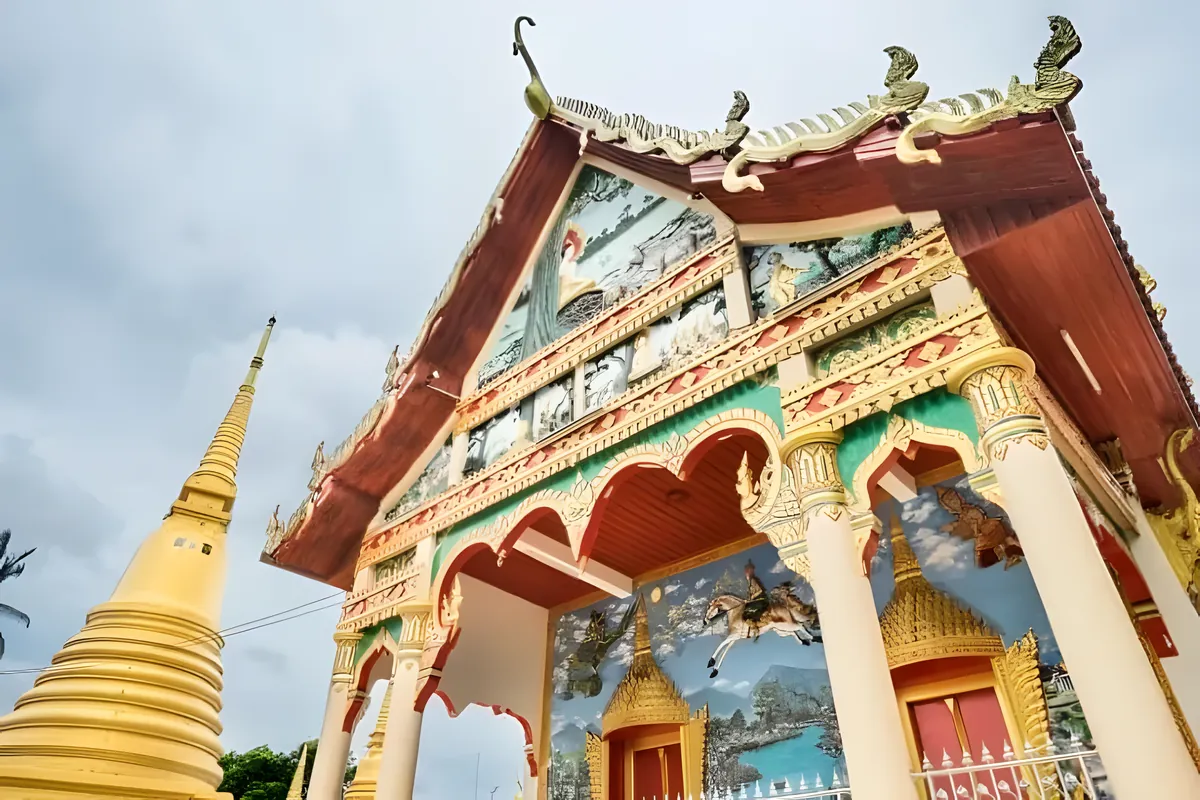
Green and yellow tiled roofs and carved dragon reliefs mark the entrance, in the same Chinese Nikai architectural style as its two sister temples. An octagonal tower rises beside the main hall, its roof stacked in three tiers in the classic southern-Chinese temple form. Columns and beams carry painted dragon motifs rather than the gilded stucco typical of a Thai wat. A separate hall holds a statue of Guanyin (Avalokitesvara Bodhisattva) depicted with a thousand arms and eyes, a feature more common at Chinese Mahayana temples than at Thai Theravada ones. Carved wooden doors show floral and animal motifs rather than the jataka scenes usually found at a Thai temple entrance.
- Founded: 1977, as the “dragon’s tail” of a three-temple Chinese Mahayana lineage
- Tradition: Chinese Nikai Mahayana Buddhism, the same lineage as Bangkok’s Wat Mangkon Kamalawat
- Entry: Free, daily 06:00-18:00
- Location: Sukhumvit Road (Highway 3), Phlio subdistrict, Laem Sing district
- Highlight: Hall dedicated to the thousand-armed Guanyin (Avalokitesvara Bodhisattva)
Wat Mangkon Buppharam functions as an active monastery rather than a lay shrine: it has its own resident clergy under the Chinese Nikai administration, not just caretakers. Thai-Chinese families from Chanthaburi’s gem-trading community, whose history runs through the town’s Gems Market, come here for sadoh khro, a ritual to release bad luck, and to burn incense before Guanyin. Weekday mornings are quiet, with only a handful of visitors and the smell of incense and sandalwood drifting through the courtyard. The temple fills more on festival dates tied to the Chinese lunar calendar, when visitors travel between all three temples in the lineage as part of the same pilgrimage.
The temple sits directly on Sukhumvit Road in Phlio subdistrict, Laem Sing district, a short drive south of the Chanthaburi town centre, not from Trat, a separate province further southeast. No public bus stops right outside, so a car, motorbike, or taxi is the practical way in. Dress modestly, with shoulders and knees covered, and remove shoes before entering the prayer halls.
Insider Tip: Pair the visit with Khao Laem Sing Forest Park, a few minutes further along Sukhumvit Road in the same district, or the Chanthaburi City Pillar Shrine in town. Both make an easy half-day loop without doubling back.
Location & Directions
Laem Sing, Chanthaburi
Chanthaburi, Thailand
Show your taxi or Grab driver
วัดมังกรบุปผาราม
Frequently Asked Questions
Is Wat Mangkon Buppharam the same temple as Bangkok's famous Wat Mangkon Kamalawat?
Is Wat Mangkon Buppharam free to enter?
Does Wat Mangkon Buppharam have resident monks?
What is the temple known for?
How do I get to Wat Mangkon Buppharam from Chanthaburi?
Spotted something out of date or incorrect? Let us know
Stay Near Wat Mangkon Buppharam
Live prices for places closest to Wat Mangkon Buppharam: tap a pin to compare.