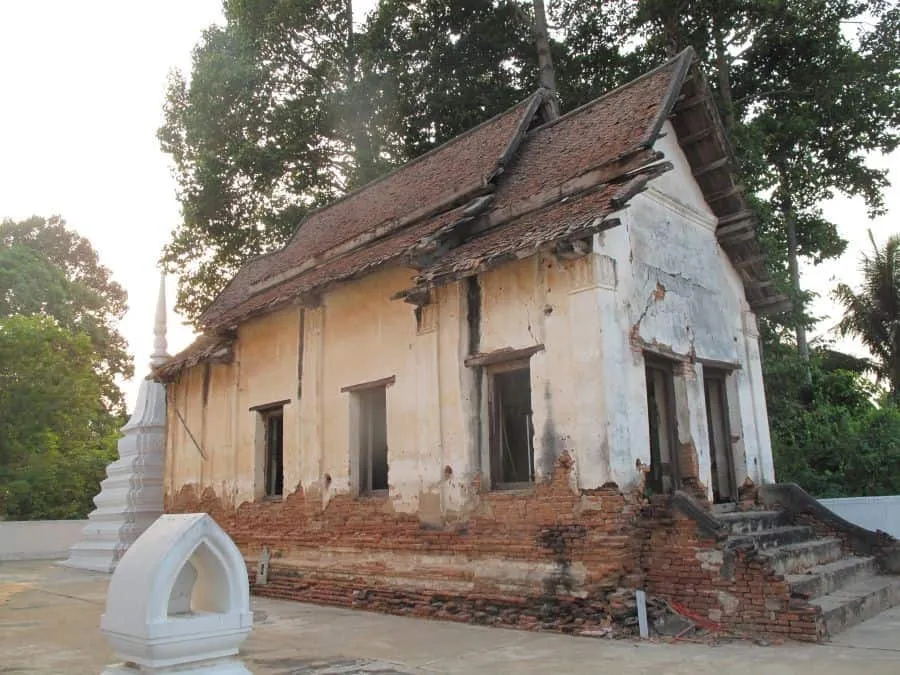

Wat Sang Kratai is a roofless, abandoned Ayutthaya-period ordination hall in Sala Daeng subdistrict, its brick walls held together — and slowly pulled apart — by the roots of four Bodhi trees grown into its four corners. Entry is free, and the site is open daily from 08:30 to 16:30.
Experience
The temple’s history explains the ruin: founded roughly 400 years ago by Thuat Ti Chanthana Saewi, mother of Phraya Hatsakan, under the name Wat Sam Kratai (Three Rabbits Temple — later slurred in local speech to “Sang Kratai”), it functioned as an active monastery for generations before a dispute among its resident monks split the clergy. Villagers stopped coming to make merit, the monks drifted away, and the temple was left with no one to maintain it. What time didn’t take, the four Bodhi trees did — their roots crept into the mortar joints at each corner of the ubosot and have spent centuries prying the brickwork apart while simultaneously holding what’s left of it standing.
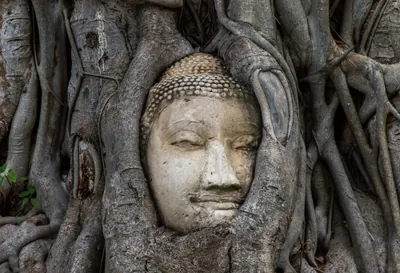
Inside the three-chambered hall, the surviving Buddha images are still in place: the central chamber holds the principal image flanked by two smaller statues, with a smaller shrine at one end. The strangest detail is a window opening directly onto the principal Buddha image, framed on all sides by root growth thick enough to have become part of the structure. Thailand’s Ministry of Culture has formally registered the four Bodhi trees as a protected national heritage tree group, recognition usually reserved for far older or more prominent specimens.
Atmosphere & Timing
There’s no ongoing temple activity here — no resident monks, no scheduled ceremonies — so a visit is self-paced and usually short, 20-30 minutes to walk the ruin and take it in. Morning light works best for photographing the root-and-brick detail, since the canopy overhead blocks harsh midday sun but also flattens contrast later in the day.
Insider Tip: Walk a full circuit of the exterior before going inside — the root growth looks different from each of the four corners, and the most photographed angle (the window framed in roots) is easy to miss if you only see the interior.
Watch out: The ubosot’s brickwork is genuinely fragile in places where roots have displaced it. Stick to the marked path around the structure rather than climbing on the walls for a photo — it’s both a preservation risk and a fall hazard on uneven brick.
Practical
Wat Sang Kratai is in Sala Daeng subdistrict, a couple of kilometres from downtown Ang Thong — a short taxi, songthaew, or motorbike ride from the town centre. There’s a car park on-site. Dress modestly (shoulders and knees covered) even though there’s no active congregation, since it remains a religious site; sturdy shoes help on the uneven ground around the ruin. Wat Ang Thong Worawihan, the province’s principal royal temple, is a short drive away if you’re combining temple stops.
- Entry fee: Free
- Hours: Daily 08:30-16:30
- Age: Ordination hall dates to the Ayutthaya period, ~400 years old
- Original name: Wat Sam Kratai (“Three Rabbits Temple”)
- Getting there: Sala Daeng subdistrict, ~2km from downtown Ang Thong
Good to Know
On site
Location & Directions
Mu 4
Ang Thong, Thailand
Show your taxi or Grab driver
วัดสังกระต่าย
Frequently Asked Questions
What does "Wat Sang Kratai" mean?
Is Wat Sang Kratai an active temple?
Why do trees grow through the temple walls?
Is Wat Sang Kratai free to visit?
How old is Wat Sang Kratai?
Spotted something out of date or incorrect? Let us know
Stay Near Wat Sang Kratai
Live prices for places closest to Wat Sang Kratai — tap a pin to compare.