Sapan Mon Bridge
สะพานไม้อุตตมานุสรณ์ (สะพานมอญ)
Sapan Mon Bridge — officially the Uttamanusorn Bridge — spans 445 metres across an arm of the Khao Laem (Vajiralongkorn) reservoir at Sangkhla Buri, in Kanchanaburi province near the Myanmar border. That makes it Thailand’s longest wooden bridge and the world’s second-longest after Myanmar’s U Bein Bridge — despite being commonly misquoted online at around 850 metres. Crossing is free, and the bridge is open from early morning into the evening.
The bridge exists because the reservoir does: when the Vajiralongkorn Dam flooded the valley in 1984, it split the Mon village of Wang Kha from Sangkhla Buri town. Luangpho Uttama, a Mon monk and abbot of Wat Wang Wiwekaram, organised its construction in 1986–87 using local Mon labour — many of them refugees who had crossed from Myanmar. It replaced an earlier bamboo bridge that charged a one-baht toll, remembered locally as the “bridge of one baht.” The current structure isn’t untouched original timber: flash floods collapsed roughly 70 metres of the middle section in July 2013, and the rebuilt bridge reopened in October 2014 to a ceremony of more than 3,000 people.
Insider Tip: Cross at dawn. Monks from Wat Wang Wiwekaram walk the bridge to collect alms from Wang Kha villagers most mornings, and mist often sits on the reservoir before the heat burns it off — the best light for photographs and the quietest the bridge gets.
Walking the weathered planks gives a wide view over the reservoir and the hills ringing Sangkhla Buri, with longtail boats occasionally passing beneath the wooden pilings. Wang Kha, the Mon village on the far side, is a genuine working community — a market, a temple, cyclists and schoolchildren crossing daily — rather than a set piece for visitors, and it’s worth the ten-minute walk across just to see it rather than turning back partway.
Watch out: The planks are uneven in places and there’s little shade over the full crossing, so midday heat is a real factor; bring water and sun protection, and wear shoes with grip rather than flip-flops.
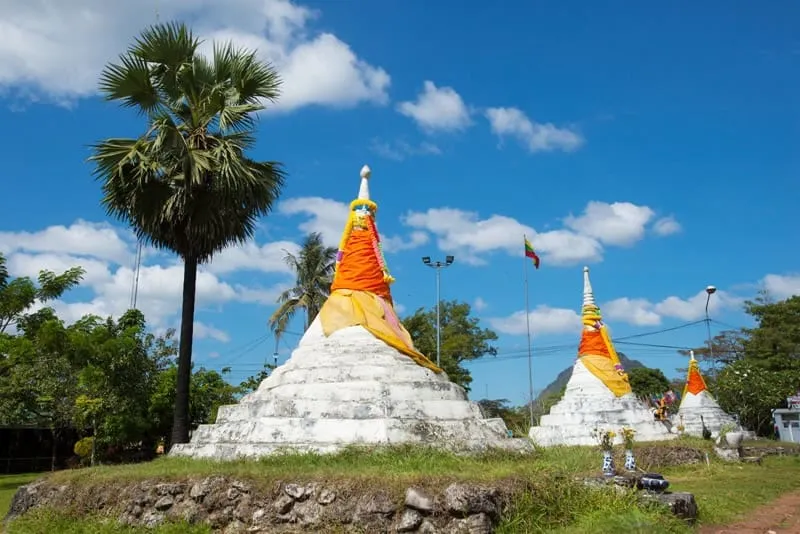
The bridge sits a short drive from Sangkhla Buri town centre — reachable by motorbike or car — and pairs naturally with a Sangkhla Buri day that also takes in Three Pagodas Pass at the Myanmar border, Khao Laem National Park, or Pom Pee Viewpoint overlooking the same reservoir.
- Length: 445 metres — Thailand’s longest wooden bridge (often misreported as ~850m)
- Entry fee: Free
- Hours: Roughly 06:00–20:00 daily
- Built: 1986-87 by Luangpho Uttama and local Mon labourers; rebuilt 2014 after a 2013 flood collapse
- Connects: Sangkhla Buri town to Wang Kha, a Mon village, across the Khao Laem/Vajiralongkorn reservoir
Location & Directions
Sangkhla Buri, Kanchanaburi
Kanchanaburi, Thailand
Show your taxi or Grab driver
สะพานไม้อุตตมานุสรณ์ (สะพานมอญ)
Frequently Asked Questions
How long is Sapan Mon Bridge really?
Is Sapan Mon Bridge free to cross?
Why was the bridge built?
Has the bridge ever collapsed?
What's on the other side of the bridge?
Spotted something out of date or incorrect? Let us know
Popular tours in Kanchanaburi

![Erawan Waterfall and Kanchanaburi Private Tour [Optional Luxury]](https://images.thaiholidayguide.com/images/tours/erawan-waterfall-and-kanchanaburi-private-tour-optional-luxury.webp)



Stay Near Sapan Mon Bridge
Compare places to stay in Kanchanaburi, or open the map for options closest to the attraction.