






Thailand’s rainy season runs from mid-May to mid-October for most of the country, and the Gulf islands around Koh Samui get theirs later, from October to December. That split is the most useful thing to know. When it’s pouring in Phuket in September, Samui is often dry, and when Phuket is in full sun at the end of November, Samui is having its wettest month.
Quick answer
The rainy season (also called the monsoon or green season) is mid-May to mid-October in Bangkok, the north and the Andaman coast (Phuket, Krabi, Khao Lak, Koh Lanta). August and September are the wettest months. The Gulf islands (Samui, Phangan, Tao) follow a different calendar, with their heaviest rain from October to December, peaking in November.
Rain rarely lasts all day. A typical wet-season day has a heavy shower for an hour or two, usually in the afternoon, and sunshine either side. The real costs are rough seas on the Andaman side, a few island parks closing, and the odd day of flooding in Bangkok.
- Season dates (2026): the Thai Meteorological Department declared the rainy season on 15 May and the cool season on 9 November, a few weeks later than usual
- Wettest months: September in Bangkok and Phuket, August in Chiang Mai, November on Koh Samui
- Driest coast in June-September: the Gulf (Samui, Phangan, Tao)
- Parks that close: Similan and Surin islands, 16 May to 14 October
- Upside: lower hotel prices on the Andaman coast, fuller waterfalls, greener rice fields
When does the rainy season start and end?
The Thai Meteorological Department (TMD) declares the start of the rainy season each year once rain covers more than 60% of upper Thailand and the low-level winds swing round to the southwest. In 2026 that happened on 15 May. The TMD’s own forecast for the season ran like this:
- Mid-May to mid-June: rain becomes steady, heaviest along the southern coasts
- Late June to early July: a lull, with less rain and more dry days
- August and September: the wettest stretch, with flash-flood warnings in some provinces
- October: rain tapers off in the north and northeast, but carries on in Bangkok, the east and the south
The season ends when the TMD declares the cool season. Normally that’s mid to late October. In 2026 rain kept falling and the announcement came on 9 November.
Insider Tip: That late-June lull is the best-value window of the whole year for the Andaman coast. Prices are at low-season levels and you get more dry days than in August or September.
Rainfall by month: Bangkok, Phuket, Chiang Mai and Koh Samui
The table shows average rainfall in millimetres for each month, with the average number of rainy days in brackets. Bangkok, Chiang Mai and Koh Samui are 1991-2020 normals; Phuket is the TMD’s 1981-2010 normal for Phuket town.
| Month | Bangkok | Phuket | Chiang Mai | Koh Samui |
|---|---|---|---|---|
| April | 93 (5) | 143 (12) | 54 (5) | 83 (6) |
| May | 217 (12) | 260 (19) | 168 (12) | 132 (11) |
| June | 199 (13) | 213 (18) | 118 (12) | 134 (10) |
| July | 190 (14) | 258 (20) | 149 (14) | 117 (11) |
| August | 227 (16) | 287 (19) | 223 (17) | 102 (11) |
| September | 336 (18) | 361 (22) | 207 (15) | 118 (11) |
| October | 289 (14) | 320 (23) | 124 (9) | 295 (16) |
| November | 45 (4) | 177 (15) | 41 (3) | 445 (17) |
| December | 12 (1) | 72 (9) | 14 (1) | 263 (12) |
Two things jump out. Samui’s June-September rainfall is roughly half of Phuket’s. And November, a dry-season month almost everywhere else, is Samui’s worst.
Rainy season by region
Phuket, Krabi and the Andaman coast (May to October)
This is where the rainy season bites hardest. The southwest monsoon pushes swell onto the west-facing beaches of Phuket, Khao Lak and Koh Lanta, and red flags go up at Patong, Kata and Karon on rough days. The flags mark rip currents strong enough to pull a good swimmer out, so stay on the sand when they fly.
Boats are the bigger problem. Speedboat trips to Phi Phi and the Phang Nga Bay islands still run on most days, but operators cancel when the sea is up, so leave a spare day for any trip you’ve set your heart on. Our Phuket weather guide goes month by month for the island.
Watch out: Maya Bay on Koh Phi Phi Leh has closed for August and September each year since the national park started a yearly recovery break, and reopens on 1 October.
Koh Samui, Koh Phangan and Koh Tao (October to December)
The Gulf islands sit in the rain shadow of the southwest monsoon, so June to September is one of their better spells. Their wet season comes with the northeast monsoon from October, peaks in November and eases through December. Ferries between Samui, Koh Phangan and Koh Tao can be cancelled in November storms, and diving visibility drops.
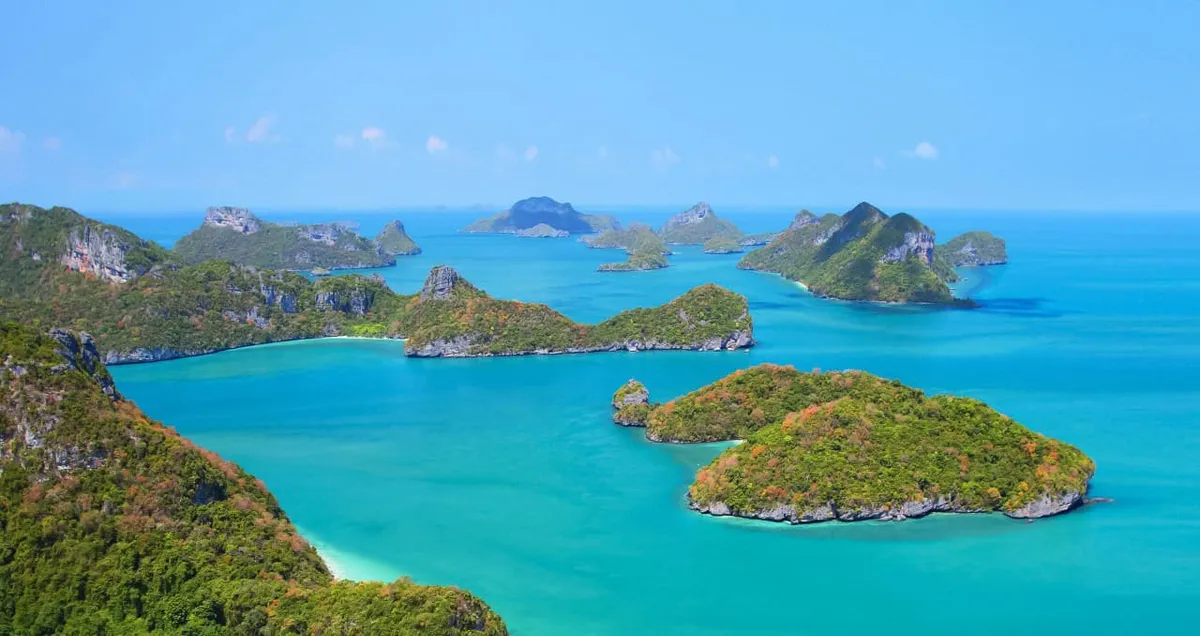
Ang Thong Marine Park, the main boat day trip from Samui, closes every year from 1 November to 15 December.
Bangkok and central Thailand (May to October)
Bangkok gets a hard afternoon or evening storm most days from May, peaking in September. Low-lying roads flood for an hour or two after a big downpour, and taxis and Grab cars get scarce and slow. The BTS and MRT keep running, so plan rainy afternoons around the train lines rather than the roads. Museums, malls and Thai cooking classes fill the gaps.
Chiang Mai and the north (May to October)
Chiang Mai has the lowest totals of the four cities, and the rain clears the air after the smoky hot season. August is the wettest month. Rice fields are bright green, waterfalls on Doi Inthanon run at full force, and hill roads can be muddy or blocked by landslides after heavy rain, so check before driving the Mae Hong Son Loop in August or September.
Islands and national parks that close
Marine park closures are the main reason a rainy-season trip goes wrong. These are the ones to plan around:
| Park | Closed | Coast |
|---|---|---|
| Similan Islands | 16 May to 14 October | Andaman |
| Surin Islands | 16 May to 14 October | Andaman |
| Maya Bay, Koh Phi Phi Leh | 1 August to 30 September | Andaman |
| Ang Thong Marine Park | 1 November to 15 December | Gulf |
The Department of National Parks sets these dates and can change them, or shut a park for a few days when the sea is dangerous. In October 2026 the Similans reopened on schedule, but some boat operators waited several days for the waves to drop.

Is it worth visiting Thailand in rainy season?
Yes, if you pick the right coast and keep a little slack in the plan. Here’s the honest trade.
- Hotels on the Andaman coast cost less than in high season, and beaches are quieter
- Waterfalls are at their fullest from August to October; see our waterfalls guide
- The Gulf islands get much of their best weather from June to September
- Rice terraces and national parks such as Khao Sok are at their greenest
- Andaman boat trips get cancelled on rough days, and Similan and Surin are closed
- Red-flag days on Phuket’s west-coast beaches
- Bangkok streets flood briefly after big storms
- Mosquitoes are worse, and dengue cases rise in the wet months
Pro Tip: Book refundable rooms for island stays and put boat trips early in your stay, so a cancelled day can move. Check your travel insurance covers trip disruption from weather before you go; our travel insurance guide compares the policies.
What to pack for rainy season
A light rain jacket or poncho (7-Eleven sells ponchos), quick-drying clothes, sandals you can wade in, a dry bag for boat trips and your phone, and mosquito repellent with DEET or picaridin. Leave the umbrella at home on the islands, where the wind turns them inside out. The Thailand packing list has the full kit.
When to go instead
If you want dry weather on both coasts at once, there is no perfect month, but January to March comes closest: the Andaman side is dry and calm, and the Gulf has come out of its wet season. For a month-by-month view of the whole country, read the best time to visit Thailand.