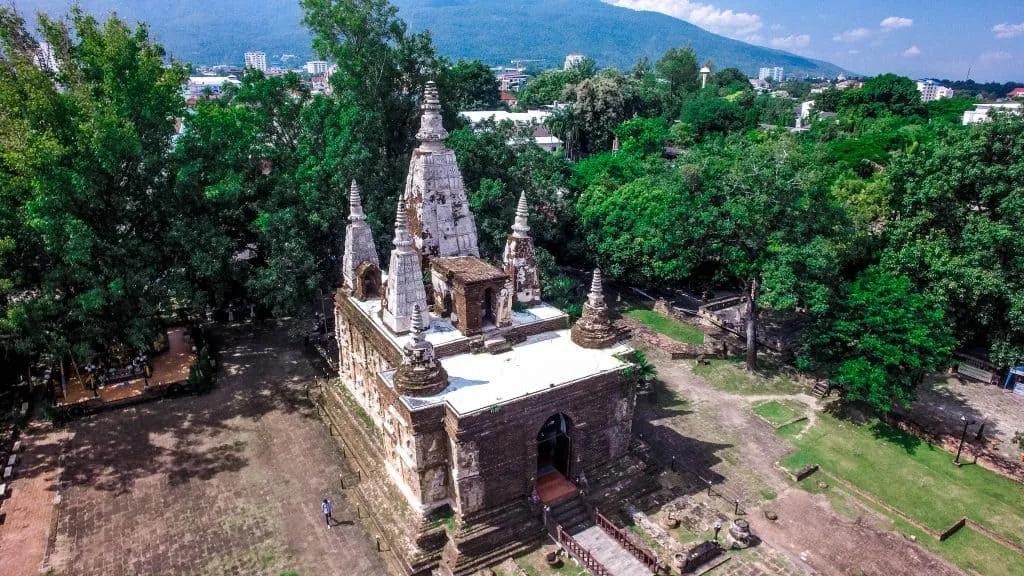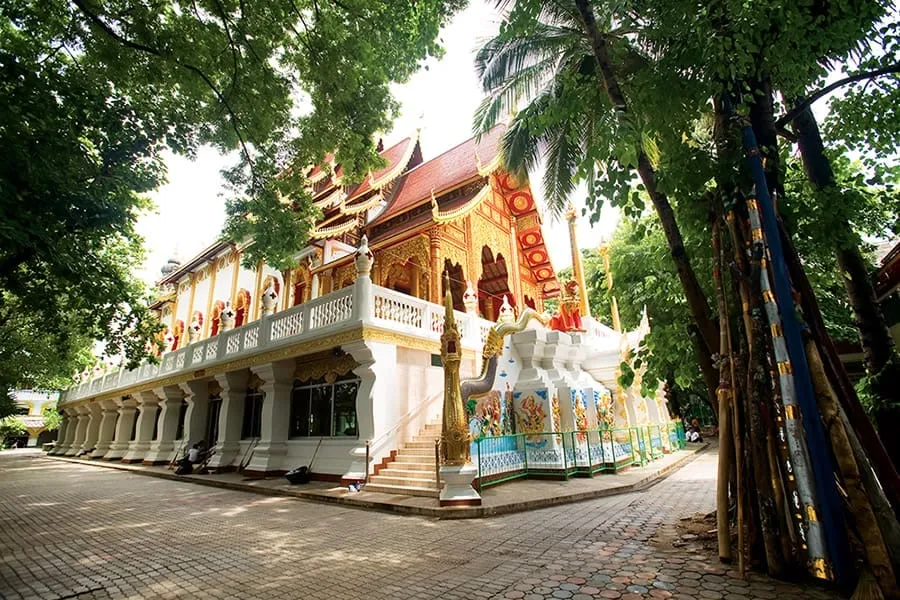





Wat Fha Wiang Intara sits in Piang Luang subdistrict, Chiang Mai province, right on the Thailand-Myanmar border in remote Wiang Haeng district. Locally it’s known as Wat Song Phaen Din (“temple of two lands”) because the grounds genuinely straddle the frontier: the Marachina Chedi, called “Kong Mu Laen Loen” (boundary relic stupa) in the Tai Yai language, stands on Thai soil, while the temple’s ordination hall sits just across the line in Myanmar. Entry is free.
The temple’s Shan (Tai Yai) character comes through more strongly than the central-Thai Lanna style found in Chiang Mai city temples, a reflection of the Shan and Tai Yai communities who live along this stretch of border. Local tradition holds that the chedi occupies the site of an older stupa, possibly dating back to the era of King Naresuan, though that link is oral history rather than a documented record. What’s better established is the temple’s restoration under Chao Kong Jerng, also known as General Moheng Chanasuek, a leader in the Shan State independence movement. His involvement is part of why the site carries such a distinct cross-border, cross-cultural identity.
Because the temple sits directly on the border, it isn’t a place to attempt an actual crossing: there’s no immigration checkpoint here, and visitors should stay on the Thai side of the grounds. What you can do is view the chedi, take in the temple architecture, and appreciate the unusual fact of a religious site quite literally built across a national frontier.
Getting here is most of the challenge. It’s roughly 150 km and three to four hours’ drive from Chiang Mai city, heading north via Chiang Dao into Wiang Haeng district. The road is sealed the whole way but winds through mountain terrain, so this is a full-day trip rather than a quick detour.
Insider Tip: Combine the drive with Ban Piang Luang, the Shan and Yunnanese-Chinese border village a short distance away, and the Ban Lek Nai Pa Yai Doi Khum Project royal project further up the ridge, three stops that together justify the long drive out to Wiang Haeng district.
Watch out: Mobile signal is patchy for long stretches of the Wiang Haeng road, and there’s little in the way of fuel or services once you’re past Chiang Dao. Fill up and tell someone your route before setting off.
- Entry fee: Free
- Local name: Wat Song Phaen Din (“temple of two lands”)
- Border feature: Marachina Chedi on the Thai side, ordination hall across the line in Myanmar
- Restored by: Chao Kong Jerng (General Moheng Chanasuek), Shan State independence movement leader
- Getting there: ~150 km, 3-4 hours’ drive from Chiang Mai via Chiang Dao and Wiang Haeng town
Location & Directions
Wiang Haeng, Chiang Mai
Chiang Mai, Thailand
Show your taxi or Grab driver
วัดฟ้าเวียงอินทร์
Frequently Asked Questions
Why is Wat Fha Wiang Intara called the "temple of two lands"?
Can I cross into Myanmar here?
Who restored the temple?
How far is it from Chiang Mai city?
Is there an entry fee?
Spotted something out of date or incorrect? Let us know
Popular tours in Chiang Mai





Stay Near Wat Fha Wiang Intara
Live prices for places closest to Wat Fha Wiang Intara: tap a pin to compare.