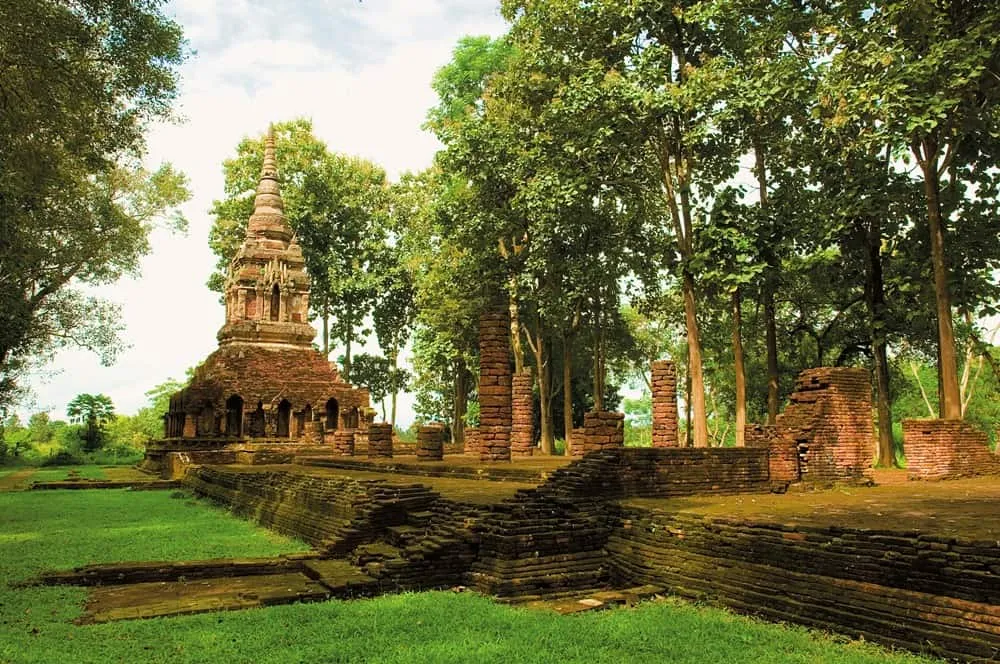







Wiang Kalong is a moated Lanna-era settlement in Wiang Pa Pao district, Chiang Rai, dated to the 15th-16th century, that doubled as one of northern Thailand’s major ceramics centres. Archaeological surveys have mapped roughly a hundred kiln structures in the surrounding hills (some estimates for the historical total run into the thousands) making this one of the largest known celadon production sites in the old Lanna kingdom.
The old town’s earthwork defences are still traceable on the ground: raised ramparts and triple-lined moats mark out where the walled settlement once stood, now folded into rice paddies and village land. Wiang Kalong celadon has a distinct look among Thai ceramics: a fine white clay body under a pale grey-green glaze, decorated with hand-painted Buddhist motifs, with some pieces showing a “chocolate base” technique that points to contact with Vietnamese potters. Production is generally thought to have run from the late 14th century through at least the fall of Chiang Mai in 1558, and possibly later: some researchers cite European-style tobacco pipes among the finds as evidence the kilns stayed active into the 17th century.
A handful of workshops along Highway 120 near the old town keep the tradition going, throwing and firing celadon using the same white-clay recipe and selling pieces on site. A temple near the settlement holds a scale model of the old walled town, useful for getting your bearings before walking the earthworks themselves. There’s no formal visitor centre or museum building at the archaeological site: this is a working rural district where the ruins sit alongside farmland and the ceramics trade continues as a village industry, not a staged heritage attraction.
Insider Tip: Pair a stop here with the ceramics workshops on Highway 120. Seeing a kiln firing (when one’s running) makes the archaeological earthworks easier to picture as an active production town rather than just grass-covered mounds.
Watch out: There’s no signage in English at the earthwork site itself, and the moat lines are easy to miss if you don’t know what you’re looking for. Ask at one of the roadside ceramics shops for directions before heading out on foot.
- Entry fee: Free, open ground, no ticket booth
- What’s here: Moated Lanna-town earthworks (15th-16th century) plus active celadon kiln workshops
- Getting there: ~60-70 km / 1-1.5 hours by road from Chiang Rai city via Highway 118 then 120
- Best for: Ceramics collectors and anyone interested in Lanna-era archaeology
- Facilities: None at the ruins themselves: shops and a temple with a town model nearby
Khun Chae National Park and Khun Chae Waterfall, both also in Wiang Pa Pao district, make a natural add-on if you’re already out this way from Chiang Rai.
Location & Directions
Wiang Pa Pao, Chiang Rai
Chiang Rai, Thailand
Show your taxi or Grab driver
เวียงกาหลง
Frequently Asked Questions
What is Wiang Kalong known for?
Can you still buy Wiang Kalong ceramics today?
Is Wiang Kalong the same as Wiang Pa Pao town?
Is entry to Wiang Kalong free?
How do you get to Wiang Kalong from Chiang Rai?
Spotted something out of date or incorrect? Let us know
Popular tours in Chiang Rai





Stay Near Wiang Kalong
Live prices for places closest to Wiang Kalong: tap a pin to compare.