



Huai Thap Than Khmer Ruins (Ban Prasart Khmer Ruins)
ปราสาทบ้านปราสาท (ปราสาทห้วยทับทัน)
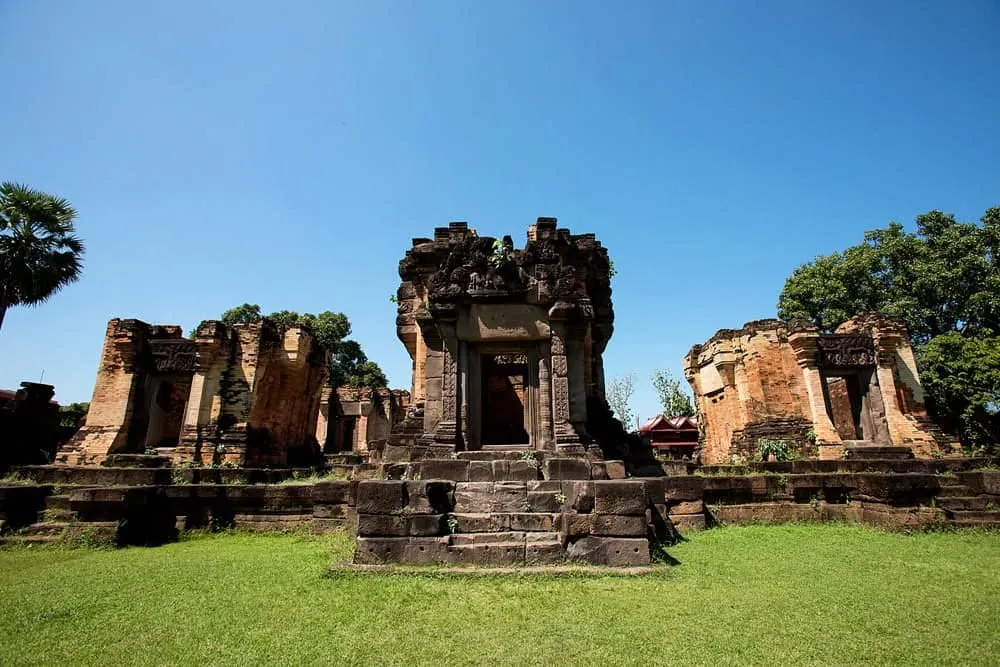
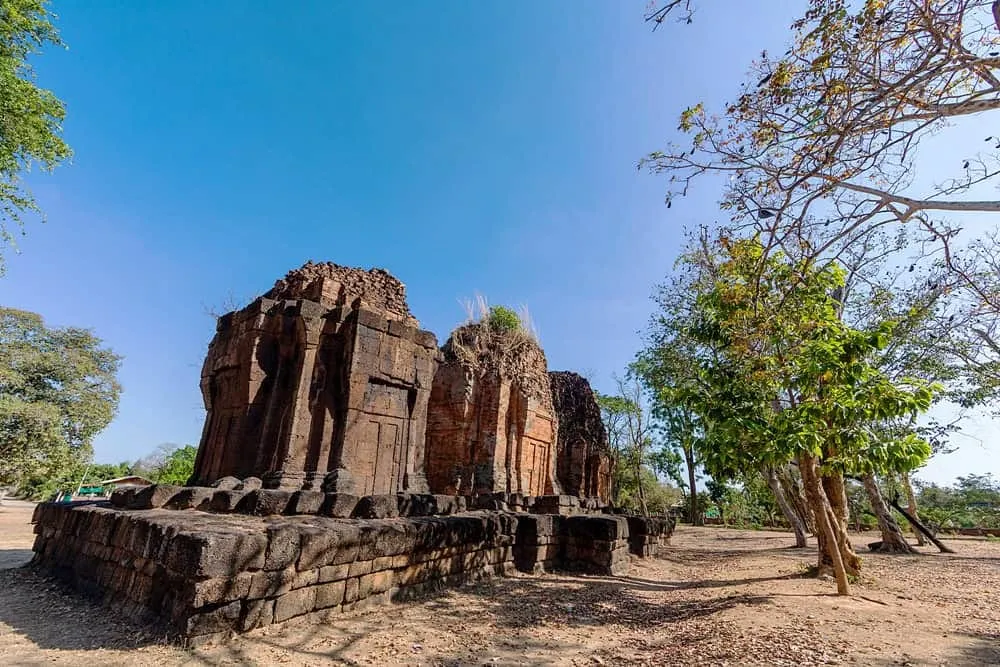
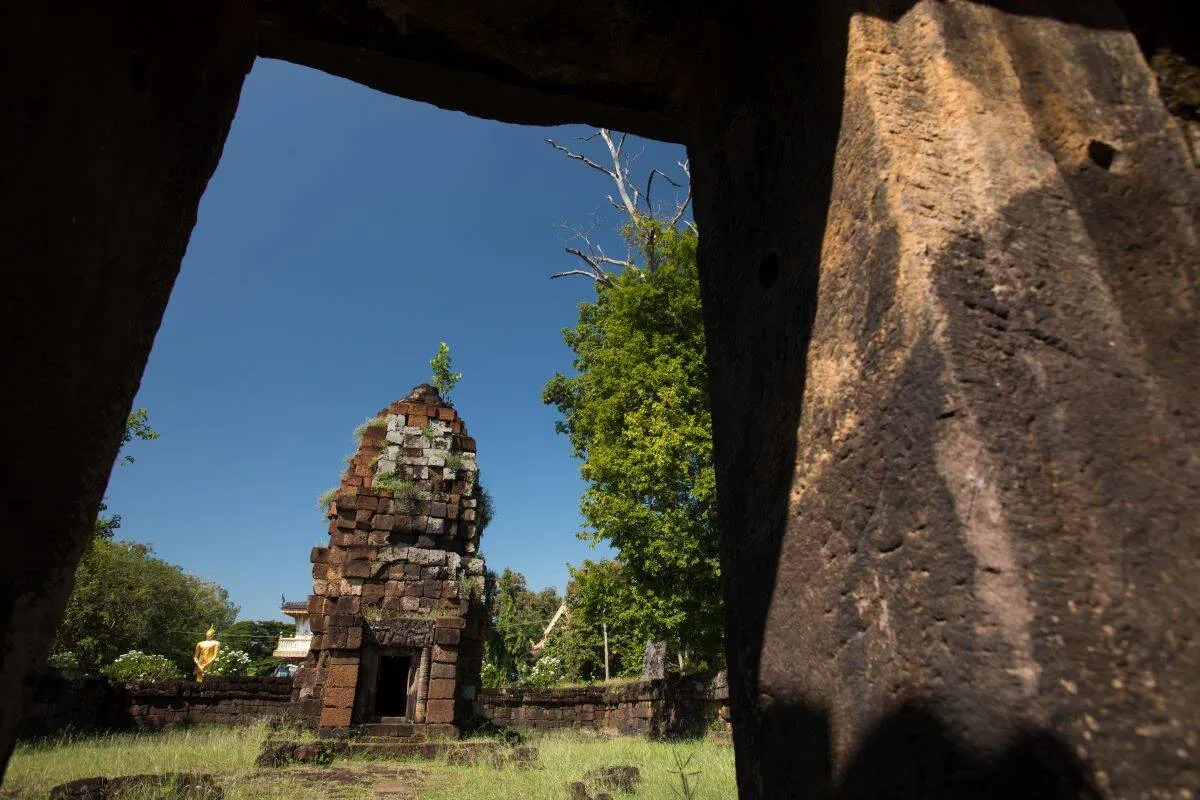
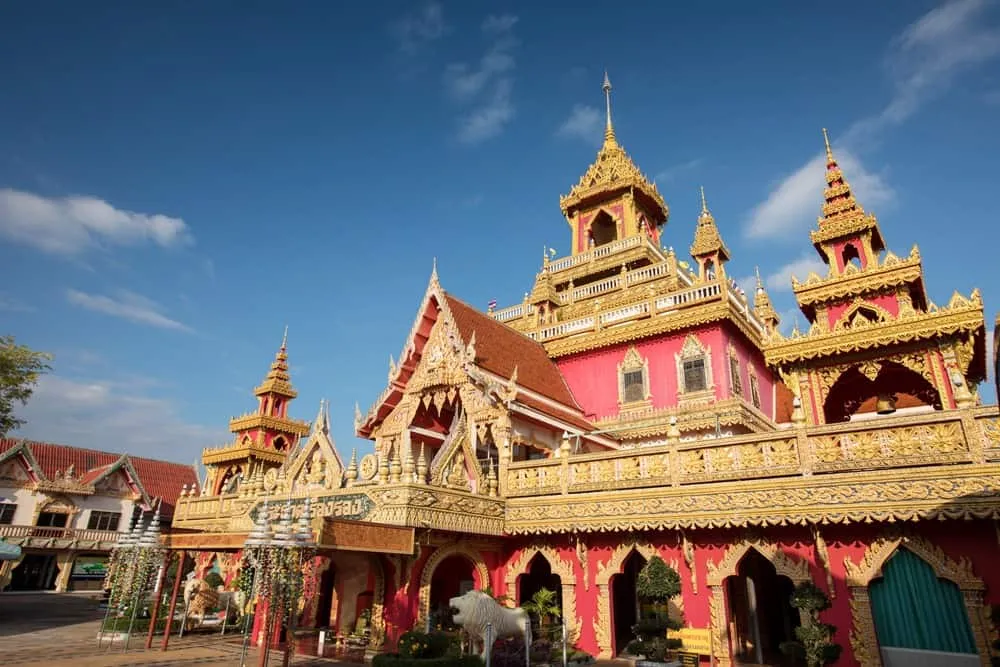
Three brick Khmer towers stand on a shared laterite platform at Huai Thap Than, inside the grounds of Wat Prasat Phanaram temple in Si Sa Ket’s Huai Thap Than district. Built during the Baphuon period of Khmer architecture — roughly the mid-11th century — the towers are aligned north-south and enclosed by a low laterite wall with arched gateways. Entry is free, daily 06:00-18:00.
This is also known locally as Prasat Ban Prasat or Prasat Noenthat, and it was surveyed and registered as an ancient monument by the Fine Arts Department in 1935. The single carved feature worth seeking out is a stone lintel above the entrance to the south tower, depicting the Churning of the Sea of Milk — a Hindu creation myth carved on Khmer temple lintels across the region, from Angkor down to sites like this one on the empire’s western edge. The other two towers are plainer, their brickwork weathered but still legible as classic Khmer prang forms rather than a fully collapsed ruin.
Watch out: Don’t come expecting Angkor-scale stonework — this is three modest brick towers on a laterite base, not a sprawling temple complex. If you want carved sandstone galleries and multiple lintels, Sa Kamphaeng Yai or Sa Kamphaeng Noi elsewhere in Si Sa Ket province show more surviving stonework.
Sometime in the 18th or 19th century, as Lan Xang (Lao) Buddhist influence spread through the area, the top of at least one tower was altered and the site took on a secondary identity as a Buddhist “that chedi” — a common pattern across Isan, where Hindu Khmer structures were adapted into Buddhist stupas centuries after the Khmer empire’s decline. That layered history — Hindu foundation, Buddhist reuse — is part of what makes the site worth the detour, even at this modest scale.
The grounds sit among working rice fields, and the temple compound around the towers is otherwise unremarkable — a few shade trees, no ticket booth, no gift shop. Farmers work the surrounding land right up to the enclosure wall, so early morning or late afternoon visits catch both softer light and village life going on around the ruins.
Insider Tip: Bring your own water and sun hat — there’s almost no shade directly among the towers, and the laterite platform reflects heat hard by midday.
Huai Thap Than lies about 47 km southwest of Sisaket town, reached by car or motorbike along paved rural roads — there’s no direct public transport to the temple compound. Pair it with the province’s other Khmer sites: Sa Kamphaeng Yai and Sa Kamphaeng Noi for larger sandstone remains, or Prang Ku for another modest brick tower, all within a similar radius of Sisaket town.
- Entry fee: Free
- Hours: Daily 06:00-18:00
- Era: Baphuon period, c. mid-11th century
- Getting there: ~47 km southwest of Sisaket town
- On site: 3 brick towers on a laterite platform, 1 carved lintel (Churning of the Sea of Milk)
Location & Directions
256 Moo 12, Prasat Road
Si Sa Ket, Thailand
Show your taxi or Grab driver
ปราสาทบ้านปราสาท (ปราสาทห้วยทับทัน)
Frequently Asked Questions
What era are the Huai Thap Than ruins from?
Are these the same as the famous Angkor temples?
Is there an entry fee?
How far is it from Sisaket town?
What can you actually see on site?
Spotted something out of date or incorrect? Let us know
Stay Near Huai Thap Than Khmer Ruins (Ban Prasart Khmer Ruins)
Live prices for places closest to Huai Thap Than Khmer Ruins (Ban Prasart Khmer Ruins) — tap a pin to compare.