


Doi Chang Mup Stupa
สถูปดอยช้างมูบ
A three-metre stupa shaped like a kneeling elephant marks the entrance to the Mae Fa Luang Arboretum, at the highest point most visitors reach on Doi Tung, a ridge above the mountain’s main 1,389-metre summit, close enough to the border that a marker nearby confirms you’re standing on the Thailand-Myanmar line. Entry is 90 THB, or 220 THB on the combined ticket with the Royal Villa, Mae Fa Luang Garden, and Hall of Inspiration. It’s open daily except Thursday, 6am to 6pm.
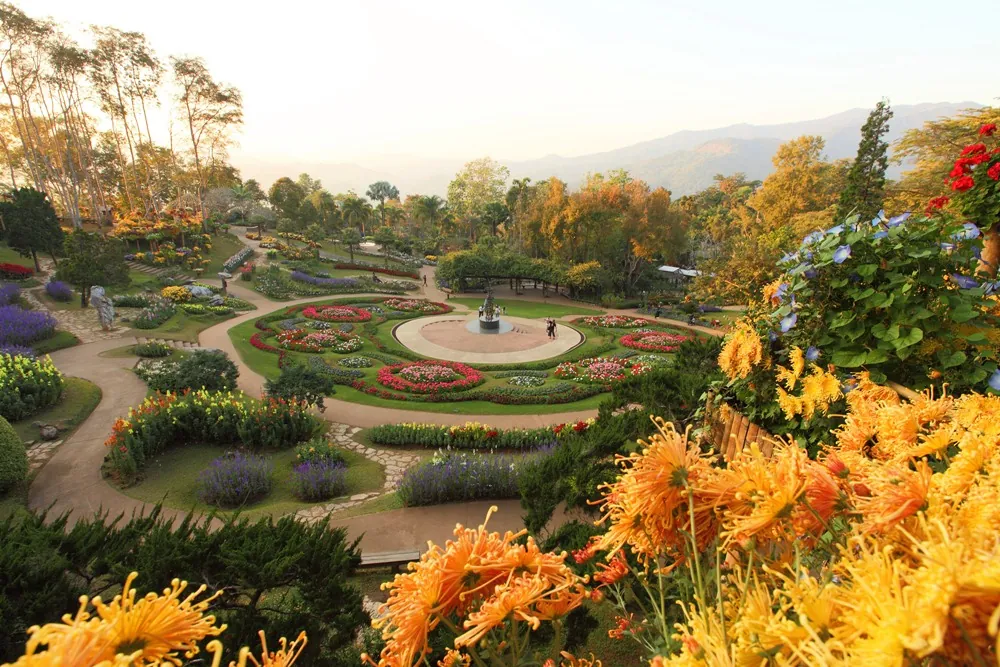
The arboretum is the real draw, not the stupa itself: terraced plantings of rhododendron species gathered from other countries, wild Himalayan cherry, and native highland orchids, laid out along a pine-shaded nature trail rather than formal flower beds. January and February bring the heaviest bloom, when the rhododendrons and cherry trees flower together. Older pine and banyan trees planted here as part of the original Doi Tung reforestation project now anchor the slope against erosion, the same soil-stabilising work that turned this hillside from bare opium fields into forest through the 1980s and ’90s.
Watch out: The Doi Tung Tree Top Walk (the 1.6km canopy walkway) is down at Mae Fa Luang Garden, not here. Don’t come expecting to find it at the arboretum.
The viewpoint gives one of the widest panoramas on the mountain: rolling hills running toward Myanmar, with more distant ranges visible on a clear day. Weather turns quickly at this altitude, so mornings before the haze builds are the reliable window: by March and April, cross-border crop-burning smoke can erase the view for weeks at a time.
Insider Tip: Pair the arboretum with the villa and garden lower down the mountain rather than visiting it alone: the combined ticket only pays off if you’re seeing at least two of the four Doi Tung sites, and it’s the same road up.
- Entry: 90 THB single-site; 220 THB combined ticket (110 THB concession) with Royal Villa, Garden and Hall of Inspiration
- Hours: Daily except Thursday, 06:00-18:00
- Landmark: A 3m stupa shaped like a kneeling elephant, at the arboretum entrance
- Best for blooms: January-February (rhododendron and wild Himalayan cherry)
- Not here: The Tree Top Walk: that’s down at Mae Fa Luang Garden
Getting There
Doi Chang Mup Stupa and the Mae Fa Luang Arboretum sit on the Phra That Doi Tung–Ban Pha Mi road, a short drive past Phra Tamnak Doi Tung and Mae Fa Luang Garden. It’s part of the wider Doi Tung hilltop complex. No public transport runs up here, so a rental car or hired driver from Chiang Rai is the only practical way in.
Location & Directions
Mae Fa Luang, Chiang Rai
Doi Tung, Thailand
Show your taxi or Grab driver
สถูปดอยช้างมูบ
Frequently Asked Questions
What is the elephant-shaped stupa at Doi Chang Mup?
Is the Tree Top Walk here?
How much does it cost to visit?
What's the best time to see the rhododendrons?
Is this the same as Doi Mae Salong?
Spotted something out of date or incorrect? Let us know
Stay Near Doi Chang Mup Stupa
Live prices for places closest to Doi Chang Mup Stupa: tap a pin to compare.