




Hoob Krapong Learning Center According to Royal Intention
ศูนย์เรียนรู้โครงการตามพระราชประสงค์หุบกะพง
The Hoob Krapong Learning Center sits on the site of Thailand’s first royal land-reform project: a 1966–71 cooperative agreement between the Thai and Israeli governments that resettled landless farmers on arid scrubland in Cha-am district and taught them to farm it through agricultural cooperatives. What’s there today is part exhibition hall, part working demonstration farm, run by the Cooperative Promotion Department as the model that later royal projects around Thailand borrowed from.
- History: Thai-Israeli Community Development Project, formal agreement 19 Aug 1966–18 Aug 1971, initiated under King Bhumibol Adulyadej
- Purpose: Resettled landless farmers on arid land, organised into Thailand’s first royal-project farming cooperative
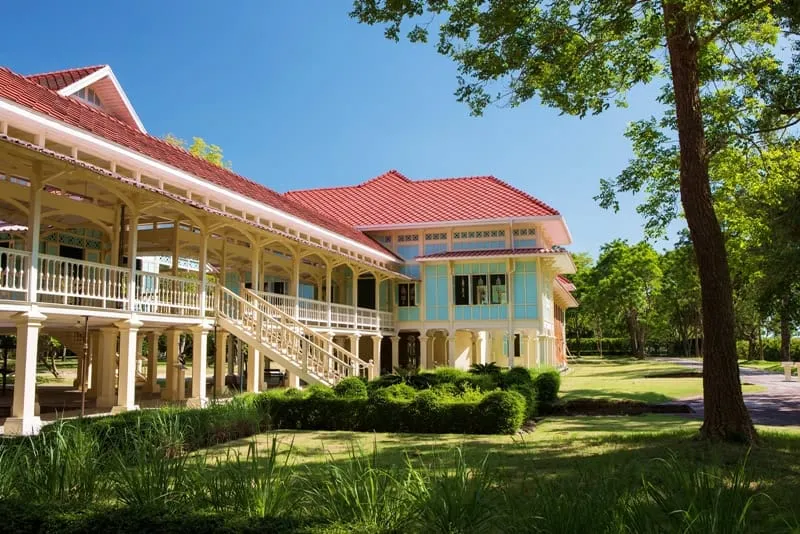
- Main building: Khum Klao Sahakon exhibition hall, covering six royal development projects nationwide, plus a rebuilt original settler’s house
- Field visits: An asparagus learning centre (established 1962), a beef cattle demonstration unit, and the Pan Srinararai weaving centre
- Hours: Monday–Friday, 08:30–15:00, closed weekends. Group visits should book ahead
- Location: Khao Yai subdistrict, Cha-am, roughly 40 km from Phetchaburi city and 34 km from Hua Hin
Inside the exhibition hall, displays cover six of Thailand’s royal-initiated development projects from around the country, including a working model of the Chaipattana aerator and an explainer on royal rainmaking, presented partly through simple animated videos aimed at visitors without a farming background. A reconstructed version of the settlement’s first farmhouse sits alongside historical photographs of the original 1960s cooperative, a concrete anchor for what’s otherwise a fairly abstract story about land policy.
The standard visit adds a roughly hour-long lecture, then field stops at three still-operating centres: an asparagus farm running since 1962 using techniques introduced by Israeli agricultural advisers, a beef cattle unit demonstrating cooperative livestock practices, and Pan Srinararai, a weaving workshop where local women’s groups produce textiles under continuing royal patronage. It reads more like a working agricultural extension office than a garden attraction, which fits the audience it’s built for: school groups, cooperative-studies visits, and travellers curious how Thailand’s royal development projects actually function on the ground.
Insider Tip: Group tours get the full lecture-plus-field-visit format. Solo travellers can still walk the exhibition hall independently, but call ahead to confirm whether the asparagus and cattle sections are open that day, since they’re working farms first and attractions second.
Watch out: The centre keeps government office hours (closed Saturday and Sunday), which catches out visitors expecting a daily-opening tourist site.
Reach it by car from Cha-am town in about 30–40 minutes; it pairs naturally with other royal-project sites around Phetchaburi if you’re building a day around Thailand’s rural development history.
Location & Directions
Cha-am, Phetchaburi
Cha-am Beach, Thailand
Show your taxi or Grab driver
ศูนย์เรียนรู้โครงการตามพระราชประสงค์หุบกะพง
Frequently Asked Questions
What is the Hoob Krapong Learning Center?
Is Hoob Krapong open every day?
What can you see at Hoob Krapong?
Is there an entry fee?
How far is Hoob Krapong from Cha-am and Hua Hin?
Spotted something out of date or incorrect? Let us know
Stay Near Hoob Krapong Learning Center According to Royal Intention
Live prices for places closest to Hoob Krapong Learning Center According to Royal Intention: tap a pin to compare.