







Bangkok eats better than any city in Asia, and the 2026 results say so out loud. It holds the most Michelin stars of any city in Thailand and put nine names on Asia’s 50 Best — more than Tokyo, Singapore or Hong Kong. The remarkable part is how little that excellence costs if you know where to point yourself.
The best restaurants in Bangkok run from three-Michelin-star tasting menus at Sorn and Sühring down to a charcoal-fired crab omelette at Jay Fai and a 60-THB plate of roast duck in Chinatown. This guide sorts them by tier and neighbourhood, so you can eat well on a 200-THB budget or a 15,000-THB one.
- Price tiers: Street legends 60-300 THB · mid-range Thai 300-800 THB · fine dining 3,000-15,000+ THB tasting menus
- Michelin 2026: Two restaurants at three stars (Sorn, Sühring); Bangkok holds the most stars in Thailand
- Book ahead: 2-4 weeks for starred fine dining; same-day for mid-range; queue for street legends
- Best food area: Yaowarat (Chinatown) for variety; Old City for heritage Thai
- Reservations: Chope and Hungry Hub apps cover most bookable tables
- Cash: Street stalls and many old-school Thai spots are cash only
Before you go chasing tables, sort a Thailand eSIM — half the good places confirm bookings by LINE, and Google Maps is how you’ll find an unmarked shophouse. To move between food neighbourhoods, the BTS and MRT skip the traffic. And for the stall-by-stall version of the cheap end, pair this with our Bangkok street food guide.
Quick answer
Start with Sorn in Sukhumvit for the strongest all-round pick. Use Sühring for three Michelin stars, Gaggan Anand for an Asia’s 50 Best room, and Potong when an Asia’s 50 Best room matters most.
| You want | Go to | Rough price |
|---|---|---|
| A three-star blowout | Sorn or Sühring | 8,000-15,000 THB |
| Michelin-starred Thai you can book | Le Du, Nahm, Nusara | 2,500-5,000 THB |
| The famous street-food star | Jay Fai (Old City) | Check the posted menu |
| Royal Thai, casual | Krua Apsorn | 300-700 THB |
| The best pad thai | Thipsamai | 80-300 THB |
| Chinatown after dark | Yaowarat stalls | 100-400 THB |
| Dinner with a view | A rooftop restaurant | 1,500-4,000 THB |
Match the row to your night and read its section below. Most of these cluster in three areas — the Old City and Chinatown in the historic west, and Sukhumvit and the river for the modern and the high-end.
How we picked these food stops
This shortlist starts with the place information already maintained for this guide in Bangkok, then weights the practical signals readers need most: area, price, hours, ratings when listed, booking or website links, and the specific use case named on each card. Missing prices, ratings, images, or booking links stay blank rather than being guessed.
We also kept the awkward parts visible. A good food stop is only useful when the area, timing, crowd level, and transport fit the trip you are actually taking.
The peak: Bangkok’s Michelin-starred fine dining
Two restaurants hold the maximum three stars.
Sorn
Thailand's first three-Michelin-star restaurant serves a southern Thai tasting menu in a house on Sukhumvit Soi 26. The current menu is 7,800 THB before service charge and VAT. Reservations are difficult to secure, so use the restaurant's current booking instructions rather than relying on a fixed monthly release date.
- Area
- Sukhumvit · 56 Sukhumvit Soi 26, Khlong Toei
- Hours
- Dinner Sun–Fri; advance reservation required
- Price
- 7,800 THB tasting menu, plus service charge and VAT
- Go for
- Southern Thai tasting menu
Sühring
Bangkok's second three-Michelin-star restaurant, awarded in 2026. Twin brothers Thomas and Mathias Sühring serve modern German cooking — rooted in family recipes and childhood memories — inside a restored midcentury villa in a quiet corner of Sathorn. One of Asia's most distinctive tasting-menu concepts: European fine dining executed at the highest level, in the tropics.
- Area
- Sathorn / Yen Akat · 10 Yen Akat Soi 3, Chong Nonsi
- Hours
- Dinner Wed–Sun; book well in advance
- Price
- 7,500 THB tasting menu, plus service charge and VAT
- Go for
- Modern German tasting menu from family recipes
Below them sits a deep bench of starred Thai and international. Le Du (chef Ton’s flagship near Silom) and Nusara, its riverside sibling in the Old City, both rework regional Thai recipes into tasting menus. Nahm at the COMO Metropolitan keeps the refined-Thai tradition alive under Chef Pim Techmuanvivit, and Paste at Gaysorn Village is worth knowing for its heritage recipes. And Gaggan Anand remains the city’s most theatrical table.
Gaggan Anand
Ranked No. 3 on Asia's 50 Best Restaurants 2026, Gaggan serves progressive Indian cooking as food theatre. The 14-seat figure applies to the G's Spot chef's counter; the restaurant also has the larger Arena G dining room. Confirm the menu, seating format, and price when booking.
- Area
- Sukhumvit · 68 Sukhumvit Soi 31, Watthana
- Hours
- Thu–Mon; closed Tue–Wed
- Go for
- 25-course progressive Indian tasting menu (emoji format)
Potong
Chef Pam (Pichaya Soontornyanakij) — Asia's Best Female Chef 2024 and the World's Best Female Chef 2025 — runs this Thai-Chinese tasting menu inside her family's 1910 Chinese herbal medicine building in Chinatown. Ranked No. 25 on Asia's 50 Best 2026 and No. 13 on the World's 50 Best Restaurants 2025. The five-element menu draws on Thai and Chinese culinary heritage through a modern fine-dining lens. One of Bangkok's most compelling dining stories.
- Area
- Chinatown / Yaowarat · 422 Vanich 1 Rd, Samphanthawong
- Hours
- Mon–Tue and Thu–Sun, 4:30pm–11pm; closed Wed
- Price
- ~5,000–7,000 THB tasting menu
- Go for
- Thai-Chinese five-element tasting menu
Le Du
Chef Ton's flagship near Silom has held a Michelin star since 2019 and ranked No. 36 on Asia's 50 Best 2026. Dinner runs Monday to Saturday, with lunch limited to Thursday through Saturday. Check the current menu and price when reserving.
- Area
- Silom / Bang Rak · 399/3 Silom Soi 7, Bang Rak
- Hours
- Dinner Mon–Sat; lunch Thu–Sat; closed Sun
- Price
- Check the current tasting-menu price when booking
- Go for
- Seasonal modern Thai tasting menu
Nusara
Chef Ton's ten-seat riverside room on historic Maha Rat Road, with a rooftop that looks directly at Wat Pho. A Michelin-starred heritage Thai tasting menu in one of Bangkok's most atmospheric settings — the Old City's temples and the Chao Phraya visible from the same table. Dinner is served daily; book well ahead.
- Area
- Old City / Maha Rat · Maha Rat Rd, Phra Nakhon (near Wat Pho)
- Hours
- Daily dinner, 6pm–11pm
- Price
- ~2,500–4,000 THB tasting menu
- Go for
- Heritage Thai tasting menu with Wat Pho rooftop view
The newer wave is just as strong. Potong holds one star, while R-Haan and Mezzaluna hold two.
R-Haan
Two Michelin stars for Chef Chumpol Jangprai's celebration of Thai culinary heritage — from traditional village recipes to refined royal cuisine. The tasting menu moves through amuse-bouches, four starters, a three-dish main and dessert, with exceptional service in an intimate Thonglor room. One of the most thorough expressions of Thai cooking at the fine-dining level.
- Area
- Thonglor (Ekkamai) · 131 Soi Thonglor 9, Watthana
- Hours
- Dinner nightly; book ahead
- Price
- ~5,500 THB tasting menu (incl. service)
- Go for
- Royal Thai tasting menu — 4 amuse-bouches through petit fours
Mezzaluna by lebua
Two Michelin stars for nine consecutive years, 65 floors above the river. Chef Ryuki Kawasaki's contemporary French cuisine is shaped by Japanese precision and seasonality — one of the most technically refined menus in Bangkok, paired with a view few restaurants in the world can match. The food is worth it independently of the setting.
- Area
- Bang Rak / Silom · 65th Floor, State Tower, 1055 Silom Rd
- Hours
- Dinner nightly
- Price
- ~5,000–9,000 THB tasting menu
- Go for
- Contemporary French tasting menu with Japanese precision
Most of these run tasting menus of 3,500-6,000 THB — pricey for Bangkok, modest against the equivalent in London or Tokyo.
Insider Tip: Lunch sets at the starred restaurants cost a fraction of dinner for much of the same kitchen. Le Du and several others run weekday lunch menus around 1,500-2,500 THB — the cheapest legitimate way into a Michelin star in this city.
Watch out: These tables sell out. Sorn requires advance booking and its deposits are non-refundable. Follow the current booking instructions rather than relying on an old release schedule.
Street food with a star: Jay Fai and the Bib Gourmand legends
The most Bangkok thing about Bangkok dining is that one of its Michelin stars belongs to a street stall.
Jay Fai (Raan Jay Fai)
The most famous street stall on the planet with a Michelin star. Chef Supinya 'Jay Fai' Junsuta cooks crab omelettes and drunken noodles over twin charcoal woks, alone, wearing ski goggles, on a pavement in the Old City. Prices and waiting times vary, and Michelin currently links to a booking option while still warning walk-ins to expect a queue. Check the posted menu before ordering and bring cash.
- Area
- Old City / Phra Nakhon · 327 Maha Chai Rd, Samran Rat, Phra Nakhon
- Hours
- Wed–Sat, 9am–7:30pm; closed Sun–Tue
- Price
- Check the posted menu before ordering
- Go for
- Crab omelette (kai jeow poo)
For the same heritage at a fraction of the price, Krua Apsorn has served royal-recipe Thai food since 1996.
Krua Apsorn
Open since 1996 on Dinso Road, a short walk from the Grand Palace. Founder Aunt Daeng cooked for the Princess Mother and brought the royal-household recipes to a restaurant that now draws locals and regulars far more than tourists. The stir-fried blue crab with yellow curry powder is the dish — around 450 THB, and one of the best versions of it in the city. Eight consecutive years of Michelin recognition.
- Area
- Old City / Phra Nakhon · 169 Dinso Rd, Phra Nakhon
- Hours
- Mon–Sat 10:30am–7:30pm; closed Sun
- Price
- 300–700 THB
- Go for
- Stir-fried crab with yellow curry powder (~450 THB)
Thipsamai near Wat Saket has plated pad thai since 1966. And Chinatown hides decades-old specialists.
Thipsamai
A long-running pad thai restaurant on Maha Chai Road, open since 1966 and formerly recognised by Michelin. The signature order is the pad thai haw khung sot: sen chan rice noodles stir-fried with prawn oil, wrapped in an egg skin, around 150 THB. Sun-dried noodles from Chanthaburi province and a homemade prawn oil are what separate it from the competition.
- Area
- Old City / Phra Nakhon · 313–315 Maha Chai Rd, Samran Rat, Phra Nakhon
- Hours
- Daily 9am–midnight (closed Tue)
- Price
- 80–300 THB
- Go for
- Pad thai haw khung sot — prawn-oil pad thai wrapped in egg (~150 THB)
Prachak Roasted Duck
A Bangkok institution going back to 1909 — over a century on Charoen Krung Road, the city's first paved street. The draw is the Cantonese-style roast duck: crispy skin, tender meat, served on rice with a side of soup. Order the che-po (mixed roast meats on rice) if you want to try duck and pork together. Cash only, early close, no frills.
- Area
- Bang Rak / Charoen Krung · 1415 Charoen Krung Rd, Bang Rak
- Hours
- Daily 8:30am–8:30pm
- Price
- 60–200 THB
- Go for
- Roast duck on rice (che-po: mixed roast meats on rice)
Nai Mong Hoy Tod
A Chinatown shophouse specialising in exactly four things: crispy oyster omelette, soft oyster pancake, oysters with oyster sauce, and crab fried rice — with oysters or mussels depending on what came in. The o-lua (crispy version) is the order: charcoal-fired, fat oysters in a crunchy batter, from 100 THB. Michelin-listed since 2018. No bookings; join the pavement queue.
- Area
- Chinatown / Yaowarat · 539 Phlap Phla Chai Rd, Pom Prap Sattru Phai
- Hours
- Wed–Sun 10am–7pm; closed Mon–Tue
- Price
- 70–300 THB
- Go for
- O-lua: crispy oyster omelette with crunchy batter
Polo Fried Chicken (Soi Polo)
Three generations of the same family have served fried chicken on Soi Polo near Lumphini Park. Michelin confirmed Bib Gourmand recognition through the 2024 guide. The chicken is deep-fried until crispy with a crust of golden fried garlic — a southern-style recipe that's still made to the original formula. Order it with sticky rice and som tam. One air-conditioned room, one open-air room, no pretence.
- Area
- Lumphini · 137/1–3 Sanam Khli Alley, Lumphini, Pathum Wan
- Hours
- Daily 7am–10pm
- Price
- 80–200 THB
- Go for
- Garlic fried chicken + sticky rice + papaya salad
- Serious flavour for 60-300 THB a plate
- No reservations, no dress code, pure Bangkok
- Most are walkable from the Old City temples or Chinatown
- Jay Fai’s price and queue are in a league of their own
- Many are cash only and close early (or sell out)
- Limited English menus — Google Translate the board
Where locals actually eat: neighbourhood Thai
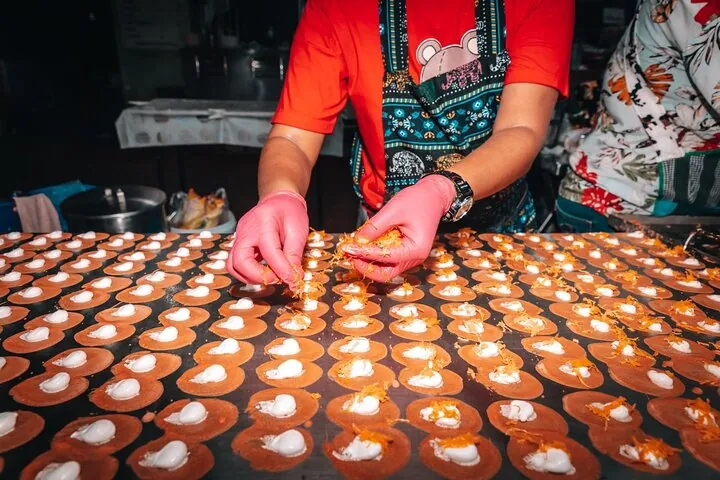
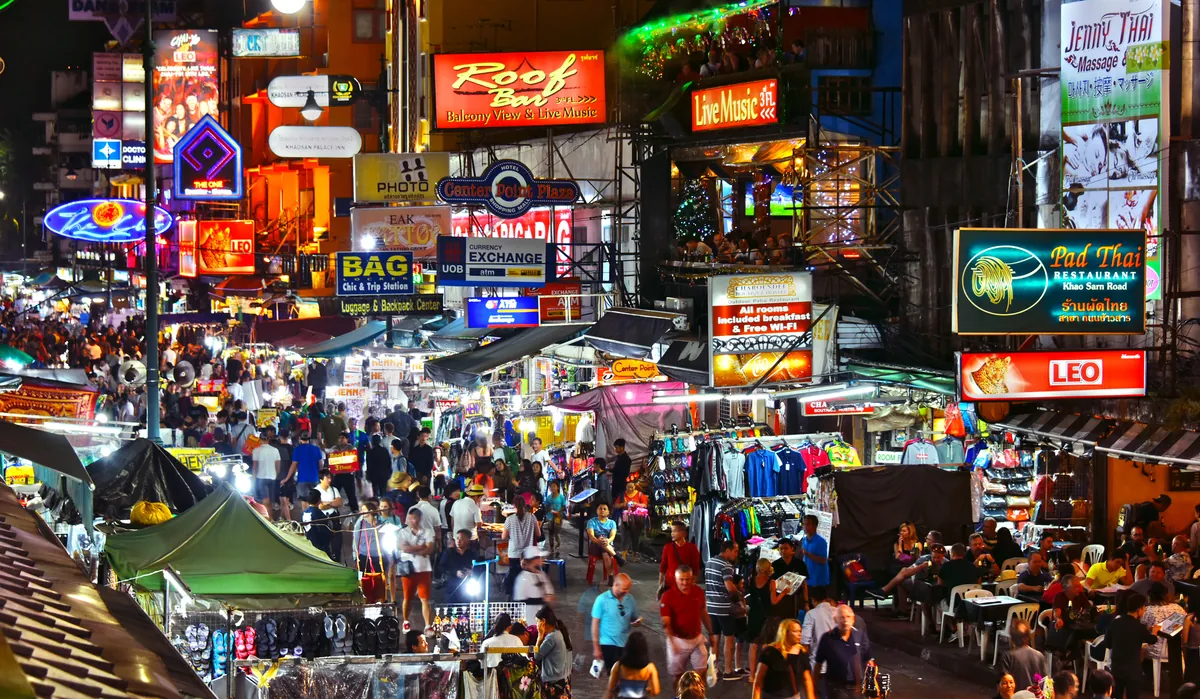
Step away from the lists and Bangkok’s everyday eating is the real story. Yaowarat — Chinatown’s main artery — turns into the city’s biggest open-air kitchen after 6 PM, with grilled seafood, bird’s-nest dessert stalls and Michelin-listed wok hawkers down its sois. It’s the single best place to graze, and our Bangkok street food guide maps it stall by stall.
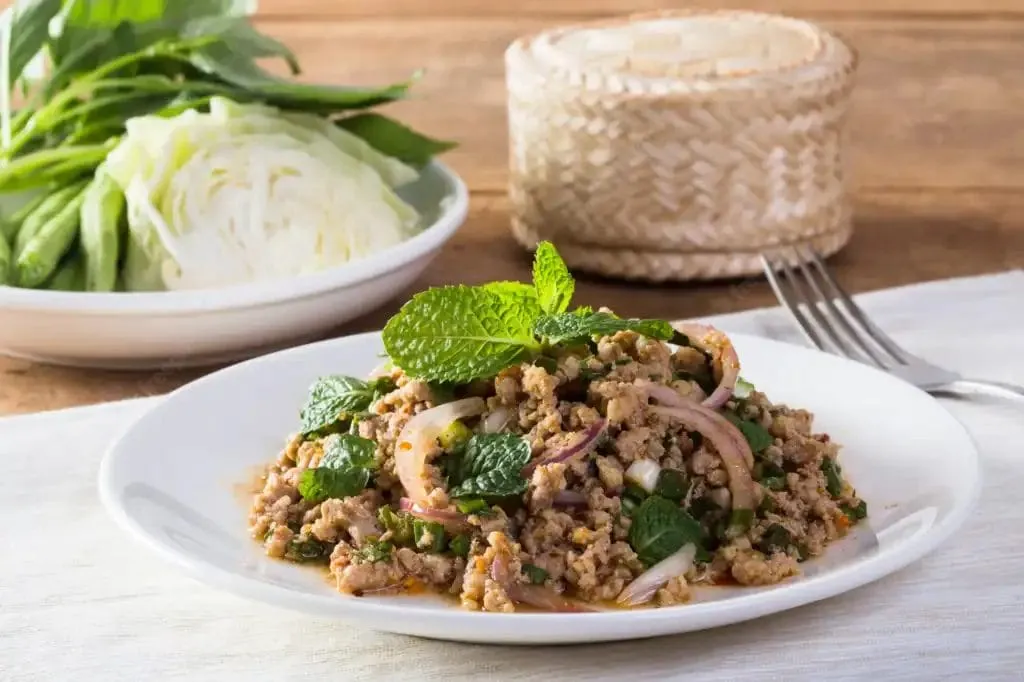
The Old City around Phra Nakhon holds the heritage Thai institutions within a tuk-tuk ride of the Grand Palace and Wat Pho. Out east, Ari and Thonglor are where young Bangkok eats — modern Thai bistros, natural-wine rooms and izakayas tucked down residential lanes. For the dishes themselves and where each is done best, our guide to popular Thai food breaks down what to order.
Insider Tip: A restaurant full of Thai families at 1 PM on a Sunday is a better signal than any star. The crab-curry shops along the river and the boat-noodle alleys near Victory Monument run on local trade, not tourists, and the prices show it.
International dining and dinner with a view
Bangkok’s wealth shows up in its international tables. Sukhumvit holds serious Japanese (omakase counters in the 3,000-6,000 THB range), Italian, Indian and Korean, much of it as good as anything in the region. The riverside fine-dining rooms — converted Charoen Krung shophouses and grand hotel restaurants like Le Normandie at the Mandarin Oriental (now under two-Michelin-starred Chef Anne-Sophie Pic) — pair the cooking with the Chao Phraya going past the window.
For dinner that doubles as a view, the city’s sky-high restaurants deliver. Many of the venues in our Bangkok rooftop bars guide — Sirocco at Lebua, Red Sky at CentralWorld, the rooftop at Mahanakhon — serve full menus, not just cocktails. The food is rarely the best in the city, but the setting is the point.
A word on value. Bangkok’s genius is the range: you can spend 15,000 THB on a tasting menu and 150 THB on a better-tasting bowl of noodles in the same afternoon, and both feel like the right call. Don’t fall for the riverside dinner-cruise buffets — overpriced, mediocre, aimed squarely at tour groups. Put that money toward one proper starred lunch and eat the rest of your meals where the office workers queue. The cheaper-eats end of the city is where Bangkok actually wins.
How to choose where to eat in Bangkok
A few rules save you money and disappointment.
Book the right way. Fine dining goes through Chope or the restaurant direct, two to four weeks out. Mid-range Thai and international spots take same-day tables on Hungry Hub, often with set-menu discounts. Street legends don’t book — you queue, so arrive when they open rather than at peak.
Eat where the locals point. Bangkok punishes the lazy diner with tourist-trap riverside buffets and rewards the curious one with a 50-THB bowl of boat noodles. When in doubt, follow the longest queue of office workers at lunch. For where to base yourself near the best eating, our Bangkok area guide covers which neighbourhood suits which appetite.
Mind the cash and the hours. Old-school Thai institutions are frequently cash only and many close by 8 or 9 PM, or shut one day a week — check before you cross the city. Tipping isn’t expected at street stalls; at restaurants, rounding up or 10% is plenty.
10Verdict: Do one street legend (Jay Fai or Krua Apsorn for the crab), one Chinatown graze along Yaowarat, and — if the budget stretches — one starred lunch for the fraction-price taste of why Bangkok tops Asia. That trio shows you the whole range, from charcoal wok to three stars, for less than a single fancy dinner in most Western capitals. Rating: 10/10 — no city in Asia eats better for the money.